
When you’re taking a generic medication for high blood pressure, diabetes, or cholesterol, it’s not just about picking up the prescription. It’s about taking it every single day-even when you feel fine. But studies show nearly half of people stop taking their generic meds within a year. Why? Because forgetfulness, side effects, or simple inconvenience get in the way. And unlike brand-name drugs, generics rarely come with free reminders, apps, or support programs. That’s where digital adherence tracking steps in.
Why Generic Medications Need Better Tracking
Generics make up 90% of all prescriptions in the U.S., but they’re often treated like commodities. No fancy packaging. No branded ads. No patient support teams. Just a bottle of pills with a price tag that’s 80% cheaper than the brand. That’s great for your wallet-but terrible for your health if you stop taking them. The cost of non-adherence isn’t just personal. It’s $300 billion a year in the U.S. alone, from emergency visits to hospitalizations that could’ve been avoided. For chronic conditions like heart disease or asthma, skipping doses doesn’t just mean feeling worse-it means your body starts to break down. And since generics are often used for long-term conditions, the stakes are higher. The problem? Traditional methods like pill counts or pharmacy refill records are unreliable. Someone might refill a prescription but never open the bottle. Or they might take half the dose to stretch it out. Digital tools change that by tracking actual ingestion, not just purchases.How Digital Adherence Tools Work
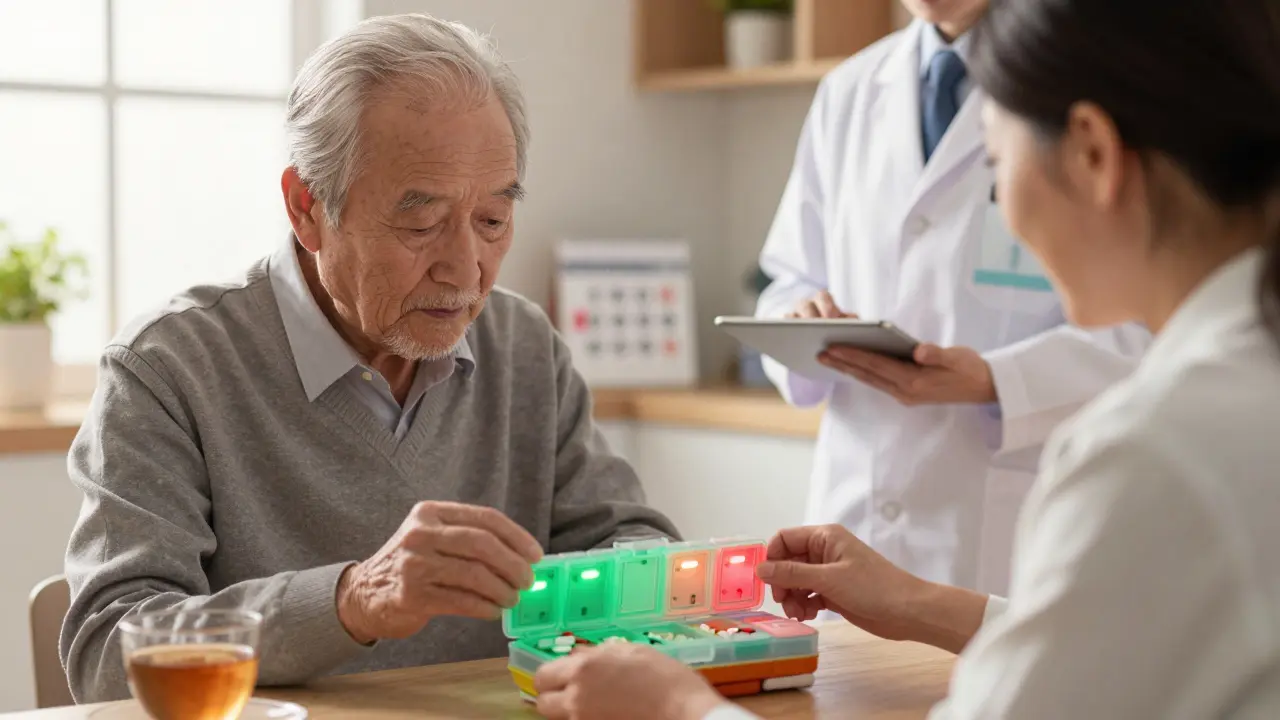
These aren’t just phone alarms that say, “Take your pill!” They’re systems that record when a pill is taken-and send that data to your doctor, pharmacist, or even your own phone. One common type is the smart pill bottle. Devices like MEMS AS® use electronic caps that log every time you open the bottle. That data gets sent to the cloud, where algorithms analyze patterns. Did you open it at 8 a.m. every day? Or only once a week? The system tells you-and your provider-exactly what’s happening. Then there’s the smart pillbox, like Tenovi. It holds multiple medications, lights up with colored LEDs (red for missed, green for done), and connects via cellular signal to send updates. No smartphone needed. Just open the box, take your pills, and the system knows. It’s simple, visual, and works even if you’re not tech-savvy. Another option is electronic blister packs, like Wisepill. Each dose is sealed in a compartment. When you open it, a sensor records the time. These are especially useful for people on complex regimens-say, five different pills at different times of day. Even more advanced: ingestible sensors. Tiny chips embedded in pills send a signal to a patch on your skin when swallowed. It’s FDA-approved and used in clinical trials, but still rare in everyday use due to cost and privacy concerns. And then there’s video monitoring-yes, really. VDOT lets patients record themselves taking medication via smartphone. A pharmacist reviews the video. It’s 95% accurate, but many patients quit after a few weeks because it feels intrusive.What Works Best-and What Doesn’t
Not all tools are created equal. Here’s how they stack up in real life:- MEMS AS is the gold standard in clinical trials-used by big pharma for accuracy. But it’s designed for research, not daily life. It doesn’t remind you. It doesn’t talk to you. It just logs. Many patients find it cold and impersonal.
- Tenovi Pillbox wins for ease of use. Elderly patients, especially those on multiple meds, love the color-coded lights. But the device costs $149 upfront, plus $30/month for cellular service. That’s a barrier for many on fixed incomes.
- McKesson APS is used by pharmacies to track refill patterns. It doesn’t know if you took the pill-it just knows you bought it. So if you refill early, the system thinks you’re adherent. That’s wrong. And it’s misleading.
- Basic reminder apps (like Medisafe or MyTherapy) are free and popular. But they rely on you tapping a button. People forget to tap. Or they tap it without taking the pill. Accuracy? Around 60%.
Real-World Challenges
Even the best tech fails if it doesn’t fit into real life. One pharmacist in Adelaide told me about a patient on six medications. She used Tenovi for two months. Her adherence jumped from 42% to 81%. Then she stopped using it. Why? “The box was too big,” she said. “It sat on my kitchen counter like a robot. I didn’t want it staring at me every day.” Battery life is another issue. Tenovi’s cellular gateway dies every 2-3 days if tracking four or more meds. Wisepill’s blister packs need Wi-Fi or Bluetooth to sync. If you live in a rural area with spotty signal? You’re out of luck. Privacy is a silent concern. A 2022 AHRQ survey found 63% of patients worry their adherence data could be sold to insurers or used to raise premiums. No one wants their pharmacy to know they skipped their blood pressure pill because they couldn’t afford the copay. And then there’s the human factor. A study showed patients who got both a smart pillbox and a 5-minute chat with their pharmacist every month had 35% better adherence than those who got tech alone. Technology helps. But connection matters more.What Pharmacists Are Doing About It
Forward-thinking pharmacies are starting to screen for adherence during pick-up. Instead of just handing over the script, they ask: “Do you ever forget your meds?” “Do you take them all at once?” “Would a reminder system help?” Some are starting pilot programs. One chain in South Australia gave out Tenovi boxes to high-risk patients on heart meds. After six months, hospital admissions dropped by 27%. The cost? $180 per patient. The savings? Over $2,000 per patient in avoided ER visits. Pharmacies using McKesson’s dashboard are seeing better reporting, too. One pharmacy increased adherence rates from 62% to 78% over 18 months. But they had to hire a technician just to manage the data. Not every small pharmacy can afford that.
What’s Coming Next
The future isn’t just about tracking-it’s about predicting. CVS Health is testing AI that looks at your refill history, weather patterns, even your pharmacy’s foot traffic to guess who’s likely to stop taking their meds. If the system flags you as “high risk,” you get a call from a pharmacist-not a robot, but a real person. Early results show a 22% improvement in catching at-risk patients before they drop out. The FDA is also working on new guidelines to standardize how these tools are tested. Right now, anyone can make an app and claim it “improves adherence.” Soon, there may be a seal of approval-like a digital stamp of trust. And reimbursement is slowly changing. Medicare Advantage plans now reward pharmacies and providers for better adherence scores. A 1-point increase in adherence can mean $1.2 million more in revenue for a plan serving 100,000 people. That’s driving big investment.What You Should Do Right Now
If you’re on generic meds:- Ask your pharmacist: “Do you have any tools to help me remember my pills?”
- Don’t assume refill counts mean you’re doing well. Ask for actual adherence data if it’s available.
- If you’re on five or more meds, consider a smart pillbox. Even if it’s a one-time cost, it might save you a hospital visit.
- Use a simple app if you’re tech-savvy-but only if you’ll actually tap the button every time.
- Don’t be afraid to say: “This feels too much like surveillance.” Your health shouldn’t come with guilt.
Final Thought
Digital adherence tools aren’t magic. They won’t fix a system that makes meds unaffordable. They won’t replace a caring pharmacist. But they can turn a silent problem-someone skipping pills because they forgot, or felt overwhelmed-into something visible, trackable, and fixable. The goal isn’t to monitor you. It’s to help you stay healthy-without making you feel like a data point.Are digital adherence tools covered by insurance?
Most insurance plans, including Medicare, don’t yet cover smart pillboxes or tracking devices. A few Medicare Advantage plans are starting to reimburse for remote therapeutic monitoring, but only if your doctor prescribes it and the device is on their approved list. Always ask your pharmacy or insurer before buying.
Can these tools work for elderly patients?
Yes, but only if the design is simple. Devices with visual cues-like Tenovi’s colored LEDs-are better than apps that require tapping or swiping. Voice reminders and large buttons help. Avoid anything that needs Wi-Fi setup or smartphone pairing unless the patient is already comfortable with tech.
Do these tools actually improve health outcomes?
Yes, when used correctly. Studies show adherence tracking reduces hospitalizations for heart failure, asthma, and hypertension by 20-30%. For every $1 spent on adherence tools, $7.20 is saved in avoided medical costs. But results depend on combining tech with human support-like pharmacist check-ins.
What’s the difference between a smart pill bottle and a reminder app?
A reminder app just alerts you-it doesn’t know if you took the pill. A smart pill bottle (like MEMS AS) records when you open it. That’s real data. But even that isn’t perfect-you could open the bottle and throw the pill away. The most accurate systems combine sensors with video or ingestible chips.
Is my data safe with these tools?
It depends. Reputable systems like MEMS AS and Tenovi follow HIPAA and GDPR rules. But many apps don’t. Always check their privacy policy. Look for phrases like “encrypted,” “no third-party sharing,” and “data belongs to you.” If it’s unclear, don’t use it. Your pill-taking habits are personal health information.
Can I use these tools for over-the-counter meds?
Technically, yes-but most systems are designed for prescribed medications. If you’re taking OTC pills daily (like aspirin or vitamin D), a simple pill organizer with alarms may be enough. Dedicated adherence tools are usually not worth the cost unless your doctor recommends them.
Mark Able
December 20, 2025 AT 07:26William Storrs
December 20, 2025 AT 21:02Nina Stacey
December 21, 2025 AT 14:12Kevin Motta Top
December 23, 2025 AT 09:44Chris porto
December 24, 2025 AT 02:06William Liu
December 25, 2025 AT 00:53Isabel Rábago
December 25, 2025 AT 18:05Matt Davies
December 26, 2025 AT 10:02Mike Rengifo
December 27, 2025 AT 03:07Dev Sawner
December 28, 2025 AT 08:45Moses Odumbe
December 28, 2025 AT 12:01bhushan telavane
December 28, 2025 AT 21:56Kelly Mulder
December 30, 2025 AT 14:07Dikshita Mehta
January 1, 2026 AT 09:27pascal pantel
January 2, 2026 AT 21:02