
Penicillin-Cephalosporin Cross-Reactivity Calculator
Beta-Lactam Antibiotic Risk Assessment
Based on CDC guidelines and clinical evidence: Less than 3% of true penicillin allergies react to cephalosporins. Your risk depends on cephalosporin generation and reaction history.
Risk Assessment Result
Actual risk is based on clinical evidence from the CDC and major medical studies.
Key Findings:
- Less than 3% cross-reactivity for all cephalosporins when patient has true penicillin allergy
- >95% of 'penicillin allergies' are not true allergies and can be safely re-evaluated
- Alternative antibiotics (e.g., vancomycin, fluoroquinolones) increase C. difficile risk by 70%
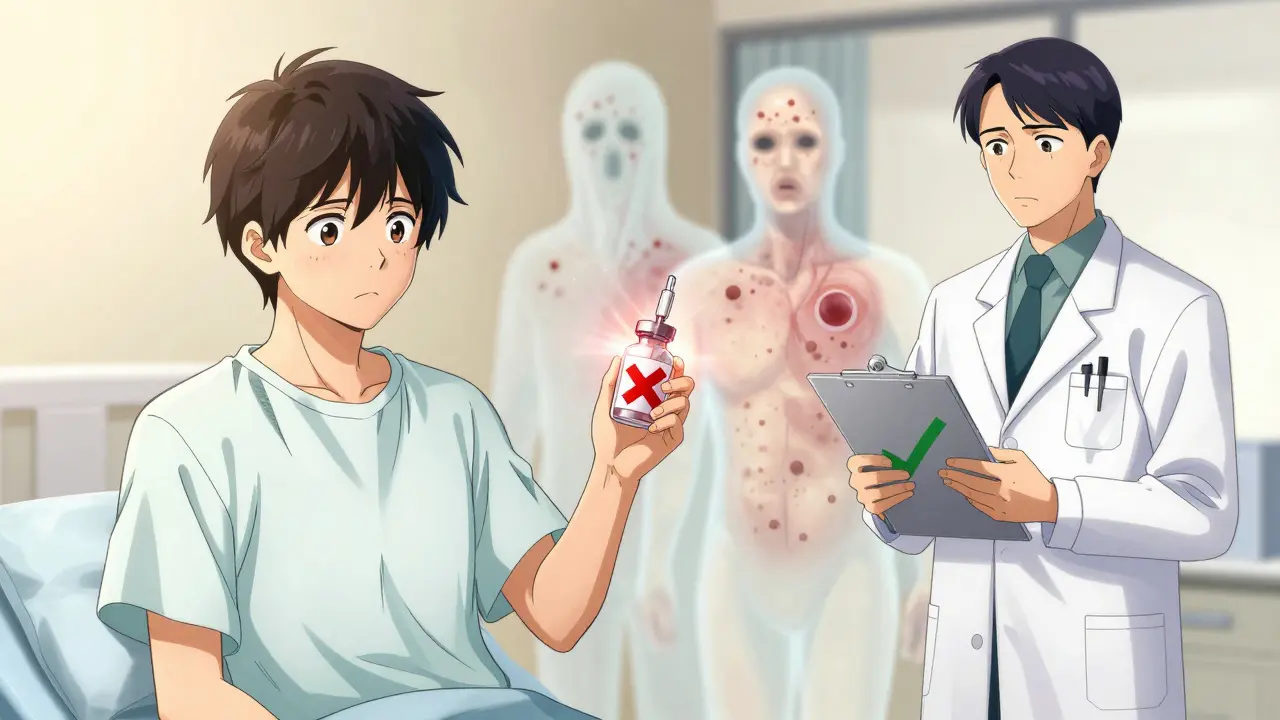
More than 10% of people in the U.S. say they’re allergic to penicillin. But here’s the catch: up to 95% of them aren’t. That’s not a typo. Most people labeled as penicillin-allergic can safely take it again - if they’re tested. This misunderstanding isn’t just a myth. It’s costing lives, increasing infections, and driving up healthcare bills.
When someone says, "I’m allergic to penicillin," doctors often avoid all beta-lactam antibiotics. That includes cephalosporins like ceftriaxone and cephalexin. But the fear of cross-reactivity? It’s been blown out of proportion. The truth? Less than 3% of people with a true penicillin allergy react to cephalosporins. And for newer ones? It’s closer to 1%. Yet, most hospitals still treat them as if they’re the same.
What Exactly Is a Beta-Lactam Allergy?
Beta-lactam antibiotics share a core structure: a four-membered ring called the beta-lactam ring. Penicillins (like amoxicillin and penicillin G) and cephalosporins (like cefazolin and cefdinir) both have it. That’s why they’re grouped together. But having the same ring doesn’t mean they trigger the same immune response.
True allergy means your immune system mistakes the drug for a threat. It produces IgE antibodies. When you take the drug again, those antibodies trigger histamine release - leading to hives, swelling, trouble breathing, or worse, anaphylaxis. Most reactions happen within an hour. That’s called an immediate-type reaction.
But here’s what gets missed: a lot of "allergies" aren’t allergies at all. A rash from a viral infection? A stomachache from antibiotics killing gut bacteria? A headache? These get labeled as "penicillin allergy" - especially in kids. And once that label sticks, it rarely gets checked again. Ten years later, you’re still avoiding penicillin. Even if you never had a real reaction.
Penicillin Reactions: What They Really Look Like
When a true penicillin allergy strikes, symptoms are clear:
- Hives (urticaria) - 90% of cases
- Swelling under the skin (angioedema) - 50% of cases
- Wheezing or shortness of breath - 30% of cases
- Anaphylaxis - 0.01% to 0.05% of doses
Anaphylaxis is rare but deadly. It needs epinephrine fast. No delays. No "wait and see." But most people who think they’re allergic never had anything this severe. They had a mild rash as a child. Or a stomach ache. Or a headache after taking amoxicillin for an ear infection. Those aren’t allergies. They’re side effects.
And here’s the kicker: 80% of people who had a penicillin reaction in childhood lose their sensitivity after 10 years. That means if you were labeled allergic 15 years ago, you’re likely not allergic anymore. But your chart still says "penicillin allergy." And every doctor who sees you will treat you like you’re at risk.
Cephalosporin Reactions: Are They Really the Same?
Cephalosporins are often grouped with penicillins - but they’re not identical. First-generation cephalosporins (like cefazolin) have side chains that look a bit like penicillin. That’s where the old 10-30% cross-reactivity number came from.
But third-generation cephalosporins? Like ceftriaxone? Their side chains are completely different. The beta-lactam ring is still there, but the rest? Not close. Modern studies show cross-reactivity with ceftriaxone is less than 1%. And for fourth-generation? Even lower.
Yet, most hospitals still avoid all cephalosporins in patients with a penicillin allergy label. Why? Fear. Tradition. Lack of clear guidelines. A nurse in a Reddit thread summed it up: "I’ve seen patients with childhood rashes get Zosyn for a UTI - because they can’t get amoxicillin. Zosyn is stronger, more expensive, and harder on the gut. It’s not better. It’s worse."
The CDC says patients with penicillin allergy labels get alternative antibiotics 70% more often. And those alternatives? They’re linked to higher rates of C. difficile infections, kidney damage, and surgical site infections. That’s not just inconvenient. It’s dangerous.
Testing for Penicillin Allergy: It’s Simple - If You Do It Right
There’s a proven way to find out if you’re truly allergic: skin testing.
It starts with a detailed history. Was it hives? Did it happen within an hour? Did you need epinephrine? Or was it a rash that appeared a week later? That’s not IgE-mediated. That’s a delayed reaction - different mechanism, different risk.
If it sounds like an immediate reaction, you get skin prick tests. Two drops: one with penicillin’s major determinant (PPL), one with the minor determinant (MDM). If those are negative, you get intradermal tests - tiny injections under the skin. If both are negative? You’re not allergic. The test has a 97-99% negative predictive value. That’s better than most cancer screenings.
And if skin testing isn’t available? You can do an oral challenge. Give 10% of a normal dose. Wait 30 minutes. Watch. Then 30%. Then 60%. If no reaction? You’re cleared. This works for 95% of people labeled as allergic.
But here’s the problem: only 35% of U.S. hospitals have formal penicillin allergy evaluation programs. Most don’t have allergists on staff. So the label stays. And the cycle continues.
What About Cephalosporin Testing?
There’s no commercial skin test for cephalosporins. Not yet. So doctors rely on history and graded challenges. If a patient has a history of mild penicillin reaction (like a rash) and needs a cephalosporin - say, for a serious infection - they can often be given the drug under observation. No testing needed. Just careful monitoring.
For patients with a history of anaphylaxis to penicillin, the risk with cephalosporins is still low - but not zero. In those cases, doctors may choose a cephalosporin with a very different side chain (like ceftriaxone) and proceed with caution. Or they may do a direct oral challenge in a controlled setting.
The bottom line: don’t avoid cephalosporins just because of a penicillin label. Test the history. Evaluate the risk. Don’t assume.

Desensitization: When You Need Penicillin But Can’t Take It
Sometimes, penicillin is the only option. Like in syphilis during pregnancy. Or neurosyphilis. Or severe strep infections. In those cases, if you’re truly allergic, there’s a solution: desensitization.
It’s not a cure. It’s a temporary reset. You’re given tiny, increasing doses of penicillin every 15 to 30 minutes over 4 to 8 hours. Your immune system gets used to it. You can take the full dose. But the effect doesn’t last. If you stop for more than a day, you’ll need to do it again.
It requires a hospital setting. Emergency equipment. Trained staff. And it’s only done when there’s no alternative. The CDC says it’s required for neurosyphilis treatment in allergic patients. Success rates? Over 80%.
But it’s not magic. It’s risky. And it’s not for everyone. That’s why testing first - to rule out false allergies - is always better.
Why This Matters More Than You Think
Every time a doctor avoids penicillin because of a mislabeled allergy, they reach for something else. Vancomycin. Clindamycin. Fluoroquinolones. These drugs are broader, more toxic, and more likely to cause C. difficile - a deadly gut infection that’s harder to treat than the original infection.
One study found hospitals with allergy delabeling programs cut C. difficile infections by 17%. Another found they reduced vancomycin use by 28%. That’s not just saving money. It’s saving lives.
And the cost? The CDC says mislabeling adds $2,000 to $4,000 per patient per year in extra care. Multiply that by millions of people. That’s billions in wasted healthcare spending.
Patients aren’t just losing access to the best antibiotic. They’re getting worse outcomes. One patient on WebMD wrote: "I was denied amoxicillin for strep throat because of a childhood rash. I got azithromycin. It didn’t work. I got sicker."
What You Can Do
If you’ve been told you’re allergic to penicillin:
- Ask: "When did it happen? What were the symptoms?"
- If it was a rash years ago - and you’ve never had a reaction since - ask about testing.
- If you need an antibiotic now - and you’re being given something expensive or risky - ask: "Could I try penicillin?"
- If you’ve never been tested, request a referral to an allergist.
And if you’re a healthcare provider: don’t just accept the label. Dig deeper. Update records. Offer testing. Your patient might be able to take the best antibiotic - not the most expensive one.
Penicillin is cheap. It’s effective. It’s targeted. And for most people, it’s safe. The problem isn’t penicillin. It’s the myth.
Lorna Brown
March 14, 2026 AT 22:51So let me get this straight - we’re giving people riskier, more expensive antibiotics because of a label from 15 years ago? And we’re not even testing? That’s not just lazy, it’s barbaric. I had a rash as a kid after amoxicillin. Thought I was allergic. Turned out it was a virus. Now I’m 32, never had another reaction, and still can’t get penicillin for my UTI. My doctor just shrugged. No one checks. No one cares. We’re treating symptoms on paper, not people.
Why is this still a thing? It’s like refusing to update a software patch because someone once had a bug report from 2007. We need systemic change, not just awareness. This isn’t about penicillin. It’s about how broken our medical record systems are.
And yet, we wonder why healthcare costs are insane. It’s not the drugs. It’s the fear. And the inertia.
Someone needs to audit every penicillin allergy label in the U.S. and force a re-evaluation. Not optional. Mandatory. Like a fire drill.
Rex Regum
March 15, 2026 AT 20:38Oh wow, so now we’re gonna trust a skin test over decades of medical wisdom? You know what else was "proven" by science? That bloodletting cured everything. And now we’re doing the same thing - throwing out tradition for some lab trick. And don’t even get me started on "oral challenges." You’re telling me we’re gonna hand out penicillin like candy to people who might drop dead? What’s next? Letting people self-diagnose anaphylaxis with a TikTok filter?
I’ve seen too many patients get sicker because someone played doctor with their history. You think a rash from childhood means nothing? What if it was the start of something worse? You don’t get to ignore the past just because modern science says so. Medicine isn’t a game of Whack-a-Mole with allergies. We don’t know what we don’t know. And that’s why we stick to the rules.
Kelsey Vonk
March 17, 2026 AT 03:44Okay but… I’m crying a little. 😭
I had the same thing. Rash at 7. Labeled allergic. 15 years later, I needed an antibiotic for pneumonia. They gave me vancomycin. I got C. diff. Spent 10 days in the hospital. My mom cried. I cried. I was so angry I didn’t even know I could’ve just had amoxicillin.
I got tested last year. Negative. I’ve taken penicillin twice since. No issues. No drama. Just… relief.
If you’ve been told you’re allergic and you’re not sure - please, please ask. It’s not scary. It’s not complicated. It’s just… one appointment. And it could save your life. I’m not saying it’s easy. But it’s worth it. 💛
Emma Nicolls
March 18, 2026 AT 19:42im so glad someone finally said this
i was told i was allergic to penicillin when i was like 5 and now im 28 and i just got a sinus infection and they gave me some crazy expensive drug that made me dizzy and sick
my mom was like oh yeah you were allergic back then
i was like wait what if i aint
so i called my doc and they were like oh we can test you
and i did
and i wasnt allergic at all
so now im taking amoxicillin and i feel 100x better
why dont more people know this
also why is healthcare so confusing
ps i just told 3 friends and theyre all gonna get tested too
we need to fix this
Jimmy V
March 20, 2026 AT 19:09Testing isn’t optional. It’s standard of care. If your hospital doesn’t do it, they’re negligent. Period.
Vancomycin isn’t a "backup." It’s a sledgehammer. C. diff kills. You’re not "being safe." You’re being stupid.
Stop letting fear dictate treatment. Use data. Use guidelines. Use common sense.
And if you’re a provider: update the chart. Delete the allergy. Document the test. Don’t wait for the patient to ask. Do your job.
Richard Harris
March 21, 2026 AT 21:48Interesting read. I work in a UK hospital and we’ve started doing oral challenges for penicillin labels - mostly in pre-op clinics. It’s been eye-opening. One woman, 72, had been avoiding all beta-lactams since age 10. Turned out she had a chickenpox rash. We gave her cefazolin for her hip replacement. No issues. She’s now on her third post-op walk. No antibiotics. No complications.
Still, uptake is slow. Nurses are scared. Doctors are busy. Patients don’t know to ask. It’s a perfect storm of inertia.
Maybe we need a national campaign. Like "Don’t Guess. Test."
Kandace Bennett
March 23, 2026 AT 09:40Oh honey. 😘
You mean to tell me that in AMERICA - the land of innovation, cutting-edge medicine, and billion-dollar pharma empires - we’re still using 1950s logic to treat allergies? 🤦♀️
Meanwhile, Germany tests everyone. Canada has protocols. Australia? Already fixed it.
And here we are, letting people get C. diff because someone’s chart says "allergic" from 1998. 💩
It’s not just ignorance. It’s negligence. And if you’re a doctor who doesn’t update records? You’re part of the problem. I’m not mad. I’m just… disappointed. 😔
Also, why is this not on the nightly news? 🤔
Tim Schulz
March 24, 2026 AT 05:49So let me get this straight - we’ve got a 95% false-positive rate on penicillin allergies, and the medical system still treats it like a death sentence?
That’s not incompetence.
That’s a cult.
"I’m allergic to penicillin."
"Oh no! We’ll give you vancomycin!"
"But I’m fine now."
"Nope. We’ve got protocols."
It’s like a medieval guild of fear. No one dares to question it. No one wants to be the one who "let someone die."
So we kill people slowly with antibiotics instead.
Bravo, medicine. 🎩👏
Also, if you’re still avoiding cephalosporins? You’re not a doctor. You’re a spreadsheet.
Jinesh Jain
March 25, 2026 AT 05:14Interesting. In India, we don’t test much. But we also don’t overprescribe penicillin. Most people take what’s available. If they have a rash, they stop the drug. No label. No record. Just common sense. Sometimes, less bureaucracy means less harm.
Still, I agree - if you had a mild reaction years ago, it’s probably gone. Your body changes. Your immune system changes. Don’t hold onto old ghosts.