

Every year, millions of people drink cranberry juice to prevent urinary tract infections. It’s cheap, easy to find, and many swear by it. But if you’re taking medication-especially blood thinners like warfarin-you’ve probably heard a warning: cranberry juice could be dangerous. Is that true? Or is it just another health myth that won’t go away?
The truth isn’t black and white. Some studies say it’s risky. Others say it’s harmless. And most people? They’re confused. One pharmacist told me they get asked about cranberry and warfarin at least once a week. Yet, in clinical trials, the interaction rarely shows up. So what’s going on? Let’s cut through the noise.
What’s the real risk with cranberry juice and warfarin?
Warfarin is a blood thinner. It keeps clots from forming, but it’s tricky. Too little, and you risk a clot. Too much, and you could bleed internally. Your doctor checks your INR-a number that tells them how thin your blood is-to make sure you’re in the safe zone.
Back in 2003, a single case report made headlines: a man on warfarin started drinking cranberry juice and his INR shot up. He almost bled to death. That one story sparked years of fear. Hospitals started warning patients. Pharmacies put up signs. But here’s the thing: after 20 years of research, controlled studies haven’t confirmed this.
A 2010 review looked at 11 case reports and 4 real clinical trials. Eight of the case reports suggested a problem. But all four controlled studies? No change in INR. One study had 12 healthy people drink 250 mL of cranberry juice three times a day for two weeks. Their INR stayed perfectly normal. Another study with 18 patients on warfarin found no effect when they drank cranberry juice daily for 14 days.
So why do some people still have problems? The answer might be in the product. Most cranberry juice you buy at the store isn’t pure. It’s a cocktail-only about 27% cranberry, the rest sugar and water. But supplements? Those can be concentrated. Some contain over 36mg of proanthocyanidins per serving-the compounds thought to affect drug metabolism. And those? They might be the real concern.
Why do some doctors say to avoid it completely?
Some experts take the conservative route. Dr. Lisa Stamp from the University of Otago says we should treat cranberry like a known risk until proven safe. Her argument? Warfarin has a narrow window. Even a small change in INR can be dangerous. One patient’s INR jumped from 2.5 to 4.0 after starting cranberry supplements. That’s not normal. It’s not safe. And if you’re on warfarin, you can’t afford to guess.
That’s why the American College of Clinical Pharmacy recommends avoiding cranberry products entirely if you’re on warfarin. They don’t say it’s proven to be harmful. They say: we don’t have enough certainty, and the consequences of getting it wrong are too high.
Meanwhile, the American Urological Association changed its stance in 2021. They now say: It’s fine to use cranberry for UTI prevention if you’re not on warfarin. That’s a big shift. It means they’re trusting the bulk of the evidence-that for most people, it’s safe.
What about other medications? Antibiotics, statins, antidepressants?
Here’s where things get interesting. For most drugs, cranberry juice doesn’t do anything noticeable.
A 2009 study tested cranberry juice with two common antibiotics: amoxicillin and cefaclor. Both are used for UTIs. Researchers gave 18 women the antibiotics with or without 8oz of cranberry juice. They measured how much drug entered the bloodstream. No difference. Not even a small one. The juice didn’t slow absorption. It didn’t change peak levels. Nothing.
Same goes for statins. A 2012 study with simvastatin found no change in blood levels after 14 days of cranberry juice. No increased risk of muscle damage. No liver stress.
Even drugs like alprazolam (Xanax), which are broken down by the same liver enzyme (CYP3A4) that cranberry might affect in a test tube, show no real-world interaction. No case reports. No clinical evidence. Just theory.
So why does this myth stick? Because grapefruit juice does interact with dozens of medications. People mix them up. They hear “fruit juice + medication = danger” and assume cranberry is the same. It’s not.
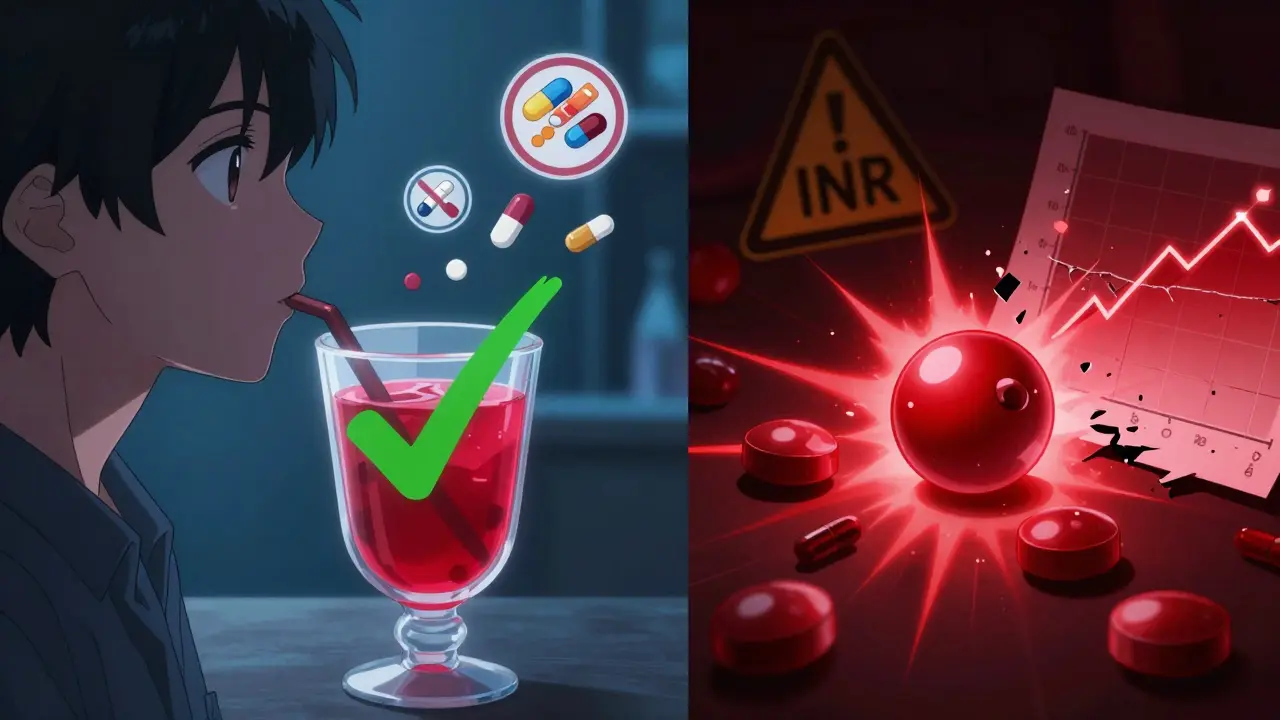
What about cranberry supplements? Are they riskier than juice?
Yes. And here’s why.
When you drink 8oz of cranberry juice cocktail, you’re getting maybe 20-30mg of proanthocyanidins. But a single supplement pill? It can deliver 36mg or more. And some products don’t even list how much they contain.
That’s a problem. Because the higher the dose of these compounds, the more likely they are to interfere with how your body processes drugs. We know this from lab studies. In a test tube, concentrated cranberry extract inhibits liver enzymes just like ketoconazole-a known strong inhibitor.
But we don’t yet have enough human data to say exactly how much is too much. That’s why the Cranberry Institute is funding new studies in 2023 to find the threshold. Until then, if you’re on any medication, avoid high-dose supplements. Stick to juice. And even then, keep it to one glass a day.
What should you actually do?
Let’s cut to the practical advice. You don’t need to panic. You don’t need to quit cranberry juice forever. But you do need to be smart.
- If you’re on warfarin: Avoid cranberry supplements. If you want juice, stick to one 8oz glass per day and tell your doctor. Get your INR checked more often if you start drinking it.
- If you’re on antibiotics: You’re fine. Cranberry juice won’t interfere with amoxicillin, cefaclor, or most other antibiotics.
- If you’re on statins, blood pressure meds, or antidepressants: No evidence of interaction. You can drink it.
- If you’re on direct oral anticoagulants (like apixaban or rivaroxaban): No known interaction so far. But new studies are underway. Talk to your doctor if you’re unsure.
- Always check the label. If it says “concentrated extract” or “10x potency,” skip it unless your pharmacist says it’s okay.
Also, don’t confuse cranberry juice with grapefruit juice. Grapefruit has 17 known serious interactions. Cranberry? One possible one-with warfarin-and even that’s debated.

Why do so many people get conflicting advice?
Because the science is messy. Some doctors rely on case reports. Others rely on clinical trials. Some see a single patient with a bad reaction and assume it’s common. Others see dozens of studies showing no effect and assume it’s safe.
And then there’s the supplement industry. Cranberry supplements are a $1.2 billion market. They’re marketed as “natural,” “pure,” and “powerful.” But “powerful” doesn’t mean “safe.”
One Reddit user, NurseJen45, summed it up perfectly: “I’ve seen patients have INR spikes, but my hospital’s pharmacists say the evidence isn’t strong enough to warn everyone.” That’s the tension right there.
Patients are caught in the middle. They want to prevent UTIs. They don’t want to risk a stroke or a bleed. They’re told to avoid cranberry. Then they’re told it’s fine. No wonder they’re confused.
The bottom line? You’re not alone. And you don’t have to guess.
What’s the bottom line?
Cranberry juice, at normal levels, is safe for most people-even those on medications. The only real concern is warfarin, and even that’s not clear-cut. Supplements? Riskier. Juice? Probably fine.
If you’re on warfarin: Talk to your doctor. Don’t assume it’s dangerous. Don’t assume it’s safe. Get your INR checked. Keep a log. If you start drinking juice, tell them. If you stop, tell them. Consistency matters more than avoidance.
If you’re on anything else: You’re likely fine. But skip the supplements unless you’ve checked with a pharmacist. And if you’re not sure? Ask. Don’t guess. Your health isn’t worth the risk of a myth.
Can cranberry juice interfere with warfarin?
Cranberry juice may theoretically affect warfarin by inhibiting liver enzymes, but clinical studies show inconsistent results. Some case reports describe dangerous INR spikes, but controlled trials found no significant effect in most patients. The American College of Clinical Pharmacy recommends avoiding cranberry products entirely if you’re on warfarin, while other experts say moderate juice consumption is likely safe. The safest approach is to avoid supplements, limit juice to one 8oz glass per day, and inform your doctor so your INR can be monitored more closely.
Is it safe to drink cranberry juice while taking antibiotics?
Yes. A 2009 clinical study tested cranberry juice with amoxicillin and cefaclor-two common antibiotics for UTIs-and found no clinically significant effect on how the body absorbs or processes them. Even though cranberry might theoretically interfere with drug transporters, real-world data shows no change in drug levels. You can safely drink cranberry juice while on these antibiotics.
Do cranberry supplements interact with more drugs than juice?
Yes. Supplements often contain concentrated cranberry extract with 36mg or more of proanthocyanidins per serving, while regular juice contains only 20-30mg. Higher concentrations may increase the risk of interacting with liver enzymes like CYP3A4 and CYP2C9. While human data is still limited, the theoretical risk is greater with supplements. Most experts recommend avoiding them if you’re on any medication, especially warfarin or other drugs with narrow therapeutic windows.
Why do some doctors say to avoid cranberry juice entirely?
Some doctors follow a precautionary principle: if there’s even a small chance of harm with a drug that can cause life-threatening bleeding, they recommend avoiding it entirely. This is especially true for warfarin, where INR changes can be dangerous. While evidence doesn’t consistently show a problem, the consequences of getting it wrong are high. So rather than risk a bleeding event, some providers say: don’t take it.
Can I drink cranberry juice if I’m on a blood thinner other than warfarin?
Current evidence suggests no significant interaction between cranberry juice and direct oral anticoagulants (DOACs) like apixaban, rivaroxaban, or dabigatran. Unlike warfarin, these drugs aren’t metabolized by the same liver enzymes that cranberry may affect. A large 2023 clinical trial is still underway, but so far, no adverse events have been reported. Still, it’s wise to mention cranberry use to your doctor, especially if you’re switching from warfarin to a DOAC.
If you’re taking any medication and considering cranberry juice or supplements, the best move is simple: talk to your pharmacist. They know your meds. They know the science. And they’re trained to spot risks you might miss. Don’t rely on internet rumors. Don’t assume it’s safe just because you’ve done it before. Your body doesn’t work on guesswork.
Tom Sanders
March 7, 2026 AT 22:44Jazminn Jones
March 8, 2026 AT 23:40Stephen Rudd
March 10, 2026 AT 00:35Erica Santos
March 10, 2026 AT 08:32George Vou
March 10, 2026 AT 12:16Scott Easterling
March 12, 2026 AT 05:55Mantooth Lehto
March 14, 2026 AT 04:58Melba Miller
March 15, 2026 AT 17:59Katy Shamitz
March 17, 2026 AT 10:07Nicholas Gama
March 17, 2026 AT 21:30Mary Beth Brook
March 18, 2026 AT 19:03