

Spinal Procedure Timing Calculator
Anticoagulant Timing Calculator
Calculate safe anticoagulant timing before epidural or spinal procedures. This tool is based on ASRA guidelines and the latest clinical evidence.
Results
When you're on blood thinners and need an epidural or spinal procedure - whether for labor, back pain, or surgery - the risks aren't just theoretical. A single mistake in timing can lead to a spinal epidural hematoma (SEH), a rare but devastating condition that can cause permanent paralysis or even death. This isn't a rare edge case. It's a real, documented danger that affects hundreds of people every year in the U.S. alone. And most of those cases? They were preventable.
What Exactly Is a Spinal Epidural Hematoma?
A spinal epidural hematoma happens when blood leaks into the space between the spinal cord's protective membrane (the dura) and the inside of the spine. That space is tiny - about the width of a pencil - and even a small amount of blood, as little as 1-2 mL, can crush the spinal cord. The result? Sudden, severe back pain, numbness in the legs, loss of bladder control, or weakness that can turn into full paralysis.
It doesn't happen in every patient. The overall risk for a routine epidural is around 1 in 150,000. But when you're on anticoagulants, that risk jumps dramatically. In patients taking therapeutic doses of low molecular weight heparin (like Lovenox), the risk goes up to 0.31% - meaning roughly 3 out of every 1,000 patients could develop this complication. And if you're on a direct oral anticoagulant (DOAC) like rivaroxaban or apixaban? The numbers change depending on how long you stopped the drug before the procedure.
Which Blood Thinners Are Most Dangerous?
Not all anticoagulants carry the same risk. Here’s how they stack up based on real-world data:
- Warfarin: Risk spikes when INR is above 1.4. Even if your INR is "normal" (1.2), there are documented cases of hematomas - meaning you can't rely on lab numbers alone.
- Low Molecular Weight Heparin (LMWH): If you take a therapeutic dose (for clots), you need to stop it 24 hours before the procedure. If you're on a low-dose version (for prevention), 10-12 hours is enough. But if you're dosed wrong? Risk skyrockets.
- DOACs (rivaroxaban, apixaban, dabigatran): For people with normal kidney function, you need to stop rivaroxaban or apixaban 48 hours before. If your kidneys aren't working well? Extend that to 72 hours. Miss this window, and your risk jumps from 0.08% to 0.42%.
- Aspirin and clopidogrel: Aspirin alone? Risk is nearly zero - studies show no hematomas in over 1,200 patients who kept taking it. But if you're on both aspirin and clopidogrel? Risk triples. That’s why doctors often ask you to stop dual therapy 7 days before surgery.
One key thing to remember: timing matters more than the drug name. A patient on apixaban who stopped it 50 hours before an epidural might be fine. Another who stopped it 45 hours before? Could end up paralyzed.
What Makes the Risk Worse?
It's not just the medication. A perfect drug schedule can still go wrong if other factors line up. These are the biggest red flags:
- Multiple needle attempts: If the anesthesiologist has to poke you more than twice, your risk increases 6.2 times.
- Bleeding during the procedure: If they see blood in the spinal fluid (blood-tinged CSF), your risk jumps 11.8 times.
- Epidural catheter vs. single shot: Leaving a catheter in place increases risk 2.3 times compared to a single injection.
- Age over 70: Risk goes up 3.7 times.
- Renal failure: If your kidney function is below 30 mL/min, your risk is nearly 5 times higher.
- Low hemoglobin: If your blood count is below 10 g/dL, you're 4.2 times more likely to bleed out.
One real case from a 2021 study: a 74-year-old woman on rivaroxaban, with mild kidney disease, had two needle passes and a catheter placed. She developed saddle anesthesia 10 hours later. Surgery saved her life - but she lost bladder control permanently. All of these factors could have been flagged and managed.
How Fast Do Symptoms Show Up?
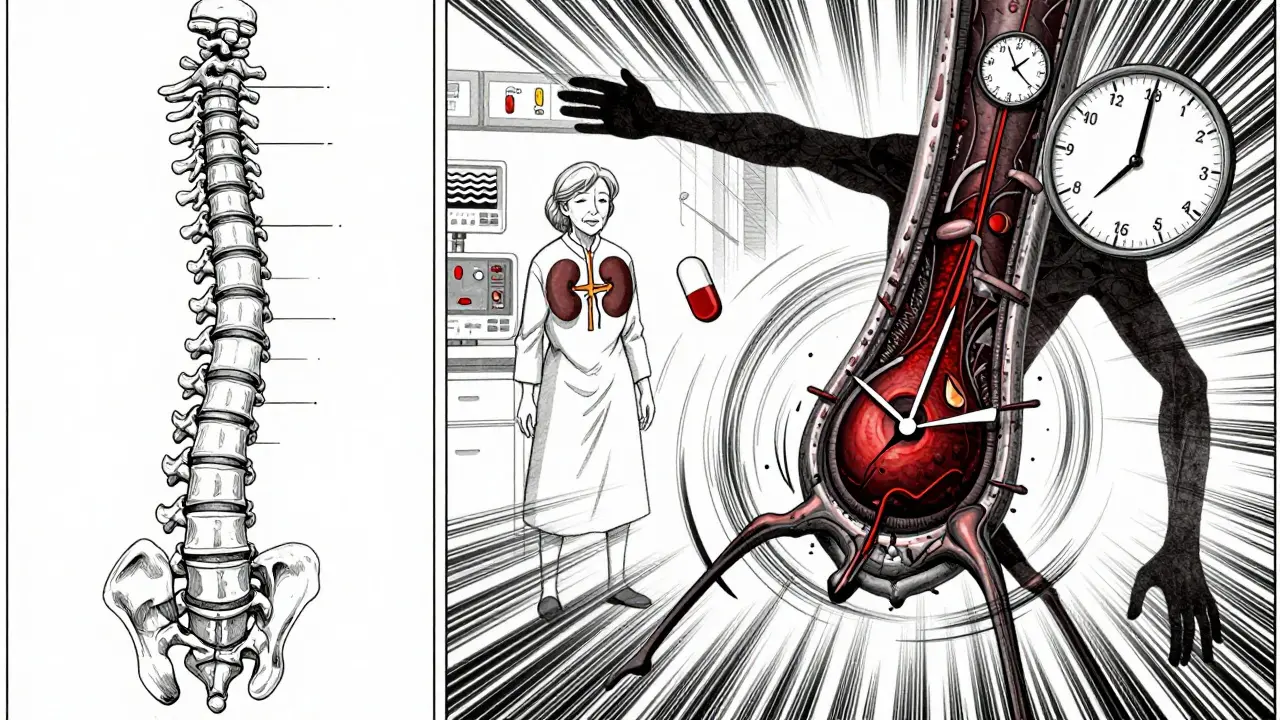
This isn't something that creeps up over days. Symptoms hit fast. In 93% of cases, the first sign is severe back pain. Within hours, you might lose feeling in your legs or be unable to urinate. The window to act is narrow: 8 hours.
Studies show that if you get surgery to drain the hematoma within 8 hours, 79% of patients recover fully. After 24 hours? Only 9% do. That’s not a coincidence. It’s biology. The spinal cord doesn’t recover well from pressure. Every minute counts.
What Do Doctors Actually Do to Prevent This?
Guidelines from the American Society of Regional Anesthesia and Pain Medicine (ASRA) are clear. Here’s what they recommend:
- For warfarin: Check INR within 24 hours before. Target must be below 1.4. Resume 4-6 hours after the procedure, depending on catheter use.
- For LMWH: Stop prophylactic doses 10-12 hours before. Stop therapeutic doses 24 hours before. Restart 2 hours after single injection, 4 hours after catheter removal.
- For DOACs: Stop rivaroxaban or apixaban 48 hours before if kidneys are normal. Extend to 72 hours if kidneys are impaired. Dabigatran? Same timing, but check creatinine clearance.
- For aspirin: No need to stop. For clopidogrel? Stop 7 days before. For dual therapy? Same rule.
But here’s the problem: many providers don’t follow these rules. A 2022 survey of 345 pain doctors found only 58% knew the correct timing for DOACs. And the FDA found that 34% of Lovenox-related hematomas happened because the patient’s anticoagulant status wasn’t documented properly.
What About Patients Who Don’t Want to Stop Their Medication?
Some patients refuse to stop blood thinners. They’re scared of clots. And they have a point. Stopping anticoagulants can trigger strokes, heart attacks, or pulmonary embolisms. That’s why doctors don’t just say "stop everything." They weigh the risks.
For example:
- A 70-year-old with a mechanical heart valve? Stopping warfarin for a back injection could be deadly. In this case, they might use a different pain management method - like a nerve block - or keep the patient on a bridge therapy with heparin that’s timed safely.
- A 55-year-old on apixaban for atrial fibrillation? The risk of stroke is low enough that a 48-hour pause is acceptable. But if they have a history of clots? Maybe they get an ultrasound to check for clots before the procedure.
There’s no one-size-fits-all. The decision is personal, and it’s made between you and your care team.

What’s New in 2025?
The field is evolving. In 2023, the FDA mandated a new Risk Evaluation and Mitigation Strategy (REMS) for all anticoagulants - meaning prescribers must complete training on neuraxial risks. Hospitals in the U.S. must now report all SEH cases if they perform more than 50 spinal procedures a year, starting January 2025.
Researchers are also testing new tools. A 2022 study found that a blood marker called GFAP - a protein released when the spinal cord is damaged - can detect a developing hematoma within 2 hours. That’s faster than an MRI. If this test becomes routine, it could change everything.
And there’s a puzzling trend: women are developing these hematomas 2.3 times more often than men, even when on the same drugs and doses. Why? No one knows yet. It’s being studied.
What Should You Do If You’re on Blood Thinners?
If you’re scheduled for an epidural or spinal procedure and you’re on anticoagulants, here’s what to do:
- Don’t assume your doctor knows. Bring a list of every medication you take - including over-the-counter aspirin, fish oil, or herbal supplements.
- Ask: "What’s my exact timing?" Don’t settle for "stop a few days before." Get the exact number of hours based on your drug and kidney function.
- Confirm the procedure type. Is it a single injection? Or a catheter? The rules change.
- Ask about alternatives. Could a nerve block or oral pain meds work instead?
- Report any back pain or numbness after the procedure. Don’t wait. Tell someone immediately.
This isn’t about being difficult. It’s about survival. One wrong timing decision can cost you your mobility. And if you’re on multiple blood thinners, or have kidney issues, or are over 70? You’re in the danger zone.
Final Thought: It’s Not About Fear - It’s About Control
Anticoagulants save lives. Spinal procedures relieve pain. But when they collide, the stakes are life-altering. The good news? This risk is predictable. It’s measurable. And with the right information, it’s avoidable.
You don’t need to be afraid. You just need to be informed.
Jacob Hessler
March 24, 2026 AT 22:33Amber Gray
March 25, 2026 AT 16:19Danielle Arnold
March 25, 2026 AT 16:43Caroline Dennis
March 27, 2026 AT 04:28peter vencken
March 28, 2026 AT 14:39Kevin Siewe
March 30, 2026 AT 13:31Chris Farley
March 31, 2026 AT 09:43Darlene Gomez
April 1, 2026 AT 09:31