
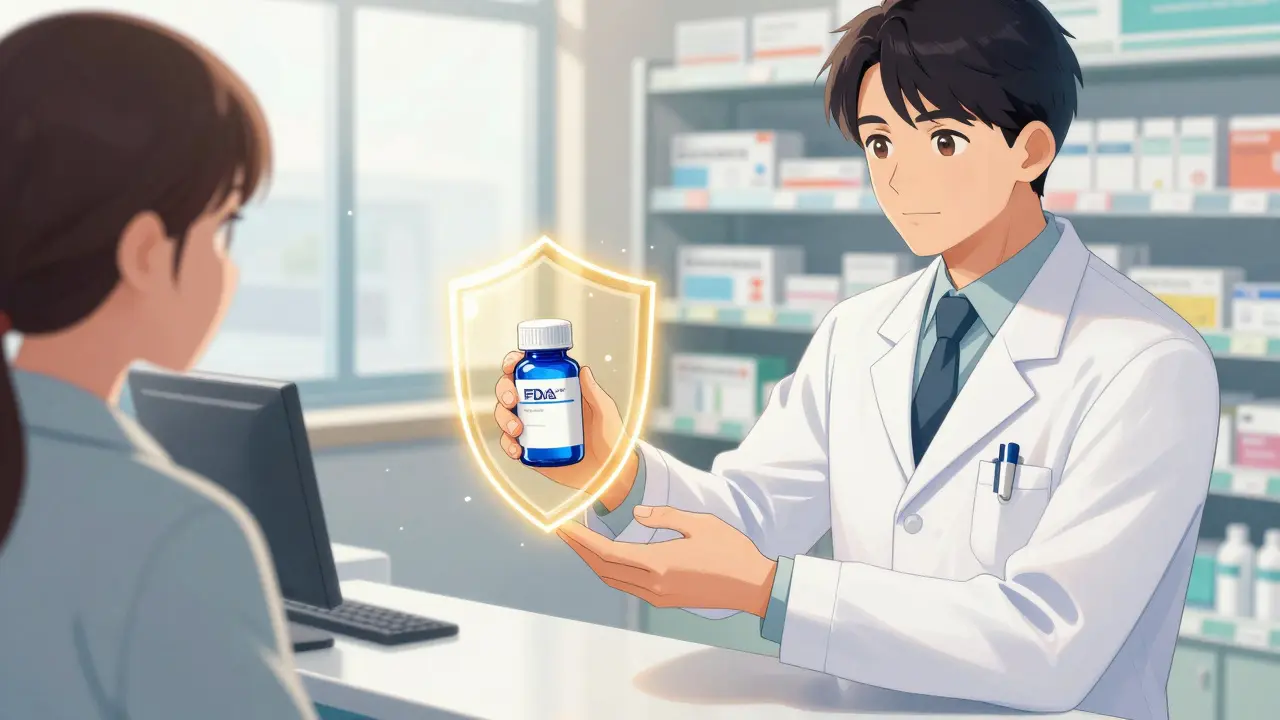
Imagine walking into a pharmacy and picking up a prescription bottle. Nine times out of ten, you're getting a generic version of the medication rather than the original brand name. Yet, most people never pause to ask how the government ensures that cheaper pill works just as well as the expensive one. This trust rests entirely on the U.S. Food and Drug Administration, which maintains strict regulatory authority over generic drug approval. As we move through 2026, understanding this system becomes vital for patients, healthcare providers, and manufacturers alike.
The Legal Backbone of Generic Approval
You cannot talk about generic drug safety without looking at the law that built it all. The foundation sits in the Federal Food, Drug and Cosmetic Act, specifically Section 505(j). This section was established under the famous Hatch-Waxman Act of 1984. This legislation created a balanced compromise: it protected pharmaceutical patents for innovators while carving out a faster lane for generic competitors.
This framework allows the FDA's Office of Generic Drugs (OGD), housed within the Center for Drug Evaluation and Research (CDER), to approve copies of existing medicines. Manufacturers don't need to repeat the massive clinical trials used for the original drug. Instead, they prove their product is bioequivalent. In 2023 alone, the agency approved 90 first-time generic drugs. By 2026, this efficiency continues to keep healthcare costs manageable while maintaining rigorous quality controls.
Navigating the ANDA Pathway
When a company wants to sell a copycat version of a brand-name drug, they submit what's called an Abbreviated New Drug Application (ANDA). Think of this as the primary roadmap for generic entry into the market. The process is distinct from a full New Drug Application (NDA) required for totally new medicines.
Abbreviated New Drug Application requires demonstrating that the generic drug contains identical active ingredients, strength, dosage form, and route of administration compared to the Reference Listed Drug. The timeline involves several critical checkpoints. First, the Division of Filing Review checks the paperwork. If documents are incomplete, you get a Refuse-to-Receive (RTR) letter. In 2022, this affected 15.3% of submissions. Once filed, the Substantive Review kicks in, with Target Action Dates usually set at 10 months for standard applications.
| Feature | New Drug Application (NDA) | Abbreviated New Drug Application (ANDA) |
|---|---|---|
| Purpose | Approval for new innovative drugs | Approval for generic versions |
| Clinical Trials Required | Extensive Phase I, II, III data | No safety/efficacy trials needed | Average Development Cost | ~$2.6 billion | $2.4-$6.3 million |
| Development Timeline | 10-15 years | 3-4 years |
| Bioequivalence Requirement | Demonstrate safety and efficacy | Demonstrate therapeutic equivalence |
Science Behind Bioequivalence
Safety isn't just about paperwork; it's about science. The core requirement is proving bioequivalence. This means measuring how fast and how much of the drug gets absorbed into the bloodstream. Studies typically involve 24 to 36 healthy volunteers. The math behind this is precise. The 90% confidence interval for the ratio of geometric means must fall within 80.00% to 125.00% for both AUC (Area Under the Curve) and Cmax (maximum concentration).
If a generic fails this test, it doesn't get approved. However, some drugs are tricky. We call these complex generics. They include things like inhalers, topical creams, and extended-release formulations. These require specialized testing methodologies because a simple blood test might not show how the drug works. In fiscal year 2023, 37.5% of approvals involved these complex products, showing the system is adapting to harder challenges.
Manufacturing and Quality Control
Even with perfect chemistry, the manufacturing site matters. Facilities must comply with Current Good Manufacturing Practice (CGMP) regulations outlined in 21 CFR parts 210 and 211. These rules dictate everything from water purity in the mixing tanks to air filtration in packaging rooms.
The FDA inspects these sites regularly. According to the 2023 Generic Drug Program report, inspection rates averaged 82.7% annually. If a factory falls short, the FDA issues warning letters or halts production. This oversight prevents substandard drugs from reaching pharmacies. For instance, in 2022, the FDA sent Complete Response Letters for 14.8% of applications due to deficiencies in bioequivalence studies, ensuring only high-quality products pass.
Financials and Fees
Maintaining this system costs money, and those costs are shared through user fees. Under the Generic Drug User Fee Amendments (GDUFA) III, applicants pay $389,490 per ANDA application. Facility fees range between $207,700 and $415,400 depending on whether the site makes active ingredients or finished products. These funds support the review team, which is crucial given the volume of work.
Despite the fees, the economic benefit is massive. Generic drugs comprised 90% of U.S. prescription volume in 2023. While they represent only 23% of spending, they generated $132.6 billion in annual savings compared to brand prices. This creates a win-win scenario where patient out-of-pocket costs drop by 80-85%, according to pharmacist surveys conducted in early 2023.

Recent Developments and Future Plans
Regulation is always evolving. In October 2025, the FDA announced a pilot prioritization program. This initiative offers faster reviews for companies manufacturing products right here in the United States. The Target Action Dates for these qualifying applications were reduced by 30%. This move aims to bolster domestic supply chains and reduce reliance on imported ingredients.
Looking ahead, the agency is integrating artificial intelligence into its review process. Pilots began in late 2024 covering 12% of ANDAs. The goal is to streamline the assessment of routine chemistry data so human reviewers can focus on complex clinical safety questions. Furthermore, GDUFA IV negotiations concluded in late 2024 with a $2.1 billion funding commitment through 2027, signaling long-term investment in generic oversight.
Public Perception and Safety Reports
Does the public trust this system? Consumer satisfaction data from 2023 showed 78.4% of patients expressed confidence in FDA-approved generics. However, skepticism exists. About 22.7% of adverse event reports involving generics cited perceived efficacy differences. Investigation determined that 92.3% of these cases resulted from disease progression rather than the drug itself. Still, transparency remains key to maintaining trust.
Dr. Sally Choe, Deputy Center Director for Pharmaceutical Quality at CDER, noted that the review process has evolved to address increasingly complex products while maintaining scientific rigor. This evolution is necessary as the landscape shifts. With 1,842 pending ANDAs waiting for review as of late 2022, managing backlog remains a priority for the Office of Generic Drugs leadership.
Is a generic drug exactly the same as a brand-name drug?
Generics must contain identical active ingredients and deliver the drug into the bloodstream at the same rate. However, inactive ingredients like fillers or dyes may differ slightly. The FDA ensures these differences do not affect safety or effectiveness.
How long does the FDA approval process take?
Standard applications generally have a target action date of 10 months after filing. Priority reviews, such as for drugs in shortage or first generics, aim for an 8-month timeline as stipulated in GDUFA III.
What happens if a generic manufacturer refuses an FDA inspection?
The FDA cannot allow the product to be marketed until compliance is proven. Repeated refusal can lead to legal actions and suspension of the facility's ability to produce regulated goods.
Can I switch between different brands of the same generic drug?
Yes, generally. All approved generics meet the same bioequivalence standards. However, some narrow therapeutic index drugs may require a specific manufacturer's product for stability.
How many generic drugs has the FDA approved so far?
As of December 31, 2023, the FDA had approved 16,732 generic drug products. These are documented in the Orange Book listing along with their therapeutic equivalence ratings.
Jordan Marx
March 27, 2026 AT 17:07The Abbreviated New Drug Application framework relies heavily on specific bioequivalence parameters. Manufacturers must demonstrate therapeutic equivalence without repeating Phase III clinical trials. Reference Listed Drugs serve as the benchmark for all subsequent generic filings. Therapeutic equivalence codes assigned in the Orange Book indicate interchangeability status clearly. Pharmacokinetic studies compare Area Under the Curve values against brand standards strictly. Maximum concentration limits fall within the eighty to one hundred twenty five percent confidence interval. Complex generics require additional dissolution testing methodologies beyond standard blood workups. Inhalation products necessitate specialized particle size distribution analysis during development. Current Good Manufacturing Practice regulations dictate environmental controls at production facilities. Facility inspections verify compliance with water purity and air filtration specifications annually. Generic Drug User Fee Amendments fund the substantive review divisions effectively. Applicant fees cover the cost of evaluating chemistry data and microbiological safety assessments. Priority designations accelerate timelines for drugs facing critical supply shortages globally. Domestic manufacturing incentives currently prioritize companies operating within U.S. borders exclusively. Final approval notifications update public databases immediately upon successful completion.
Tony Yorke
March 29, 2026 AT 01:03This system keeps costs manageable
tyler lamarre
March 30, 2026 AT 04:59Most people just nod at that nonsense without understanding the regulatory depth required here. It is impressive how many think bioequivalence is just magic instead of rigorous statistical validation. The Hatch Waxman compromise works precisely because patent protection balances against competition. We rarely appreciate the Office of Generic Drugs until supplies dwindle. Generic approvals often face more scrutiny than brand launches due to volume pressures alone.
Rachael Hammond
April 1, 2026 AT 01:58Its great we can trust the medecines now. The governmment does a good job checking stuff. I worry less when i see orange book listings online. Prices drop so much which helps families everywhere.
Devon Riley
April 1, 2026 AT 09:34So happy to see everyone supporting patient safety 💕 The science really backs us up here ✨ Health care access is key for our community 🌟 Trust the process please ❤️
Kameron Hacker
April 2, 2026 AT 04:09The regulatory oversight mechanisms must remain uncompromised under any circumstance. Safety lapses in pharmaceutical manufacturing constitute a severe threat to public health infrastructure. Enforcement actions against non-compliant facilities serve as necessary deterrents for negligence. Substandard quality control cannot be tolerated within the current legal framework. Rigorous inspection protocols define the boundary between acceptable and defective production standards.
Jeannette Kwiatkowski Kwiatkowski
April 2, 2026 AT 22:14Most common people simply do not comprehend the complexity involved in these regulatory pathways. Only those versed in pharmaceutics truly appreciate the nuance of bioequivalence intervals. General public opinion relies too heavily on perception rather than data driven outcomes. Real experts know the risk factors behind every approved formulation.
Aaron Olney
April 3, 2026 AT 03:24I feell so worried about the fakes sometimes even though its approved. The numbers scare me a bit honestly. But the doctors say its fine so I guess we trst them.
Paul Vanderheiden
April 3, 2026 AT 14:55you shouldnt worry so much the science is solid. its always better to have options that work. glad you found peace of mind through this info
kendra 0712
April 5, 2026 AT 10:52Wow!!! This breakdown is incredibly informative!!! I never realized how many steps are involved!!! Definitely going to share this!!!
Sophie Hallam
April 5, 2026 AT 12:25Sharing detailed information helps everyone understand the background processes better. Transparency supports informed decision making for patients and providers alike.
Tommy Nguyen
April 6, 2026 AT 17:00Hopeful for cheaper meds soon for everyone needing them. The effort towards domestic supply looks very promising too.