
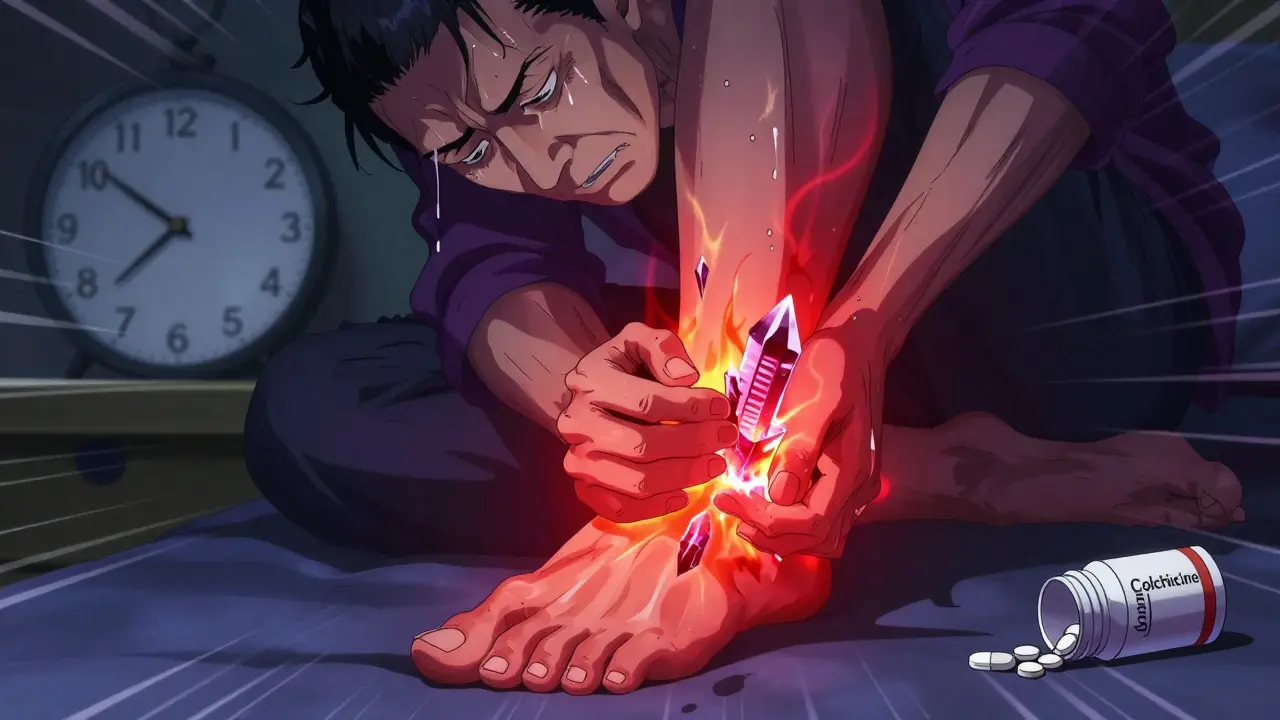
What Happens During a Gout Flare?
When gout flares up, it doesn’t just hurt-it cripples. One minute you’re walking normally, the next, your big toe feels like it’s been smashed with a hammer. The joint swells, turns red, and burns even under a sheet. This isn’t just arthritis-it’s inflammation on overdrive, caused by sharp uric acid crystals jamming into your joint. And if you wait too long to treat it, the pain can last days, even weeks.
There’s no magic cure, but three main drugs can stop it cold: colchicine, NSAIDs, and steroids. All three work. All three are used every day in clinics from Adelaide to Atlanta. But which one’s right for you? It’s not about which is strongest-it’s about which is safest for your body.
NSAIDs: The Go-To, But Not for Everyone
NSAIDs like naproxen, ibuprofen, and indomethacin are the most common first choice. They knock down inflammation fast. In fact, studies show about 73% of people get at least half their pain relief within a few days when they start early.
But here’s the catch: these drugs aren’t gentle. If you have high blood pressure, kidney trouble, heart disease, or a history of stomach ulcers, NSAIDs can make things worse-sometimes dangerously so. That’s a big deal because most people with gout are over 50, and most over-50s have at least one of those conditions.
Dosing matters too. You can’t just pop a regular ibuprofen tablet and call it a day. You need high doses: 800 mg three times a day, or naproxen 500 mg twice daily. And you have to take them for 3 to 5 days, not just one. Most people stop too soon because they feel better after 24 hours. Bad idea. The crystals are still there. The inflammation isn’t done.
Only three NSAIDs are FDA-approved specifically for gout: indomethacin, naproxen, and sulindac. But in practice, doctors use others like diclofenac or celecoxib at full anti-inflammatory doses. It works. But the risk stays the same.
Colchicine: The Old Favorite, Now With a Safer Dose
Colchicine has been around for centuries. Ancient Egyptians used a plant extract that contained it. Today, it’s a pill-but the way we use it has changed.
Years ago, people took 4.8 mg over six hours. That caused nausea, vomiting, and diarrhea in almost everyone. Now? We use 1.8 mg total, taken over one hour. Same pain relief. Way fewer side effects.
That’s a game-changer. But colchicine still has a razor-thin safety margin. Take too much, and you risk muscle damage, nerve damage, or even organ failure. It’s especially dangerous if you have kidney problems or take statins or certain antibiotics. Many patients don’t know this. They see “colchicine” on the label and think it’s harmless because it’s cheap.
And here’s something most people miss: colchicine doesn’t work well if you wait. It needs to start within 24 hours of the flare. After that, its power drops fast. That’s why doctors say: “Start it within 24 seconds of pain.” It’s not a joke. It’s science.
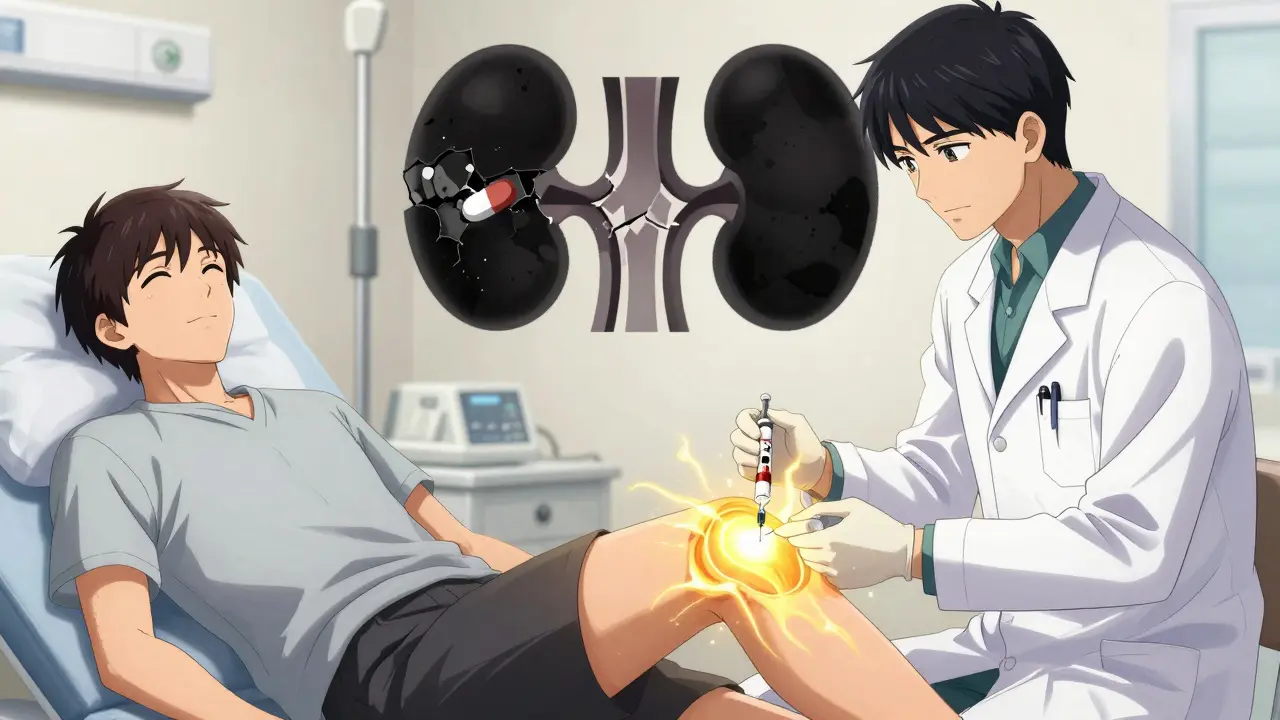
Steroids: The Underused Powerhouse
Steroids-like prednisone-are often the forgotten option. But they’re just as effective as NSAIDs and colchicine, and often safer for people with other health problems.
A 2017 meta-analysis of six trials with over 800 patients found no difference in pain relief between steroids and NSAIDs. But steroids had fewer stomach issues, less kidney stress, and no risk of bleeding. That’s huge for older patients or those on blood thinners.
Oral prednisone usually starts at 40-60 mg a day for a couple of days, then tapers down slowly over 10-14 days. Don’t skip the taper. Stopping suddenly can trigger a rebound flare-worse than the first one.
And here’s the best part: if only one joint is swollen-like your big toe or knee-you can get a steroid injection right into the joint. No pills. No stomach upset. Just direct relief. It’s quick, safe, and often lasts longer than oral meds.
Yes, steroids can raise blood sugar. If you’re diabetic, your doctor will monitor you. But a short course? It’s manageable. Far safer than a GI bleed from an NSAID.
Who Gets Which Treatment?
There’s no universal rule. It’s all about your body.
- If you’re healthy, no kidney or heart issues, and no stomach problems → NSAIDs are fine.
- If you have kidney disease, take statins, or get sick easily from meds → go for low-dose colchicine.
- If you have high blood pressure, heart failure, ulcers, or are on blood thinners → steroids are your best bet.
- If only one joint is affected → ask about the injection.
Some people need more than one. If one drug doesn’t cut it, doctors often add steroids to colchicine, or NSAIDs to steroids. It’s not risky when done right. In fact, it’s common.
And here’s a truth most patients don’t hear: gout isn’t just about flares. It’s a lifelong condition. If you’re on medication to lower uric acid (like allopurinol), you still need to take a low dose of colchicine, NSAIDs, or steroids for at least three to six months afterward. Otherwise, you’ll keep having flares-even as your uric acid drops.
Timing Is Everything
It doesn’t matter which drug you pick if you wait too long. The window for maximum effect is 24 hours. After that, the pain gets harder to control, the swelling lasts longer, and recovery takes more time.
Don’t wait until the next day. Don’t wait until you can get to the pharmacy. If you feel that first twinge, that burning heat, that swelling-you need to act. Keep a starter pack at home: a few colchicine pills, or a prescription for prednisone you can fill quickly. Talk to your doctor now, not when you’re in agony.
What About Cost?
All three options are cheap. Generic naproxen costs less than $5 for a 10-day supply. Colchicine? Often under $10. Prednisone? A few dollars. Insurance covers them all. There’s no financial reason to pick a risky drug over a safer one.
What you save on pills isn’t worth a hospital visit for a bleeding ulcer or kidney failure.
What You Should Do Next
Don’t guess. Talk to your doctor. Bring this list:
- Your current medications (especially blood thinners, statins, or diuretics)
- Your kidney function numbers (eGFR if you know it)
- Any history of ulcers, heart disease, or diabetes
- Which joint is affected
Ask: “Which of these three options is safest for me right now?”
And if you’ve had more than two flares in a year? Ask about long-term uric acid control. Gout isn’t a one-time event. It’s a signal your body is out of balance. Treating the flare is only half the battle.
Oluwatosin Ayodele
December 24, 2025 AT 11:51Colchicine at 1.8 mg total? That’s the only way it’s even tolerable anymore. Back in the day, I took the old 4.8 mg protocol and spent 12 hours hugging the toilet. Now I just pop two 0.6 mg pills an hour apart, and I’m back on my feet. But if you’re on simvastatin? Don’t even think about it without talking to your pharmacist. I nearly ended up in the ER because my doc didn’t check my med list. Lesson learned.
Harbans Singh
December 24, 2025 AT 14:36Really appreciate this breakdown. I’ve been on allopurinol for two years and still had flares until my rheumatologist finally said, ‘You need a low-dose colchicine maintenance.’ I was skeptical, but 0.6 mg every other day? No more midnight toe explosions. Also, steroid injections for my knee last month? Life-changing. No pills, no nausea, just relief. Why isn’t this the first thing everyone hears?
Zabihullah Saleh
December 25, 2025 AT 06:53There’s something deeply human about how we treat gout. We treat it like an emergency, but ignore it as a systemic signal. Uric acid isn’t just a waste product-it’s a metabolic red flag. The fact that we have three effective anti-inflammatories but still treat gout like a one-off pain event says more about our healthcare culture than our pharmacology. We fix the symptom, not the story. And the story? It’s diet, stress, insulin resistance, and decades of processed food. The pill helps, but it’s not the answer. It’s the Band-Aid on a broken bone.
sagar patel
December 25, 2025 AT 14:09NSAIDs are not safe for anyone over 50 period. End of story. I’ve seen three patients with GI bleeds from ibuprofen. One died. Your kidneys don’t care how ‘natural’ you think you are. Stop pretending this is a lifestyle choice. It’s a medical emergency that requires precision. And yes colchicine is dangerous too but at least you can titrate it. NSAIDs are a blunt instrument wielded by people who think Tylenol is a cure for everything
Linda B.
December 25, 2025 AT 20:44Let’s be real-steroids are the pharmaceutical industry’s way of keeping you dependent. They’re suppressing your immune system, not curing anything. And who decides what’s ‘safe’? Big Pharma’s board members. They don’t care about your kidneys. They care about your refill rate. Colchicine? Made from autumn crocus. Ancient remedy. NSAIDs? Synthetic poison disguised as ‘OTC relief.’ The real solution is fasting, alkaline diets, and avoiding all fructose. But you won’t hear that from your ‘doctor’ because he’s paid by the pill.
Christopher King
December 26, 2025 AT 13:20EVERYONE is being manipulated. You think this is about gout? No. It’s about control. The medical-industrial complex needs you to believe you need pills every time your toe swells. But what if the real cure is… silence? No meds. No stress. No carbs. No sugar. No hospitals. Just stillness. I stopped taking everything. Went raw vegan. Meditated for 90 minutes a day. No flares in 14 months. They don’t want you to know this. Because if you heal yourself, they lose power. The system is built on fear. And fear sells pills. I’m not mad. I’m just… awake.
Carlos Narvaez
December 27, 2025 AT 09:30Colchicine’s safety profile is a myth. The dose reduction is cosmetic. Toxicity is cumulative. And if you’re on a statin? You’re playing Russian roulette. The FDA doesn’t regulate drug interactions well enough. Doctors don’t read the insert. Patients don’t ask. And then we wonder why people end up in ICU with rhabdo. This isn’t medicine. It’s guesswork with a stethoscope.
Jason Jasper
December 28, 2025 AT 04:43I’ve had three gout flares in the last year. Started with NSAIDs, then colchicine, then finally a steroid injection. The injection was the only thing that worked fast. I didn’t even need oral meds after that. My doc said it’s underused because it’s ‘invasive’-but it’s literally just a needle. One minute. No recovery. I wish I’d known sooner. If you have one swollen joint? Ask for the shot. No excuses.
Mussin Machhour
December 28, 2025 AT 12:39Just want to say thank you for writing this. I’ve been too scared to ask my doctor about alternatives because I didn’t want to sound ‘difficult.’ But this? This is the kind of info I needed yesterday. I’ve got high blood pressure and a history of ulcers. I’ve been taking ibuprofen like candy because it’s ‘just OTC.’ Now I know I’ve been playing with fire. I’m calling my doctor tomorrow to ask about prednisone. And I’m keeping a starter pack in my medicine cabinet. No more waiting until I can’t walk.
Michael Dillon
December 29, 2025 AT 08:35Yeah but have you tried cherry juice? I’ve been drinking two cups a day for six months. My uric acid dropped 30%. No meds. No side effects. And I’m not even vegan. Also, walking barefoot on grass every morning helps. It’s called grounding. Your body discharges inflammation through the earth. Science? Maybe. But it works. Try it before you swallow another pill.
Winni Victor
December 30, 2025 AT 15:06Colchicine is just a fancy word for ‘poison you can buy at CVS.’ And steroids? Ohhh, they’re ‘safe’ because they don’t bleed your stomach? Please. They turn you into a zombie with moonface and rage. I went on prednisone for 10 days and gained 12 pounds, cried during commercials, and yelled at my cat for breathing too loud. I’d rather have a bleeding ulcer than be that person. Also, who says you can’t just ice it and wait it out? Sometimes the body knows better than the lab results.
Sophie Stallkind
December 31, 2025 AT 17:53Thank you for the meticulously researched and clinically accurate overview. The distinction between acute management and long-term uric acid control is often neglected in patient education. The recommendation to maintain prophylactic anti-inflammatory therapy for three to six months following initiation of urate-lowering therapy is not merely prudent-it is evidence-based and critical to preventing recurrent flares and tophi formation. I encourage all patients to engage in shared decision-making with their providers using this framework.
Katherine Blumhardt
January 2, 2026 AT 06:05OMG I just had a flare and I took ibuprofen and it was like a miracle but now my stomach is screaming and I think I’m dying?? I need to go to the ER?? I’m so scared I’m gonna die from a gout attack?? Also I just ate pizza and I feel guilty 😭😭😭