
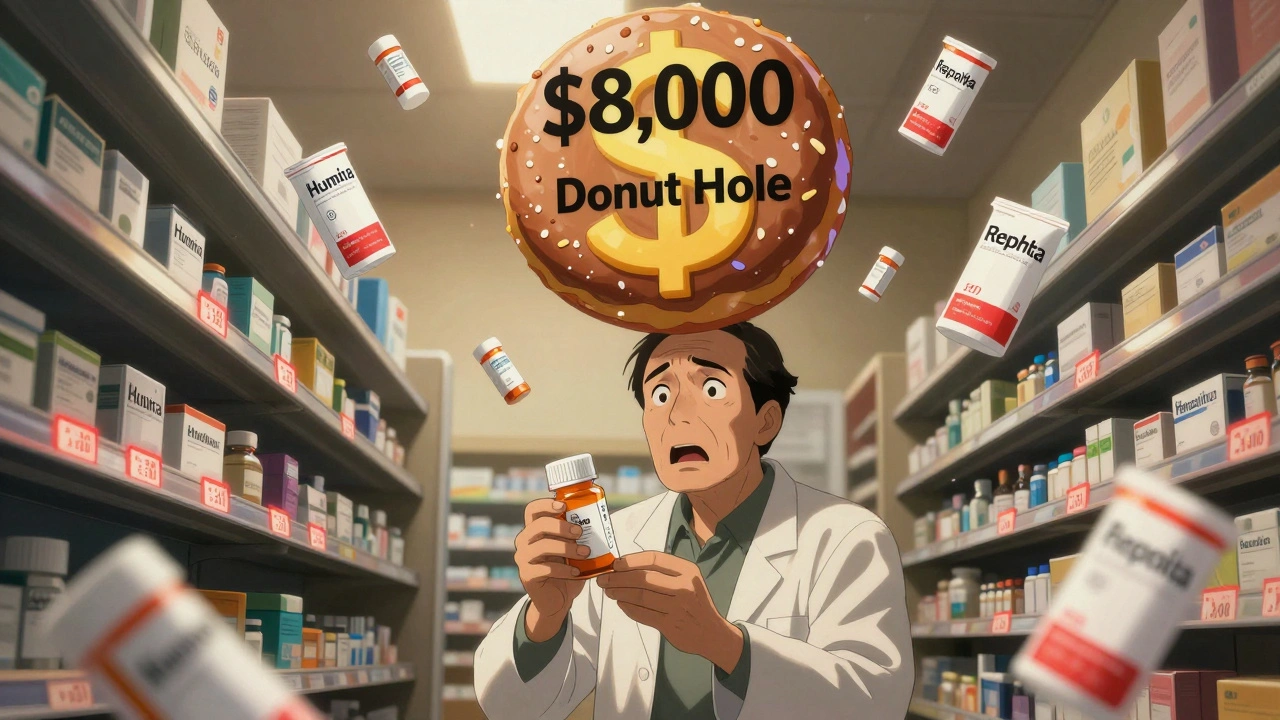
By the end of 2024, millions of Medicare beneficiaries will face a final year of the donut hole-a confusing and costly phase in Medicare Part D where out-of-pocket drug spending spikes after you hit a certain limit. But here’s the good news: starting January 1, 2025, the donut hole is gone for good. The $2,000 annual out-of-pocket cap on prescription drugs will replace it entirely. That means no more surprise bills, no more skipping doses to save money, and no more guessing how much your meds will cost next month.
But if you’re still in the donut hole this year, you need to know how to protect yourself. Even though the system is changing, 2024 is still the last year you’ll have to navigate this gap. And if you’re taking expensive medications-like Humira, Repatha, or other brand-name drugs-you could be spending thousands out of pocket before you reach catastrophic coverage. The good news? There are real, proven ways to cut those costs right now.
How the Donut Hole Actually Works in 2024
Medicare Part D has four phases: deductible, initial coverage, coverage gap (donut hole), and catastrophic coverage. Here’s what that looks like in 2024:
- You pay the full cost of your drugs until you hit your plan’s deductible (up to $590 in 2024).
- Then, your plan pays most of the cost-until your total drug spending (what you + your plan paid) hits $5,030.
- Once you hit $5,030, you enter the donut hole. For the rest of the year, you pay 25% of the cost for both brand-name and generic drugs.
- You stay in the donut hole until your out-of-pocket spending reaches $8,000. Then, you hit catastrophic coverage and pay only a small coinsurance or copay for the rest of the year.
Here’s the twist: the $5,030 total includes manufacturer discounts on brand-name drugs. That means if you take a $1,000 brand-name drug, the $700 discount the drug company gives counts toward your $8,000 out-of-pocket limit. So you reach catastrophic coverage faster if you’re on expensive brand-name meds. If you’re on generics, you’ll spend more out of pocket before getting out of the gap.
That’s why two people on the same plan can have wildly different experiences. One might spend $3,300 out of pocket to get out of the donut hole. Another might spend $6,000. That’s not a typo. It’s the math.
Who Gets Hit Hardest-and Why
People taking one or two expensive brand-name drugs are the ones who get crushed. Think rheumatoid arthritis, multiple sclerosis, or cancer treatments. A 2023 survey by the Medicare Rights Center found that 68% of beneficiaries who entered the donut hole had to change how they took their meds. About one in three skipped doses. One in five split pills. One woman on Reddit shared that she was paying $1,200 a month for Humira during the gap. She had to choose between her medication and buying groceries.
But here’s the thing: you don’t have to be one of them. Many people who hit the donut hole didn’t even know it was coming. AARP’s 2023 survey found that 74% of beneficiaries didn’t learn about cost-saving options until they were already in the gap. That’s too late.
5 Proven Ways to Slash Your Drug Costs Before 2025
1. Check Your Drug’s Tier and Switch to Generics
Your plan puts drugs into tiers. Tier 1 is cheapest. Tier 4 or 5 is most expensive. If you’re on a Tier 4 brand-name drug, ask your doctor if a generic version works just as well. For example, the generic for Humira (adalimumab) is now available and costs about 80% less. GoodRx estimates switching from brand to generic can save you $1,200 to $2,500 a year. That’s more than your monthly rent in some places.
Don’t assume your doctor knows the latest generics. Ask: “Is there a generic version of this drug? Is it covered at a lower cost?” If they say no, ask for a prior authorization form. Many insurers approve generics if you show cost savings.
2. Use Manufacturer Patient Assistance Programs
Big drug companies have programs to help people who can’t afford their meds-even if you’re on Medicare. These aren’t charity. They’re required by law to offer discounts during the donut hole. For brand-name drugs, the manufacturer pays 70% of the cost during the gap. But you have to sign up.
For example, Amgen’s Repatha program reduces monthly costs from $560 to $5. AbbVie’s Humira program cuts costs by 80%. You can find these programs by searching “[drug name] + patient assistance program” or visiting NeedyMeds.org. Some require income verification. Others just need your Medicare number and a doctor’s note. It takes 10 minutes to apply. It could save you $6,000 a year.
3. Get 90-Day Supplies Through Mail Order
Most Medicare Part D plans offer discounts for 90-day supplies through mail-order pharmacies. Instead of paying a $50 copay every 30 days, you pay $120-$130 for three months. That’s a 15-25% savings. And if you’re near the donut hole threshold, spreading out your refills can delay when you hit it.
Example: If you take a drug that costs $200/month, you pay $50 per 30-day fill. That’s $600 in 90 days. With mail order, you pay $140 for 90 days. That’s $160 saved. Do that for three drugs? You’re saving $500 a year just by switching delivery.
4. Apply for Extra Help (Low-Income Subsidy)
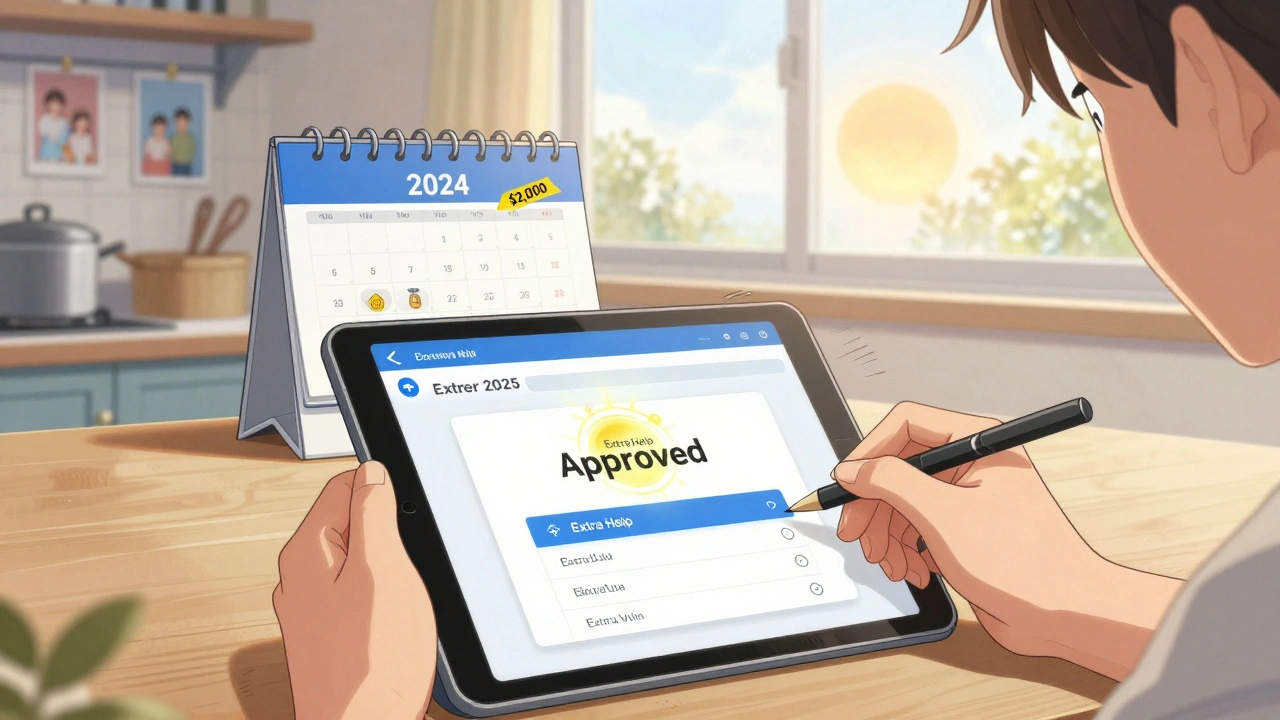
If your income is under $21,590 (individual) or $29,170 (couple) in 2024, you may qualify for Extra Help. This program pays your Part D premiums, deductibles, and copays-and it eliminates the donut hole entirely. You don’t have to wait for the 2025 change. Apply now.
12.6 million people qualified for Extra Help in 2023. But only about half applied. Why? Many think they make too much. Others don’t know it exists. You can apply online at SSA.gov or call 1-800-MEDICARE. It takes 15 minutes. If approved, your drug costs drop overnight.
5. Use the Medicare Plan Finder to Switch Plans
Every year during Open Enrollment (October 15-December 7), you can switch Part D plans. If your meds are expensive, your plan matters more than your doctor’s recommendation. Two plans might cover the same drug-but one charges $100 a month and the other charges $15. That’s $600 a year difference.
Go to Medicare.gov/PlanFinder. Enter your drugs, doses, and pharmacy. Sort by “lowest total cost.” You might be surprised. NCOA found that beneficiaries who use this tool save an average of $1,047 a year. Don’t just keep the plan you’ve had for five years. Check it every year.
What Changes in 2025-and How to Prepare
Starting January 1, 2025, the donut hole disappears. You’ll pay up to $2,000 out of pocket for all your Part D drugs in a year. After that, your medications are free. That’s it. No more tiers, no more gaps, no more confusing math.
But here’s what you need to do now:
- Read your 2024 Annual Notice of Change (sent in September). It tells you how your plan is changing.
- Compare your 2024 costs to the new $2,000 cap. If you’re already spending close to $2,000, you’re in good shape.
- Don’t assume your premiums will drop. Some plans may raise them slightly to offset the loss of manufacturer discounts.
- Keep using manufacturer programs-they’ll still be around, but the discounts will change. In 2025, manufacturers pay 10% during initial coverage and 20% during catastrophic coverage.
Experts say the $2,000 cap will cut prescription abandonment by 18-22%. That means fewer hospital visits, fewer ER trips, and better health outcomes. It’s not just a cost cut-it’s a health win.

What to Do Right Now
If you’re in the donut hole this year:
- Make a list of every drug you take, including dose and frequency.
- Go to NeedyMeds.org and search each drug for patient assistance programs.
- Call your pharmacy and ask if you can switch to a 90-day supply.
- Check if you qualify for Extra Help at SSA.gov.
- Use Medicare.gov/PlanFinder to compare plans for 2025.
Don’t wait until you’re out of pills to act. The donut hole isn’t a glitch. It’s a trap. And millions of people have fallen into it because they didn’t know how to escape. You don’t have to be one of them.
Final Thought: You’re Not Alone
Medicare Part D was never meant to make people choose between medicine and rent. The donut hole was a flaw in the design-and now it’s being fixed. But until January 1, 2025, you have to play the game smart. Use the tools. Ask the questions. Apply for help. Your health isn’t optional. Neither are your meds.
What is the Medicare Part D donut hole in 2024?
The Medicare Part D donut hole is a coverage gap that begins after you and your plan have spent $5,030 on covered drugs in 2024. During this phase, you pay 25% of the cost for both brand-name and generic drugs. The gap ends when your out-of-pocket spending reaches $8,000, after which you enter catastrophic coverage and pay much less.
Will the donut hole still exist in 2025?
No. Starting January 1, 2025, the donut hole will be eliminated. Medicare Part D will have a $2,000 annual out-of-pocket cap on prescription drugs. Once you hit that limit, your medications will be free for the rest of the year.
How can I save money on brand-name drugs during the donut hole?
Apply for the manufacturer’s patient assistance program. Most drugmakers offer discounts of 70% or more during the coverage gap. You can also switch to a generic version if your doctor approves it. Both options can cut your monthly costs by hundreds or even thousands of dollars.
Does Extra Help eliminate the donut hole?
Yes. If you qualify for Extra Help (Low-Income Subsidy), you won’t enter the donut hole at all. Your copays will be low or $0 throughout the year, and you’ll get help paying your Part D premiums. Income limits for 2024 are $21,590 for individuals and $29,170 for couples.
Should I switch Medicare Part D plans every year?
Yes, if you take prescription drugs. Your plan’s formulary and costs change every year. Using the Medicare Plan Finder tool each fall can save you over $1,000 annually. Don’t stay with the same plan just because you’ve had it for years.
Can I use mail-order pharmacies to avoid the donut hole?
You can’t avoid the donut hole entirely, but getting 90-day supplies through mail order can reduce your monthly out-of-pocket spending. This can help you stretch your spending over more months, potentially delaying when you enter the gap. It also saves you 15-25% on copays.
olive ashley
December 7, 2025 AT 00:25Priya Ranjan
December 8, 2025 AT 04:39Gwyneth Agnes
December 8, 2025 AT 07:07Akash Takyar
December 9, 2025 AT 13:26brenda olvera
December 10, 2025 AT 20:19Myles White
December 11, 2025 AT 02:00Ibrahim Yakubu
December 11, 2025 AT 20:12Chris Park
December 13, 2025 AT 05:38Saketh Sai Rachapudi
December 14, 2025 AT 07:36joanne humphreys
December 14, 2025 AT 12:43Nigel ntini
December 15, 2025 AT 07:31