
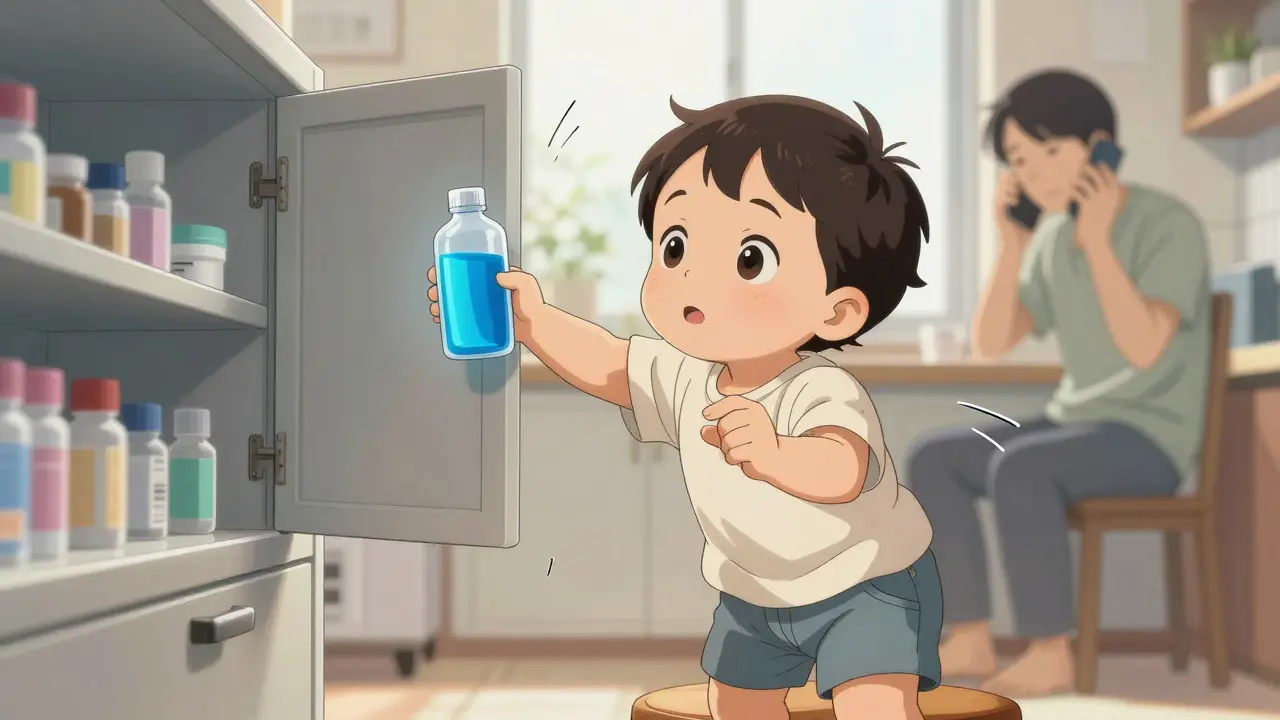
Every year, over 50,000 children under the age of five end up in emergency rooms because they swallowed medicine they weren’t supposed to. Most of these incidents don’t happen because a parent was careless-they happen because a caregiver turned their back for just a few seconds. A toddler climbs onto the counter to reach a purse left on the edge. A grandparent leaves their pills on the nightstand. A parent pours liquid Tylenol into a kitchen spoon because the measuring cup is in the sink. These aren’t rare mistakes. They’re common, preventable tragedies.
Most Poisonings Happen at Home-And Often When Adults Are Around
It’s not the locked cabinet that fails. It’s the assumption that it’s enough. According to Hassenfeld Children’s Hospital at NYU Langone Health, more than 90% of medication poisonings in kids happen inside the home. And here’s the hard truth: in most cases, an adult was right there. Someone was handing out medicine, answering a phone, or loading the dishwasher. In the time it takes to say, “Just one minute,” a child has reached a pill bottle, opened it, and swallowed.
Children between 1 and 5 years old are the most at-risk group, making up nearly two-thirds of all cases. Their curiosity is unstoppable. They mimic adults. They see medicine as something adults take, so it must be safe-or even tasty. That’s why calling pills “candy” is one of the most dangerous habits parents don’t even realize they have. Studies show kids who hear medicine called candy are over three times more likely to take it without asking.
Lock It Up-Not Just Out of Reach
Storing medicine on a high shelf isn’t enough. Toddlers as young as 18 months can climb onto chairs, pull themselves up on countertops, and use the toilet as a step stool. The American Academy of Pediatrics says safety latches on cabinets should be automatic-meaning they lock when the door closes. But even those can be tricked. A child who’s watched you open the cabinet 100 times will figure out how to do it.
Here’s what actually works: install magnetic locks on cabinets at least 54 inches above the floor. That’s beyond the reach of most toddlers. And don’t just lock the bathroom cabinet. Lock the kitchen cabinet. Lock the bedroom cabinet. Lock the one in the living room where Grandma keeps her blood pressure pills. If it’s a medicine, it goes in a locked box.
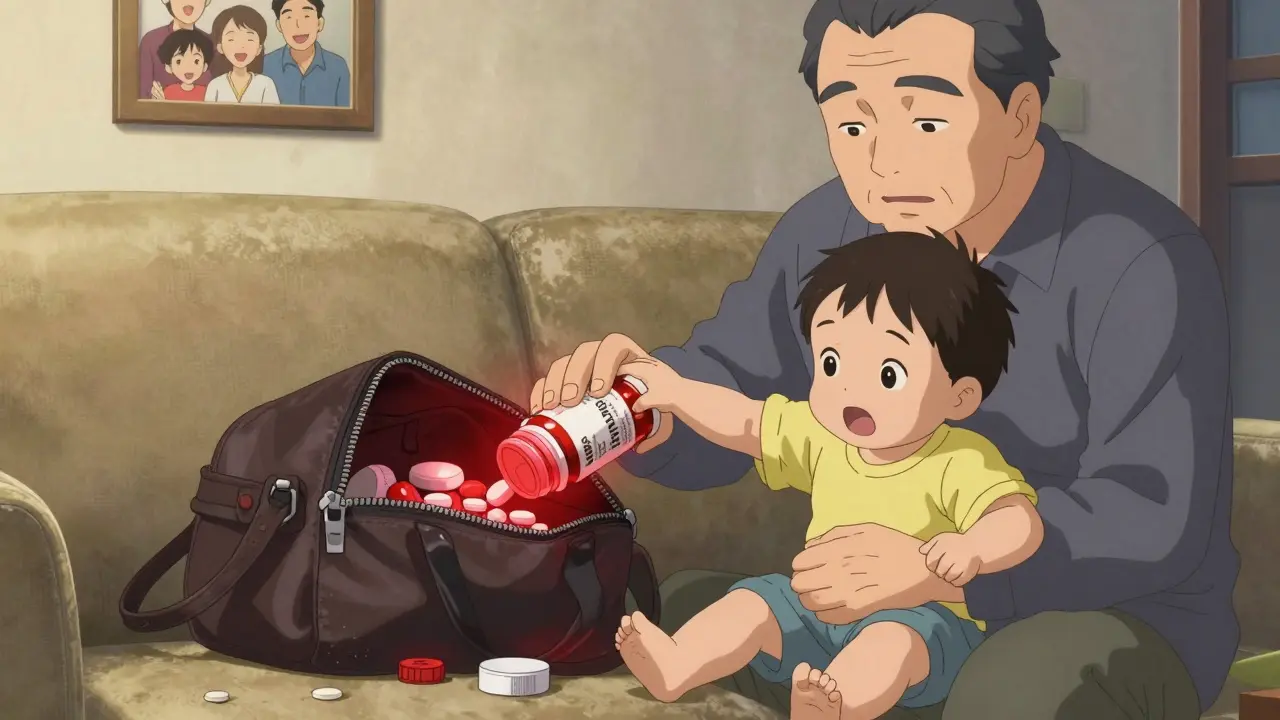
And never store medicine in purses, coats, or bedside tables. A 2022 study from Nationwide Children’s Hospital found that 30% of poisonings come from visitors’ belongings. Grandparents, aunts, uncles-they come over, drop their bag on the couch, and leave a bottle of ibuprofen inside. Within minutes, a child has found it.
Keep It in the Original Container
Transferring pills into a pill organizer, a candy jar, or a Tupperware container might seem convenient. But it’s a huge risk. Nationwide Children’s Hospital reports that 25% of poisoning cases involve medicine that was moved out of its original packaging. Why? Because kids don’t recognize the container. They see a jar of blue pills and think, “Yummy.”
Original bottles have child-resistant caps, warning labels, and dosage instructions. Even if the cap isn’t perfect, it’s still a barrier. And if something goes wrong, emergency responders need to know exactly what was taken. A jar labeled “vitamins” doesn’t help them. A bottle with “Acetaminophen 160 mg/5 mL” does.
Medicines That Kill Fast-And How to Spot Them
Not all medicines are equally dangerous. The top three killers in young children are acetaminophen (Tylenol), ibuprofen (Motrin, Advil), and aspirin. But the real silent threat? Liquid nicotine from e-cigarettes.
Just half a milliliter of concentrated nicotine can stop a toddler’s breathing. That’s less than a teaspoon. If you use vaping products, store them in the same locked cabinet as your pills. Don’t keep them on the counter, even if you think they’re “just for you.”
Also watch out for liquid medications with bright colors or sweet flavors. Many cough syrups, antihistamines, and sleep aids taste like grape or bubblegum. That’s not a feature-it’s a hazard.
Never Use a Kitchen Spoon to Measure Medicine
Over two-thirds of medication errors in kids come from wrong dosing. And nearly half of those happen because parents use kitchen spoons. A teaspoon from your drawer isn’t the same as a teaspoon from a medicine cup. Studies show household spoons vary by 20% to 40% in volume. That means you could be giving your child 40% too much-or too little.
Always use the measuring tool that comes with the medicine. It’s usually a syringe or a plastic cup with milliliter markings. If you lost it, go to the pharmacy and ask for a new one. They’ll give it to you for free. And if you’re ever unsure how much to give, call your pediatrician. Don’t guess.
Watch for the Silent Danger: Distraction
UCSF Benioff Children’s Hospital found that 40% of poisoning incidents happen while a parent is actively using the medicine. They’re pouring liquid into a cup, then turn to answer the door. Or they’re holding the syringe, then get distracted by a crying baby. In that moment, the medicine is left unattended-and a child grabs it.
Here’s the rule: never leave medicine in your hand or on a surface while you’re multitasking. Put it down only after you’ve capped it, locked it away, and walked away. Even if you’re just stepping into the next room, lock it first.
See the World Through Your Child’s Eyes
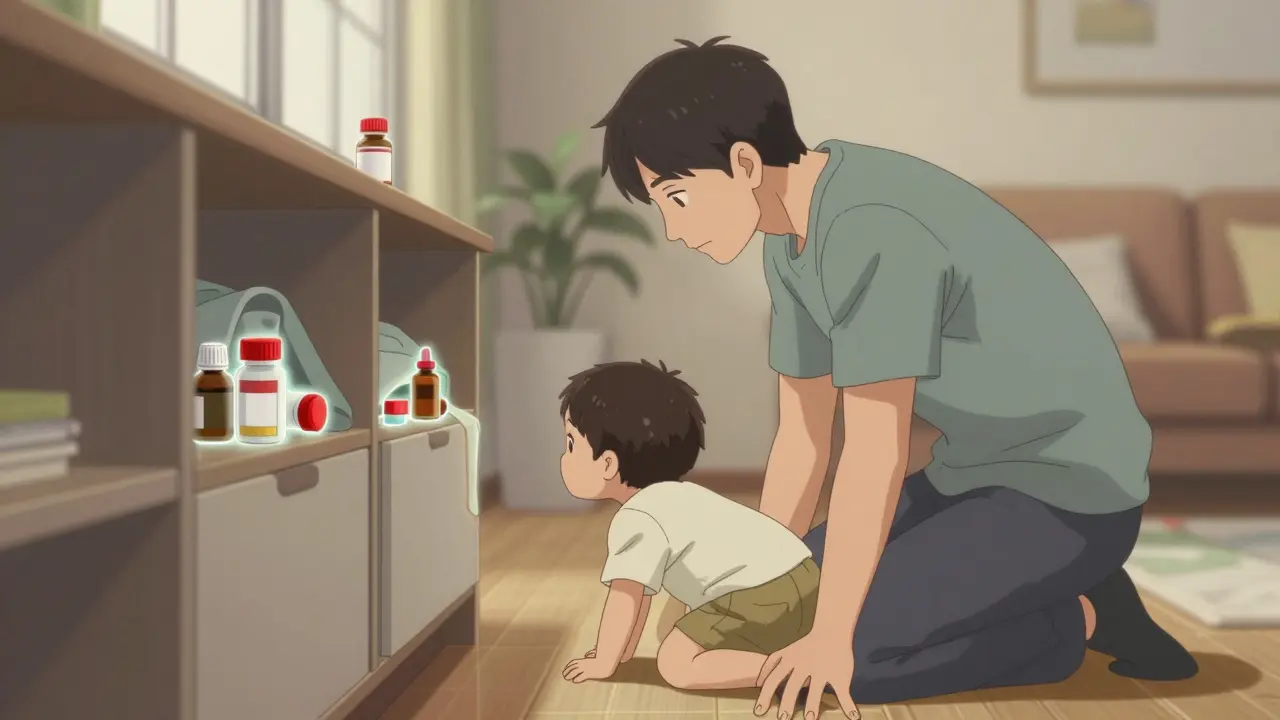
Get down on your hands and knees. Crawl through every room in your house. Look at your cabinets, shelves, drawers, and tables from a toddler’s height. What do you see? Is there a bottle peeking out of a purse on the chair? Is the medicine cabinet just a little too easy to open? Are there bottles on the windowsill where the cat sits?
Children don’t think like adults. They don’t understand “danger.” They see things at their eye level-and they reach for them. A 2022 report from the Rural Health Information Hub found that 78% of poisonings involve items stored below 4 feet. That’s the average reach of a 2-year-old.
Post the Poison Help Number-Everywhere
When a child swallows something they shouldn’t, seconds matter. The Poison Help hotline (1-800-222-1222) is staffed 24/7 by trained specialists who can tell you exactly what to do. You don’t need to wait for symptoms. You don’t need to call 911 first. Just call them.
Put the number on your refrigerator, next to your phone, on the inside of your medicine cabinet, and on your child’s daycare bulletin board. Homes with visible postings reduce emergency response time by nearly half. And if you’re ever unsure whether it’s an emergency, call anyway. Poison Control handles over 2 million calls a year. They’ve seen it all.
Teach Your Child: Medicine Is Not Candy
Start early. Even if your child is just learning to talk, repeat this: “Medicine is not candy. Only grown-ups give medicine.” Use simple words. Show them the difference between a snack and a pill. Make it a routine: “This is for your earache. This is for your tummy. This is not for eating.”
And don’t wait until they’re old enough to understand. Children as young as 18 months can learn boundaries. The more consistent you are, the less likely they are to reach for a bottle.
Plan Ahead for Growth Spurts
Children develop fast. What was safe last month won’t be safe next month. If your child just learned to pull up, they’ll be climbing in a few weeks. If they’re starting to open drawers, they’ll be unlocking cabinets soon after.
Don’t wait for a crisis to secure your home. Anticipate the next milestone. Three months before your child starts walking, check your storage. Six months before they start climbing on furniture, install magnetic locks. Prevention isn’t a one-time task. It’s an ongoing adjustment.
What to Do If Your Child Swallows Medicine
Stay calm. Don’t wait for symptoms. Don’t try to make them vomit. Don’t give them milk or water unless instructed.
Call Poison Control immediately at 1-800-222-1222. Have the medicine bottle with you. Tell them what was taken, how much, and when. They’ll guide you step by step. In many cases, they’ll tell you to stay home. In others, they’ll tell you to go to the ER.
Keep your child’s CPR and Heimlich maneuver skills up to date. Twelve percent of severe poisoning cases need immediate action before help arrives. Knowing how to respond could save their life.
Community Help Is Available
You don’t have to do this alone. Many pharmacies offer free medication lock boxes to families with young children. Nationwide Children’s Hospital found that households using these boxes saw a 41% drop in accidental access.
Check with your local pharmacy, pediatrician’s office, or public health department. Some even offer home safety visits. And if you live in a rural area, where emergency response times are longer, these tools are even more critical. Rural households have 22% higher rates of severe poisoning incidents.
What’s Next? Smarter Medicine Storage
Technology is starting to catch up. Pilot programs are testing smart pill bottles that send alerts to your phone if the cap is opened. Some can track when doses are taken and warn you if a child accesses the bottle. Early results show a 63% drop in unsupervised access.
These aren’t science fiction-they’re coming soon. But right now, the best tool is still simple: lock it, store it high, keep it in the original bottle, and never, ever call it candy.
Ian Long
January 8, 2026 AT 05:13Y’all are gonna hate this but I’ve seen it too many times - grandma leaves her blood pressure meds on the nightstand, kid grabs ‘em, and boom. No one’s evil, no one’s negligent… it’s just how human brains work. We assume safety because we’ve never had an incident. That’s the trap. Lock everything. Even the ‘harmless’ stuff. I locked my own vitamins. Yeah, really.
Matthew Maxwell
January 8, 2026 AT 11:51It is profoundly irresponsible to suggest that storing medication in a locked cabinet is insufficient without specifying the exact type of magnetic lock mechanism. The American Academy of Pediatrics does not endorse ‘magnetic locks’ as a standard. This article is dangerously misleading. Proper child-resistant caps, certified by the Consumer Product Safety Commission, are the only legally recognized standard. Any deviation from this constitutes negligence.
Lindsey Wellmann
January 10, 2026 AT 04:45OK but can we talk about how terrifying it is that my 2yo just opened my purse last week and pulled out a bottle of melatonin? 😱 I screamed so loud the dog ran under the bed. I immediately got those magnetic locks, bought a lockbox, and now I treat my meds like a nuclear launch code. 💣💊 I even put a ‘NOT CANDY’ sticker on the bottle. My kid points at it now and says ‘NO!’ 😭😭😭
Ashley Kronenwetter
January 12, 2026 AT 02:54This is an excellent, meticulously researched guide. The emphasis on original packaging and the dangers of liquid nicotine is particularly vital. I have distributed printed copies to all new parents in my prenatal support group. Prevention is not optional - it is a moral obligation. Thank you for this.
Aron Veldhuizen
January 12, 2026 AT 02:56You’re all missing the real issue. The problem isn’t the medicine. It’s the cultural delusion that children are ‘curious’ or ‘innocent’ when they reach for pills. They’re not. They’re testing boundaries. And you’re training them to do it by treating medicine like a mystery box. The real solution? Never let them see you take it. Never. Not even once. If they never associate pills with adults, they won’t want them. It’s behavioral psychology 101 - and you’re all too busy locking cabinets to see the root cause.
Heather Wilson
January 13, 2026 AT 13:4590% of poisonings happen at home? Shocking. But let’s be real - most of these parents are just lazy. If you can’t be bothered to lock a cabinet, why are you allowed to have kids? The fact that this is even a conversation is a national failure. Also, ‘call Poison Control’ is not a solution. It’s damage control. Prevention requires discipline. And discipline requires sacrifice. Most people don’t want to sacrifice convenience. So they gamble with their child’s life. Sad.
Micheal Murdoch
January 13, 2026 AT 15:31Let me tell you something - I used to be the guy who left my Tylenol on the counter. Then my nephew came over, grabbed a bottle of children’s ibuprofen, and swallowed three doses. We got lucky - he was fine. But I haven’t slept the same since. I don’t just lock my meds anymore. I lock everything. My vitamins, my CBD oil, even my wife’s birth control. I put them in a locked box in the garage. It’s not about being paranoid. It’s about being human. And if you’re not doing this, you’re not thinking like a parent - you’re thinking like a person who hasn’t been broken yet.
Jeffrey Hu
January 14, 2026 AT 14:05Everyone’s talking about magnetic locks, but no one’s talking about the fact that 18-month-olds can open child-resistant caps if they’ve seen it done enough times. The real solution? Smart bottles. The ones that beep when opened. I bought one last month. It’s $45. It’s worth it. Also, don’t use syringes - they leak. Use the dosing cups with the spout. And stop using kitchen spoons. I’ve measured 10 different spoons. The difference between a ‘teaspoon’ and a ‘tablespoon’? 40% of the time, you’re giving a lethal dose.
Drew Pearlman
January 15, 2026 AT 10:06I know this sounds cheesy, but I started putting a little note on every medicine bottle: ‘This is not candy. I love you.’ I say it out loud every time I give my daughter her medicine. She’s 2. She doesn’t talk much yet… but she looks at the bottle, then at me, then gives me a hug. I cried. Not because she understands - but because I finally realized I’m not just giving her medicine. I’m teaching her what safety looks like. And that’s the most powerful thing I can do.
Meghan Hammack
January 16, 2026 AT 03:25My cousin’s kid took a whole bottle of liquid Benadryl because it tasted like grape soda. She’s in the hospital right now. The ER doc said if they’d waited 10 more minutes, she wouldn’t have made it. I just got a lockbox today. I’m putting all my meds in it. Even the ones I don’t take. I don’t care if it’s ‘just aspirin.’ I don’t care if it’s ‘just for me.’ I’m not risking it. Not again. Ever.
RAJAT KD
January 17, 2026 AT 02:34Lock it. Store high. Never call it candy. Simple. Done. Why is this so hard to follow?
Darren McGuff
January 17, 2026 AT 16:33I’m a pharmacist in Manchester. We hand out free lockboxes to parents with kids under 5 - no questions asked. Last month, a mum came in crying because her toddler got into her insulin. She didn’t know it was dangerous. We gave her the box, showed her how to use it, and now she’s our most vocal advocate. It’s not about fear. It’s about giving people the tools to protect what they love. And yes - it works. 41% drop, like the study says. Don’t wait for tragedy. Just do it.