
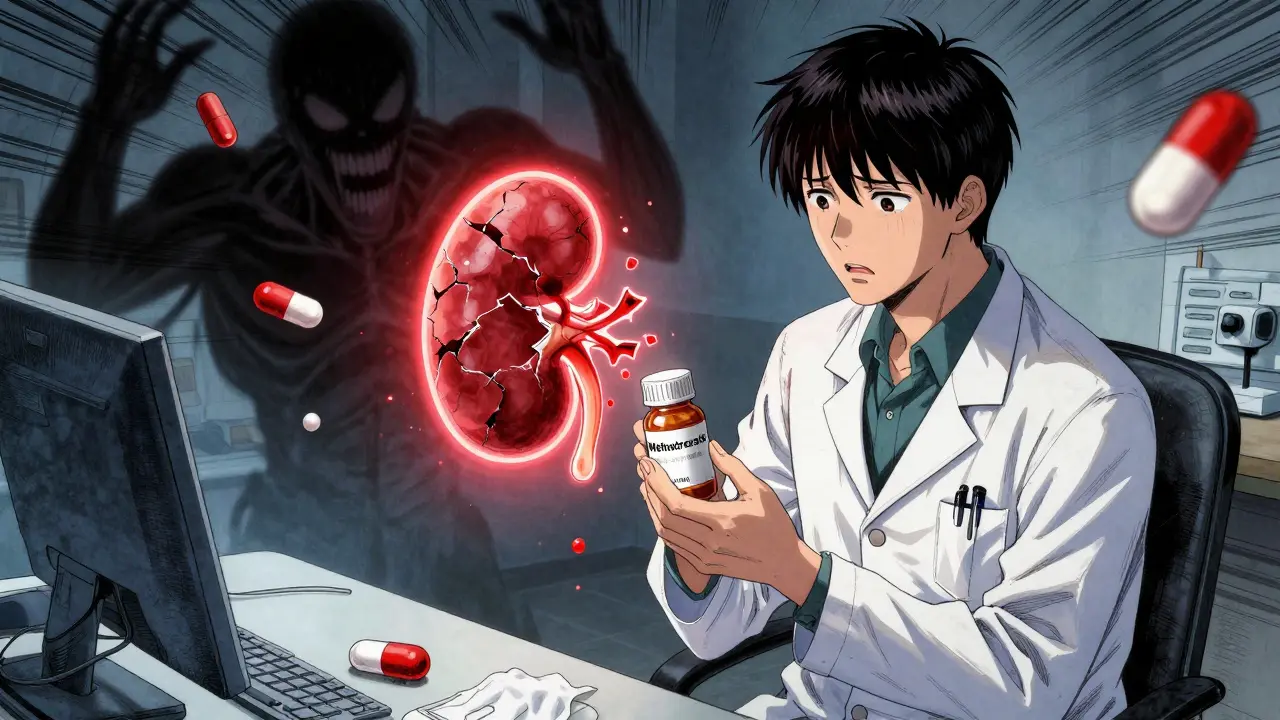
Methotrexate-NSAID Risk Calculator
Risk Assessment
This tool helps you understand your risk of kidney toxicity when taking methotrexate with NSAIDs based on clinical guidelines.
Your Risk Assessment
Risk Factors Identified:
When you're managing rheumatoid arthritis with methotrexate, pain relief shouldn't come at the cost of your kidneys. Mixing common painkillers like ibuprofen or naproxen with methotrexate can push drug levels into dangerous territory-sometimes without warning. This isn't theoretical. Real patients end up in the hospital because their kidney function dropped suddenly, and no one checked.
How Methotrexate Works and Why It's Fragile
Methotrexate is a drug that stops cells from making DNA and RNA. At low doses-usually 5 to 25 mg once a week-it calms down the immune system in rheumatoid arthritis. At high doses, it kills fast-growing cancer cells. But here’s the catch: your body gets rid of methotrexate almost entirely through your kidneys. If your kidneys slow down, even a little, methotrexate builds up. And that buildup can be deadly.
At low doses, methotrexate clears from your blood in about 3 to 10 hours. But if your kidneys aren't working well, that half-life can stretch to 15 hours or more. And methotrexate doesn’t clear in a straight line-it follows nonlinear kinetics. That means once your kidneys get overwhelmed, clearance drops fast. A small drop in kidney function doesn’t just slow things down-it can cause a sudden, sharp rise in drug levels.
NSAIDs Don’t Just Mask Pain-They Block Kidney Protection
NSAIDs like ibuprofen, naproxen, and diclofenac work by blocking enzymes called COX-1 and COX-2. That reduces inflammation and pain. But those same enzymes help your kidneys maintain blood flow. When NSAIDs block them, your kidneys get less blood. Studies show renal blood flow drops by 15-20% within hours of taking an NSAID.
This is bad news for methotrexate. Less blood flow means less drug gets filtered out. On top of that, NSAIDs compete with methotrexate for the same transporters in the kidney tubules. It’s like two cars trying to get through a single toll booth-methotrexate gets stuck. Research shows this can reduce methotrexate clearance by 25-40%. In some cases, blood levels spike by 50%.
And it’s not just about blood flow. NSAIDs can also knock methotrexate off proteins in your blood, freeing up more of the active drug. One study found free methotrexate levels rose by up to 30% when NSAIDs were added. That’s like turning up the volume on a drug you already can’t clear properly.
High-Dose vs. Low-Dose: Big Difference in Risk
Not all methotrexate use is the same. The risk changes dramatically depending on the dose.
If you’re on high-dose methotrexate-think 500 mg/m² or more for cancer treatment-adding an NSAID is a red flag. A 2022 meta-analysis found the risk of life-threatening toxicity jumps 4.7 times. There are documented cases of patients dying from kidney failure and bone marrow shutdown after combining these drugs. The FDA and EMA both warn: avoid NSAIDs completely during high-dose therapy unless there’s no other option-and even then, you need daily blood tests for 72 hours.
For low-dose methotrexate (25 mg or less weekly), the story is more nuanced. A 2021 review in Rheumatology found no major increase in serious side effects in patients with normal kidney function. But that’s only if your kidneys are healthy. If your eGFR is below 60 mL/min/1.73m²-meaning you already have mild to moderate kidney impairment-the risk of kidney injury triples. And here’s the scary part: many people don’t know their kidney function is low until it’s too late.

Some NSAIDs Are Safer Than Others
Not all NSAIDs are created equal when it comes to methotrexate interactions.
- Ketorolac is the worst offender. It’s a potent kidney blood flow blocker and can push methotrexate levels up by 50%. It’s rarely used long-term, but even a single dose can be dangerous.
- Ibuprofen and naproxen are common and increase methotrexate levels by 25-30%. They’re often prescribed for arthritis pain, but they’re not safe just because they’re over-the-counter.
- Diclofenac has a similar profile to ibuprofen and carries the same risks.
- Celecoxib, a COX-2 selective inhibitor, shows the lowest interaction risk-around 10-15% increase in methotrexate levels. It’s not risk-free, but it’s the least likely to cause trouble among NSAIDs.
That’s why some doctors will suggest celecoxib over ibuprofen for patients on methotrexate. But even celecoxib isn’t a green light-it still affects kidney blood flow.
Who’s Most at Risk?
You’re at higher risk if you:
- Are over 65
- Have diabetes, high blood pressure, or heart failure
- Already have reduced kidney function (eGFR below 60)
- Take other kidney-affecting drugs like diuretics or ACE inhibitors
- Have the SLC19A1 80G>A genetic variant (found in about 15% of Caucasians)
One study found that 78% of serious methotrexate-NSAID reactions happened in people who hadn’t had a kidney test in the past 30 days. That’s not a coincidence. It’s a system failure.
What the Experts Say
There’s disagreement among top rheumatologists. Dr. Joan Kremer from Thomas Jefferson University says short-term, low-dose NSAIDs like ibuprofen can be used cautiously in healthy patients-just monitor closely. Dr. Daniel Furst from UCLA says no NSAIDs at all for anyone over 65 or with any kidney issue. Both are right, depending on the patient.
The American College of Rheumatology says: avoid NSAIDs if eGFR is below 60. The European League Against Rheumatism says: avoid them entirely in older adults or those with any kidney impairment. The FDA label says NSAIDs may reduce methotrexate clearance. The EMA says: monitor levels for 72 hours if you must use them.
The bottom line? No one disagrees that the risk is real. They just disagree on how strict to be.
Real Patient Stories
On Reddit, a user named RAWarrior2020 wrote: "My rheumatologist prescribed naproxen without checking my kidney function. Three days later, my white blood cell count crashed to 1.8. I needed leucovorin to survive."
Another user, MTXandMe, said: "I’ve taken 15 mg methotrexate weekly with occasional ibuprofen for 8 years. No issues. But my doctor checks my creatinine and CBC every 4 weeks. That’s the difference."
A 2022 Arthritis Foundation survey found that 41% of patients who took NSAIDs with methotrexate without monitoring had an adverse event. Only 9% did when their labs were tracked regularly.
These aren’t outliers. They’re symptoms of a gap in care.
How to Stay Safe
If you’re on methotrexate and need pain relief, here’s what actually works:
- Check your kidney function before starting any NSAID. Get an eGFR test. If it’s below 60, don’t take NSAIDs.
- Use the lowest dose for the shortest time. If you need it for a flare, take it for 3-5 days max.
- Space out the doses. Take methotrexate on your chosen day, then wait at least 12 hours before taking an NSAID. This reduces peak overlap.
- Monitor bloodwork after starting NSAIDs. Get a creatinine and complete blood count 48-72 hours after your first NSAID dose.
- Consider alternatives. Acetaminophen (up to 3,000 mg/day) is generally safe. Low-dose opioids for short-term use, or better disease control with DMARDs like sulfasalazine or hydroxychloroquine, can reduce the need for painkillers altogether.
Pharmacists can be your best defense. A 2023 study showed pharmacist-led interventions cut interaction rates by 63% in Medicare patients. Ask your pharmacist to review your meds every time you pick up a prescription.
What’s Coming Next
Researchers are looking at genetic testing. If you carry the SLC19A1 80G>A variant, you’re more likely to build up toxic levels of methotrexate when taking NSAIDs. That test isn’t routine yet-but it’s coming.
Point-of-care methotrexate level tests are in phase 3 trials. Imagine a simple blood prick at your doctor’s office that tells you your methotrexate level in under an hour. That could change everything for people who need pain relief but can’t risk kidney damage.
For now, the safest approach is simple: don’t assume it’s safe. Don’t assume your doctor knows. Ask: "Is this NSAID safe with my methotrexate? Have you checked my kidney function?"
This interaction kills. But it doesn’t have to.
Rachel Kipps
February 3, 2026 AT 07:26I had no idea NSAIDs could mess with methotrexate like that. My doctor just said "take what you need" for pain. I’m gonna call and ask for a kidney test tomorrow. Thanks for laying this out.
Wendy Lamb
February 4, 2026 AT 13:31Check your eGFR. Always. If you’re on methotrexate, it’s not optional. It’s baseline care.
Katherine Urbahn
February 5, 2026 AT 21:44Let me be perfectly clear: anyone who prescribes NSAIDs to a methotrexate patient without checking renal function first is either grossly negligent or criminally ignorant. The FDA has warned about this for over a decade. This isn't "maybe dangerous"-it's a documented, preventable catastrophe. And yet, people still do it. I'm not mad-I'm just disappointed in the entire medical system.
Jesse Naidoo
February 6, 2026 AT 05:50I’ve been on methotrexate for 12 years and I’ve taken ibuprofen every time I get a headache. I’m fine. So why are you all acting like I’m gonna drop dead? Are you scared of pain? Or just scared of doctors? I don’t need a lecture-I need relief.
Sherman Lee
February 6, 2026 AT 21:52They’re hiding the truth. NSAIDs aren’t the problem-pharma is. They want you dependent on more expensive drugs. Celecoxib? That’s just a rebranded poison with a fancy name. And that "genetic test"? They’re gonna charge you $800 for it next year. Wake up. 🤫💊
Zachary French
February 8, 2026 AT 16:04Let me just say-this entire thread is a masterclass in medical overreach. Methotrexate is a poison. NSAIDs are a nuisance. And yet, we’ve turned a simple pain management decision into a 3,000-word op-ed. I’ve taken both for years. I’m alive. My kidneys are fine. Maybe your doctor is just bad. Maybe you’re just anxious. Maybe-just maybe-you don’t need to be terrified of every pill you swallow.
Daz Leonheart
February 9, 2026 AT 13:38Hey. I’ve been there. Took ibuprofen for months, didn’t get tested. Then my numbers dropped. Scared the hell out of me. But I listened. Got the eGFR, switched to acetaminophen, and now I’m stable. You can do this. One step at a time. You’re not alone.
Harriot Rockey
February 9, 2026 AT 14:49My rheumatologist finally started checking my labs every 6 weeks after I asked. Game-changer. 🙌 Also, celecoxib is my new BFF. Not perfect, but way less scary. Keep asking questions-you deserve to feel safe!
rahulkumar maurya
February 10, 2026 AT 12:36How quaint. In India, we manage RA with turmeric, yoga, and discipline. You Westerners over-medicate everything. Methotrexate? NSAIDs? You treat symptoms like they’re sins. The body heals itself if you stop poisoning it with chemicals. I pity your ignorance.
Demetria Morris
February 11, 2026 AT 08:54I’ve seen this happen too many times. Someone ignores the warning, gets hospitalized, then blames the doctor. But they never asked. They never checked. And now they’re mad at the system. It’s not the system-it’s the silence. Don’t be silent.
Geri Rogers
February 12, 2026 AT 20:51YES. This. I’m a pharmacist and I’ve stopped 17 interactions in the last year just by asking one question: "Are you on methotrexate?" Half the time, the patient didn’t even know the risk. Your pharmacist is your ally. Don’t just pick up the script-ask. And if they don’t know? Find someone who does. 💪💊