

Levothyroxine Coffee Timing Calculator
Calculate Your Absorption Risk
Absorption Results
Your absorption level will appear here.
What This Means for You
Your absorption will depend on your timing.
Every morning, millions of people with hypothyroidism take their levothyroxine pill and follow it with a cup of coffee. It’s a habit. Comfortable. Routine. But what if that coffee is quietly sabotaging your medication? If your thyroid symptoms won’t improve no matter how faithfully you take your pill, the problem might not be your dose-it might be your coffee cup.
Why Coffee Interferes with Levothyroxine
Levothyroxine is a synthetic version of the thyroid hormone T4. Your body needs it to regulate metabolism, energy, temperature, and mood. But this hormone doesn’t just float freely in your gut-it has to be absorbed through the lining of your small intestine to enter your bloodstream. And coffee? It messes with that process.
Studies show that drinking coffee within an hour of taking levothyroxine can cut absorption by 25% to 57%. That’s not a small drop. It’s enough to keep your TSH levels high, even if you’re taking the right dose. One 2008 study found patients who drank coffee right after their pill had TSH levels averaging 35.84 mIU/L-way above the normal range of 0.4 to 4.0 mIU/L. That’s like driving with the gas pedal half-pressed while the engine sputters.
The culprits? Chlorogenic acids and other polyphenols in coffee. These compounds bind to levothyroxine in your gut, trapping it like a sponge soaking up water. The result? Less of the hormone gets into your blood. Caffeine doesn’t cause this directly-it’s the other chemicals in coffee. Even decaf coffee interferes, because it still contains those binding compounds and stimulates your colon, speeding up digestion so the drug doesn’t have time to be absorbed.
The Real-World Impact: Symptoms You Can’t Ignore
If your levothyroxine isn’t being absorbed properly, your body acts like it’s still hypothyroid-even if you’re taking the pill every day. You might feel:
- Constant fatigue, even after a full night’s sleep
- Unexplained weight gain despite eating the same
- Brain fog or trouble concentrating
- Depression or mood swings
- Cold hands and feet when others are comfortable
These aren’t just inconveniences. They’re signs your thyroid isn’t getting what it needs. A 2022 study tracking patients who drank coffee within an hour of their dose found their TSH levels stayed stubbornly high-averaging 6.62 mIU/L. That’s more than double the upper limit of normal. When those same patients waited 4 hours after taking their pill before coffee, their TSH dropped to 0.75 mIU/L. That’s not luck. That’s science.
And it’s not just coffee. Tea, especially black tea, can have similar effects. One Reddit user wrote: “I thought I was doing everything right-until I stopped drinking tea with my pill. My TSH went from 10.3 to 2.9 in six weeks.”
How Long Should You Wait? The 60-Minute Rule (and When to Go Further)
The standard advice from the American Association of Clinical Endocrinologists and the Endocrine Society? Wait at least 60 minutes after taking levothyroxine before drinking coffee.
That’s not arbitrary. Research shows that at 60 minutes, absorption levels return to normal. One study measured serum T4 levels and found no difference between patients who waited an hour and those who took their pill on an empty stomach with water.
But here’s the catch: 60 minutes isn’t enough for everyone.
Some people have slower digestion. Others metabolize coffee differently. A 2023 FDA-backed study found that 18% of patients still had reduced absorption even after 60 minutes. That’s why some endocrinologists now recommend waiting 90 minutes-especially if you’re still struggling with symptoms.
And if you drink multiple cups of coffee? Or tea? Or both? Then 4 hours might be the real sweet spot. Dr. Mario Rotondi’s research showed that patients who consumed coffee and tea within 1 hour of their medication had TSH levels nearly 9 times higher than those who waited 4 hours. That’s not just a suggestion-it’s a lifesaver.
Tablet vs. Liquid: The Game-Changing Difference
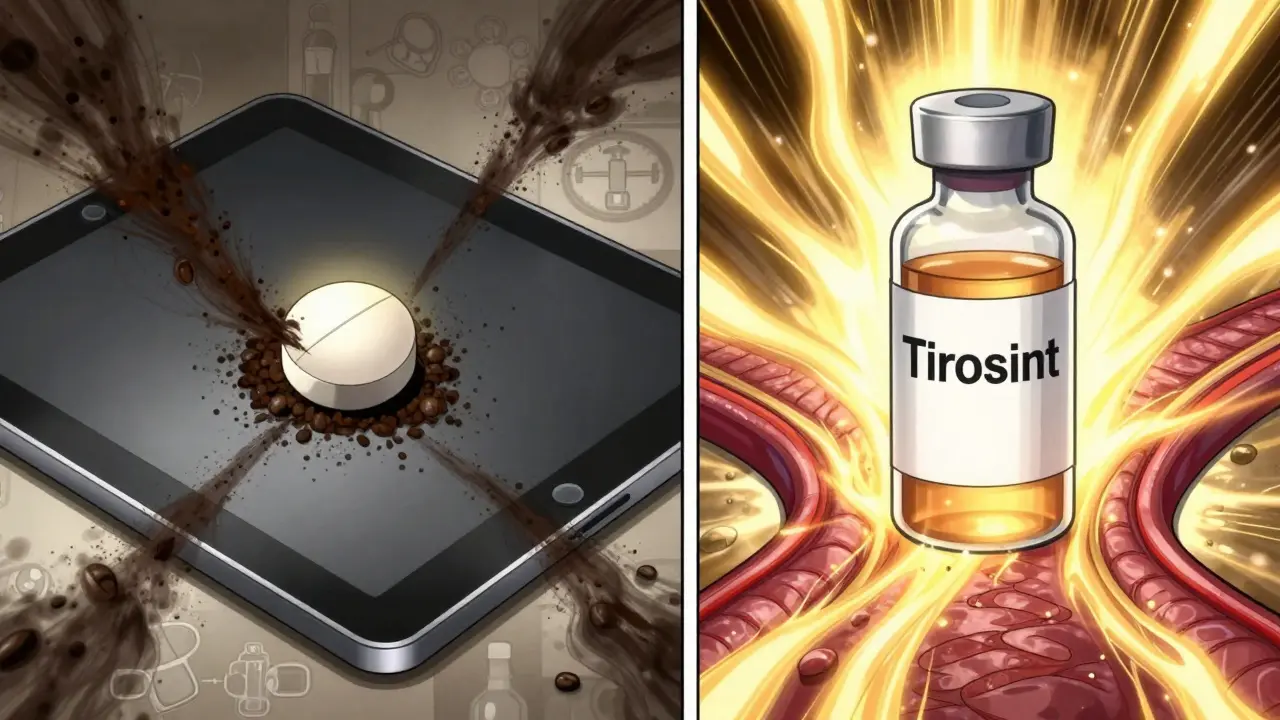
Not all levothyroxine is created equal. If you’re on a standard tablet-like Synthroid or generic levothyroxine-you’re at high risk for coffee interference. But if you’re on a liquid formulation, like Tirosint is a liquid levothyroxine sodium formulation designed for consistent absorption regardless of food or beverage intake, you’re in a different league.
Unlike tablets, which dissolve slowly and are vulnerable to binding agents in coffee, liquid levothyroxine is already in solution. It bypasses the absorption bottleneck. Studies show Tirosint maintains 98.7% bioavailability even when taken with coffee, tea, or orange juice. That’s nearly perfect absorption.
And the numbers don’t lie:
| Formulation | Absorption with Coffee (within 60 min) | Absorption with 60-Minute Wait | Recommended for Coffee Drinkers? |
|---|---|---|---|
| Standard Tablet (e.g., Synthroid) | 43%-75% reduction | Normal (90%+) | Only if strictly timed |
| Liquid (e.g., Tirosint) | 0-3% reduction | 98.7% (no change) | Yes-no timing needed |
If you’ve been taking your pill faithfully but still feel tired, it’s worth asking your doctor about switching to liquid. It’s not a cure-all, but for many, it’s the missing piece.
What About Milk, Cream, or Sugar?
You might think adding milk to your coffee makes it safer. It doesn’t. Calcium in dairy can interfere with levothyroxine absorption too-though not as badly as coffee. A splash of cream or a teaspoon of sugar won’t fix the problem. The real issue is timing. Even black coffee, taken 45 minutes after your pill, still causes measurable drops in T4 levels.
And don’t forget: some people take their pill with breakfast-oatmeal, yogurt, or a smoothie. Those are big no-nos too. Calcium, iron, soy, and fiber all block absorption. The only safe way to take levothyroxine is on an empty stomach with water, waiting at least 30 to 60 minutes before eating or drinking anything else.

Real People, Real Results
A survey of over 1,200 levothyroxine users on Reddit found that 78% saw clear improvements after spacing coffee from their medication. One user, HypothyroidWarrior, wrote: “My TSH dropped from 12.4 to 2.1 just by waiting 60 minutes. I went from needing a nap at 2 p.m. to running 5Ks.”
Another switched to Tirosint and said: “I stopped counting minutes. I just drink coffee whenever I want. My energy is back.”
But not everyone wins. About 22% reported no change-even after waiting. That’s where individual biology comes in. Some people’s guts absorb levothyroxine differently. Others have gut inflammation, celiac disease, or other conditions that make absorption harder. If you’ve done everything right and still feel off, talk to your doctor. You might need a different formulation-or a different dose.
Practical Tips: Making It Stick
Changing your morning routine sounds hard. But it doesn’t have to be.
- Set a timer. Take your pill, then set a 60-minute timer on your phone. Use that time to shower, get dressed, or check emails.
- Use two mugs. Label one “Medication First” and keep your coffee in the other. Seeing the label helps.
- Try liquid. If you’re a heavy coffee drinker and your symptoms won’t improve, ask your doctor about Tirosint or other liquid formulations.
- Track your TSH. Get your levels tested 6-8 weeks after making the change. If your TSH drops, you’ll know it worked.
- Don’t give up. It takes 2-4 weeks for your body to adjust. Don’t quit if you don’t feel better immediately.
And if you’re new to this? Start simple. Just wait 60 minutes. No need to overhaul your whole life. Small changes, done consistently, make the biggest difference.
The Future: What’s Next?
Pharmaceutical companies are catching on. In June 2023, the FDA approved a new extended-release levothyroxine called ThyQuidity XR is an extended-release formulation of levothyroxine designed to minimize interference from food and beverages, including coffee. In trials, it reduced coffee-related absorption loss to just 8%-compared to 36% for standard tablets.
The American Thyroid Association is updating its guidelines in early 2024, and they may recommend waiting 90 minutes instead of 60. That’s because new data shows even 60 minutes isn’t perfect for everyone.
Meanwhile, coffee consumption in the U.S. keeps rising-3.2 cups per person per day. And more people than ever are being diagnosed with hypothyroidism. The collision between these two trends isn’t going away. The solution isn’t to stop coffee. It’s to take control of how you take your medicine.
Can I drink coffee right after taking levothyroxine?
No. Drinking coffee within 60 minutes of taking levothyroxine can reduce absorption by up to 57%. Wait at least one hour, and ideally 90 minutes if you still have symptoms.
Does decaf coffee have the same effect?
Yes. Decaf coffee still contains compounds that bind to levothyroxine and speed up gut movement. It’s not the caffeine-it’s the other chemicals in coffee. So treat decaf the same as regular.
Is liquid levothyroxine better than tablets for coffee drinkers?
Yes. Liquid formulations like Tirosint are absorbed directly and aren’t affected by coffee, tea, or food. If you drink coffee daily and struggle with symptoms, switching to liquid may eliminate the problem.
What if I forget and drink coffee too soon?
Don’t panic. Skip your coffee for the day. Don’t take a second pill. Your body will still get some absorption. Just reset your routine tomorrow. If this happens often, talk to your doctor about switching to a liquid formulation.
Can I take levothyroxine at night instead?
Yes. Some studies show nighttime dosing works just as well, as long as you wait at least 3-4 hours after eating. This avoids coffee interference entirely. Talk to your doctor before changing your timing.
If you’re taking levothyroxine and drinking coffee every morning, you’re not alone. But you don’t have to keep feeling tired. With a few simple changes-waiting an hour, switching formulations, or adjusting your routine-you can finally get the energy your thyroid deserves.