
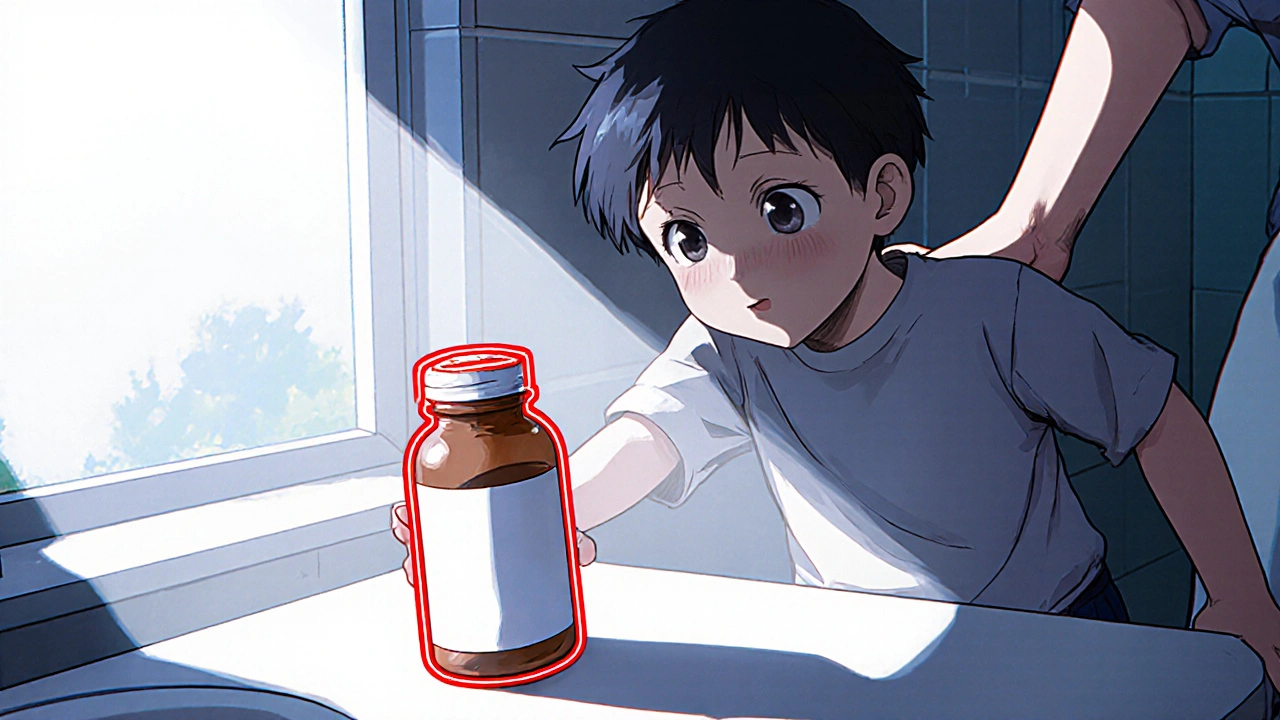
Pediatric Medication Dosage Calculator
How This Calculator Helps
Pediatric medications must be dosed by weight, not age. Even small errors can cause serious harm. This tool helps you calculate the correct dose based on your child's weight and the medication concentration.
Enter your child's weight and medication information to calculate the dose
Important Safety Note
Always use the measuring device that comes with the medicine. Never use kitchen spoons as they vary in size and can lead to dangerous errors (e.g., 1 teaspoon = 5 ml - giving 1 teaspoon instead of 1 ml is a 5-fold overdose).
Every year, 50,000 children under age 5 end up in emergency rooms because they got into medicine they shouldn’t have. Many of these cases aren’t accidents-they’re preventable mistakes. Children aren’t just small adults. Their bodies process drugs differently, they can’t tell you when something feels wrong, and even a tiny amount of the wrong medicine can be deadly. Pediatric medication safety isn’t just a guideline-it’s a life-or-death system that requires constant attention at home and in hospitals.
Why Kids Are at Higher Risk
Children’s bodies change rapidly. A newborn weighs around 3 kilograms. By age 12, they might weigh 40 or more. That’s a 13-fold difference in body size. Medications are dosed by weight, not age. Get the math wrong, and you could give a child five times too much-or too little. In adult hospitals, where pediatric cases are rare, this mistake happens more often. Studies show facilities with fewer than 100 pediatric patients per year have 3.2 times higher error rates than specialized children’s hospitals.Even more dangerous are the changes in how kids’ livers and kidneys work. These organs are still developing, especially in infants. They can’t break down or flush out drugs the way adults can. A dose that’s safe for a teenager might overload a 6-month-old’s system. And because young kids can’t describe symptoms like dizziness, nausea, or confusion, signs of an overdose often go unnoticed until it’s too late.
Common Medication Errors in Kids
The most frequent errors aren’t about the wrong drug-they’re about the wrong amount. Here’s how they happen:- Confusing teaspoons and milliliters: 1 teaspoon = 5 milliliters. Giving 1 teaspoon instead of 1 mL is a 5-fold overdose.
- Using tablespoons: 1 tablespoon = 3 teaspoons. That’s a 3-fold overdose if you meant to give a teaspoon.
- Weight conversion mistakes: Mixing pounds and kilograms. A child weighing 10 kg is not 10 pounds-it’s about 22 pounds. Many errors come from this simple mix-up.
- Removing pills from original packaging: Adults often take pills out of child-resistant bottles to put them in pill organizers. But kids can open those containers in under 30 seconds, even if they’re not fully closed.
According to the CDC’s PROTECT Initiative, 60% of pediatric poisonings happen because medicine was left within reach-even in places parents thought were safe. A bottle on the bathroom counter, a purse on the couch, or a nightstand next to the bed are all common spots where kids find medicine.
What Hospitals Are Doing Right
Children’s hospitals have learned from years of mistakes. The American Academy of Pediatrics laid out 15 key safety steps in 2018, and 78% of children’s hospitals now follow at least 12 of them. Here’s what works:- Kilogram-only dosing: No pounds allowed. All weight measurements must be in kilograms, and electronic systems block doses above safe limits.
- Standardized concentrations: High-risk drugs like insulin or morphine now come in only one strength for kids. No more guessing which concentration is in the vial.
- Two-person checks: For high-alert medications, two trained staff members independently verify the dose before giving it.
- Distraction-free zones: Medication prep areas are kept quiet and free of interruptions. No phones, no chatter-just focus.
- Length-based dosing tools: If a scale isn’t available, nurses use special tapes that measure a child’s length and give the right dose based on that.
These changes have cut pediatric medication errors by 85% in hospitals that fully adopt them. It’s not magic-it’s discipline.

What Parents Need to Know at Home
Most pediatric medication errors happen at home. And many are caused by well-meaning but misinformed caregivers.Never use kitchen spoons. A teaspoon from your drawer isn’t the same as a medical measuring spoon. Always use the syringe, dropper, or cup that comes with the medicine. If it’s missing, ask the pharmacist for one-free of charge.
Never call medicine candy. Telling a child, “This tastes like candy,” might get them to take it. But it also teaches them that pills are treats. That’s why 15% of accidental ingestions happen because kids think medicine is candy. Say instead: “This is medicine. It helps you feel better, but you can’t have it unless a grown-up gives it to you.”
Store everything like poison. That means not just prescription drugs, but also:
- Over-the-counter cough syrups
- Vitamins and gummies
- Diaper rash cream
- Eye drops
- Prenatal vitamins
These account for 20% of poisonings reported to poison control. Store them up high, in a locked cabinet, and out of sight-even if your child can’t climb yet. They learn fast.
What to Avoid Completely
Some medicines have no place in young children’s medicine cabinets.Over-the-counter cough and cold medicines are not recommended for kids under 6-and absolutely forbidden under 2. These drugs don’t work well in children, and the risk of overdose is high. The FDA and AAP both agree: skip them. Use saline drops, a humidifier, and a suction bulb instead for congestion.
Adult medications like aspirin, ibuprofen (in high doses), or sleep aids should never be given to kids-even if you think “a little won’t hurt.” A single adult aspirin can cause Reye’s syndrome in children, a rare but deadly condition.

How to Give Medicine Correctly
Getting the dose right is only half the battle. How you give it matters too.- Use the right tool: Syringes are best for babies and toddlers. They’re accurate and let you control the flow.
- Aim for the cheek: Don’t squirt medicine on the tongue. Aim it toward the back of the mouth, against the inside of the cheek. That helps avoid choking and ensures the full dose is swallowed.
- Don’t mix with food or juice: Unless your doctor says it’s okay, don’t hide medicine in applesauce or milk. If your child doesn’t finish the bottle, you won’t know how much they got.
- Use pictogram instructions: If you’re unsure about the dose, ask for a picture-based dosing sheet. Studies show these improve accuracy by 47%, especially for parents with low health literacy.
Emergency Preparedness
Even with all the precautions, accidents happen. Be ready.- Save Poison Help: 800-222-1222 in your phone. Program it as “POISON” so you don’t have to think when it’s an emergency.
- Keep the medicine container if your child ingests something. Emergency teams need to know what’s inside.
- Don’t wait for symptoms: If you think your child swallowed medicine, call Poison Help immediately. Don’t wait for vomiting, drowsiness, or breathing trouble.
- Teach older kids: Even toddlers can learn: “Medicine is not candy. Only grown-ups give medicine.” Repeat it often.
The Future of Pediatric Safety
The FDA now requires drug makers to use standardized concentrations for new pediatric medications. This means fewer confusing strengths and less room for error. The CDC’s PROTECT Initiative continues to update guidelines every year, with new emphasis on “teach-back” methods-where parents repeat the dosing instructions back to the pharmacist to confirm they understood.It’s working. In hospitals using these tools, serious medication errors have dropped by more than 80%. At home, the numbers are still too high-but awareness is growing. The key is consistency: every dose, every time, every child.
Can I use a kitchen spoon to measure my child’s medicine?
No. Kitchen spoons vary in size and are not accurate. Always use the measuring device that comes with the medicine-usually a syringe or dosing cup. If you lost it, ask your pharmacy for a free replacement. Using a spoon can lead to a 3- to 5-fold overdose.
Are over-the-counter cold medicines safe for toddlers?
No. The American Academy of Pediatrics and FDA advise against using over-the-counter cough and cold medicines in children under age 6. They don’t work well in kids and carry a high risk of overdose. Use saline nasal drops, a humidifier, and gentle suctioning instead.
What should I do if my child swallows medicine they shouldn’t have?
Call Poison Help immediately at 800-222-1222. Don’t wait for symptoms. Keep the medicine container handy so you can tell them what was taken. Do not try to make your child vomit unless instructed by a professional.
Why is it dangerous to call medicine candy?
It teaches children that pills are treats. This is a leading cause of accidental ingestions-about 15% of cases, according to poison control data. Always say: “This is medicine. Only grown-ups give it.”
Is it safe to store medicine in the bathroom?
No. Bathrooms are humid and often within reach of children. Store medicine up high, in a locked cabinet, away from sinks and counters. Even if you think your child can’t climb, they learn quickly. The CDC says 75% of poisonings happen in places parents thought were safe.
What’s the safest way to give liquid medicine to a baby?
Use a syringe without a needle. Gently insert the tip into the side of the baby’s mouth, aiming toward the cheek-not the tongue. Slowly push the plunger so the medicine flows slowly. This reduces choking risk and ensures the full dose is swallowed.
Gayle Jenkins
November 27, 2025 AT 01:27This is the kind of information every parent needs to see. I used to keep my kid's cough syrup on the nightstand because it was 'convenient.' Now I have a locked cabinet in the closet. No more excuses. Safety isn't optional.
And please, for the love of all that's holy, stop using kitchen spoons. I've seen it happen-grandma gives a 'teaspoon' of medicine and thinks she's helping. It's a 5x overdose. That's not parenting, that's Russian roulette.
Use the syringe. Ask for a free one at the pharmacy. Write the dose on the bottle with a Sharpie. Do whatever it takes. Your child's life isn't a guessing game.
Kaleigh Scroger
November 28, 2025 AT 15:28It's insane how many parents don't know the difference between mL and tsp. I work in pediatrics and I've seen kids admitted because someone used a soup spoon. It's not just about ignorance-it's about systemic failure. Pharmacists don't always reinforce this. Doctors assume you know. Schools don't teach it. The burden falls entirely on exhausted parents who are already overwhelmed.
Standardized concentrations in hospitals? Brilliant. Why isn't this required for OTC meds too? Why are we still selling liquid Tylenol in 160mg/5mL and 80mg/0.8mL? That's not a choice-it's a trap.
And yes, storing medicine in the bathroom is a disaster. Humidity degrades meds and kids learn to open cabinets before they can tie their shoes. Lock it up. Even if you think your baby can't crawl yet. They will. And they will find it.
Teach-back methods? Yes. Ask the parent to repeat the dose. Don't just hand them a sheet and walk away. We treat meds like they're candy. They're not. They're weapons if misused.
And stop calling them candy. I had a 3-year-old ask for 'medicine' because he thought it was gummy bears. That's not a joke. That's a trauma waiting to happen.
Parents aren't lazy. We're misinformed. And the system isn't helping. We need mandatory counseling at the pharmacy. Not a pamphlet. A 5-minute conversation. With a nurse. Not a cashier.
And for the love of God, stop giving cough syrup to toddlers. It doesn't work. It just makes them sleepy or hyper. Either way, it's dangerous. Use saline and a bulb. It's free. It's safe. It's effective.
Every dose matters. Every time. No exceptions. This isn't just advice. It's survival.
laura lauraa
November 28, 2025 AT 20:07Oh, how touching. Another sanctimonious lecture on how parents are all negligent, ignorant, and dangerous. Let me guess-you’ve never forgotten a dose? Never used a kitchen spoon in a pinch? Never assumed the pharmacy knew what they were doing? How noble of you to sit on your high horse while the rest of us are juggling three jobs, two kids, and a sick dog.
And yet-you don’t mention the fact that the average parent spends 12 minutes a day with their child’s pediatrician. Twelve minutes. And you expect them to memorize dosing charts? To understand pharmacokinetics? To become a clinical pharmacist overnight?
Maybe the problem isn’t us. Maybe it’s a system that sells dangerous, confusing formulations, then blames the parents when the inevitable happens. Maybe we need better labeling. Better packaging. Better regulation. Not more guilt.
Also, ‘locked cabinet’? Great. For those of us living in 500-square-foot apartments with no closet space, where exactly do you suggest we store it? The ceiling? The dog’s bed?
And yes, I know I shouldn’t call it candy. But when your 18-month-old screams like they’re being murdered because you’re trying to give them antibiotics? You say what you have to say to get them to swallow it. You do what you have to do. Don’t judge me until you’ve been there.
Blaming parents won’t fix this. Fixing the system will.
Elizabeth Choi
November 28, 2025 AT 21:0985% reduction in hospitals? That’s statistically significant. But home errors? Still 60%. So the system works where it’s funded and regulated. But in the real world? Chaos. This isn’t about parenting. It’s about class. People with resources follow the rules. People without? They’re left guessing.
And let’s be real-pharmacies don’t give out syringes for free unless you ask. And most parents don’t know to ask.
Also, why are we still using ‘teaspoon’ as a unit? It’s archaic. Milliliters only. Full stop. Why does the FDA still allow ‘tsp’ on labels? Because the industry resists change. Because profit > safety.
Don’t blame the parents. Blame the system that designed this mess.
Allison Turner
November 30, 2025 AT 10:41Parents are dumb. That’s the bottom line. If you can’t measure medicine right, you shouldn’t have kids.
Stop making excuses. Lock it up. Use the syringe. Don’t be lazy.
And no, you can’t use a spoon. No. Just no.
It’s not that hard. You’re just lazy.
Darrel Smith
December 1, 2025 AT 00:08THEY’RE KILLING OUR KIDS WITH SPOONS AND CANDY LIES!!
DO YOU KNOW WHAT HAPPENS WHEN YOU TELL A CHILD MEDICINE IS CANDY??
THEY BECOME ADDICTED TO IT!!
THEY’LL STEAL IT FROM THE CABINET!!
THEY’LL THINK IT’S A TREAT!!
AND THEN THEY’LL BE DEAD!!
AND IT’S ALL BECAUSE YOU WERE TOO LAZY TO USE A SYRINGE!!
YOU’RE NOT A PARENT. YOU’RE A MURDERER WITH A BATHROOM COUNTER.
LOCK IT UP. OR GO TO JAIL.
THIS ISN’T A SUGGESTION. THIS IS A COMMANDMENT FROM GOD.
Aishwarya Sivaraj
December 2, 2025 AT 12:02Wow this is so important i never knew about the weight conversion thing like 10kg is not 10 pounds i thought it was close but no its 22 pounds wow i feel dumb now
also i live in india and we use spoon a lot for medicine because syringes are expensive and hard to find here but now i will try to get one from pharmacy
and yes i used to keep medicine on shelf near bed but now its in locked box on top shelf
also i always say medicine is not candy but sometimes when baby cries i say just a little sweetie but now i know thats bad
thank you for sharing this i learned so much
also why dont they make medicine taste better? like why does it always taste like chemicals? cant they make it like fruit? i think that would help too
and what about older kids who are 7 or 8? can they learn to give themselves medicine? i think yes if we teach them right
but i think the real problem is we dont have enough nurses in villages to explain this
so maybe we need community health workers to go door to door
thank you again this saved my child maybe
Iives Perl
December 3, 2025 AT 14:17They’re hiding the truth. The real reason kids overdose? Big Pharma wants you to use their products. They design confusing labels. They don’t fund education. They lobby against standardized dosing. And now they’re blaming parents.
It’s all a cover-up. The CDC? Controlled by the AMA. The AAP? Funded by drug companies.
Use saline? Yeah right. Saline doesn’t make money. Syrups do.
And why do hospitals use two-person checks? Because they know their own system is rigged.
Wake up.
They’re poisoning our kids to sell more drugs.
PS: I’ve seen the footage. The syringes are tampered with. Always.
:-O
steve stofelano, jr.
December 4, 2025 AT 02:20It is with profound respect for the meticulous attention to pediatric safety that I acknowledge the exceptional progress achieved by children’s hospitals adhering to the American Academy of Pediatrics’ 15 key guidelines. The implementation of kilogram-only dosing, standardized concentrations, and two-person verification protocols represents not merely procedural refinement, but a moral imperative in clinical practice.
That 78% of children’s hospitals now comply with at least 12 of these measures is a testament to institutional integrity. Yet, the persistence of home-based errors-particularly those stemming from non-standardized measuring tools and the misclassification of pharmaceuticals as consumables-reveals a critical gap in public health infrastructure.
It is my firm belief that pharmacists, as accessible healthcare professionals, must be empowered to deliver mandatory, structured counseling at the point of dispensing. Furthermore, regulatory bodies must mandate clear, universally legible labeling on all over-the-counter pediatric formulations, eliminating the use of non-metric units entirely.
Education, not accusation, must be the cornerstone of change. Parents are not adversaries; they are partners in a system that has, for too long, failed to equip them adequately.
Let us not confuse diligence with blame. Let us build systems that prevent error-not shame those who are merely trying to do right.
Savakrit Singh
December 4, 2025 AT 18:37USA is so advanced in medicine but still people use spoon for kids medicine? 😅
Here in India we have a lot of problems but we know one thing: never use spoon. Always use syringe. Even if it costs 10 rupees. Life is worth more.
Also we don’t keep medicine in bathroom. We keep in locked box. Even if it’s vitamin. Even if it’s cream. Everything is locked.
And yes we say medicine is not candy. We say it’s medicine. Like a soldier. No tricks.
But I think you should also teach doctors. Many doctors here still write ‘tsp’ on prescription. Not mL. That’s the problem.
So change starts from doctor’s pen.
👍
Cecily Bogsprocket
December 4, 2025 AT 18:44I read this and I cried. Not because I’m dramatic, but because I remember the panic. My daughter swallowed half a bottle of Children’s Tylenol when she was 18 months old. We didn’t know it was gone until the bottle was empty and she was asleep. We called Poison Control. They said, ‘Don’t wait for symptoms. Call now.’ We did. She was fine. But I still have nightmares.
I didn’t know about the weight thing. I thought 20 pounds was 10 kg. It’s not. It’s 9.1. I thought I was being careful. I wasn’t.
Now I have a locked cabinet. I use a syringe. I write the dose on the bottle. I say ‘medicine is not candy’ every single time. I even made a little chart for the fridge.
I’m not saying this to feel superior. I’m saying it because I know what happens when you assume. When you think, ‘It won’t happen to me.’
It can. It does. Every day.
If you’re reading this and you’re not sure how to give medicine-ask. Don’t guess. Don’t use a spoon. Don’t wait until it’s too late.
I’m not your enemy. I’m just someone who learned the hard way.
Jebari Lewis
December 5, 2025 AT 05:38Thank you for this. As a pediatric nurse, I see this every single shift. A mother gives a toddler 10 mL of ibuprofen because she thought it was ‘a capful.’ It was a tablespoon. That’s 30 mL. That’s a lethal dose for a 15-pound child.
We saved her. But we almost didn’t.
And the worst part? She apologized. Said she ‘didn’t know.’
You don’t have to be a doctor to know that medicine isn’t candy. You don’t have to be a scientist to know that a kitchen spoon isn’t a measuring tool.
But you do have to care enough to ask. To double-check. To get the syringe. To lock it up.
It’s not about intelligence. It’s about attention.
And attention is a skill. One we can all learn.
So please. Learn it.
Because a child’s life isn’t a ‘maybe.’ It’s a ‘must.’
Emma louise
December 6, 2025 AT 10:46Oh look, another liberal guilt-trip wrapped in a CDC pamphlet. Next you’ll tell me I shouldn’t let my kids breathe air because it might have germs.
My grandma gave me medicine with a spoon. I’m alive. My dad used aspirin for my fever. I’m fine.
Maybe the problem isn’t the parents. Maybe it’s the over-medicalized, over-regulated, over-anxious culture that turns every little thing into a crisis.
Let people raise their kids. Stop scaring them with statistics.
Also, why are we letting the FDA control everything? Who elected them?
Freedom. Not fear.
sharicka holloway
December 7, 2025 AT 09:24My niece took a whole bottle of gummy vitamins. She was fine. But we learned. Now everything is locked up. Even the sunscreen. Even the shampoo. Anything that looks like candy.
And we never say it’s candy. We say ‘medicine only grown-ups give.’
It’s not hard. It’s just something you have to remember.
Also, if you lost the syringe? Call the pharmacy. They’ll give you one. No questions. No charge.
And if you’re scared you’ll mess up? Write the dose on the bottle. Take a picture. Ask someone to check it.
We’re all just trying to do our best.
Let’s help each other, not shame each other.
Gayle Jenkins
December 7, 2025 AT 14:25Thank you for sharing your story. That’s exactly why I started leaving syringes in my purse. I keep one in the diaper bag, one in the car, one by the bed. You never know when you’ll need it.
And I tell every new parent I meet: ‘Get the syringe. Don’t wait.’
It’s not about being perfect. It’s about being prepared.