
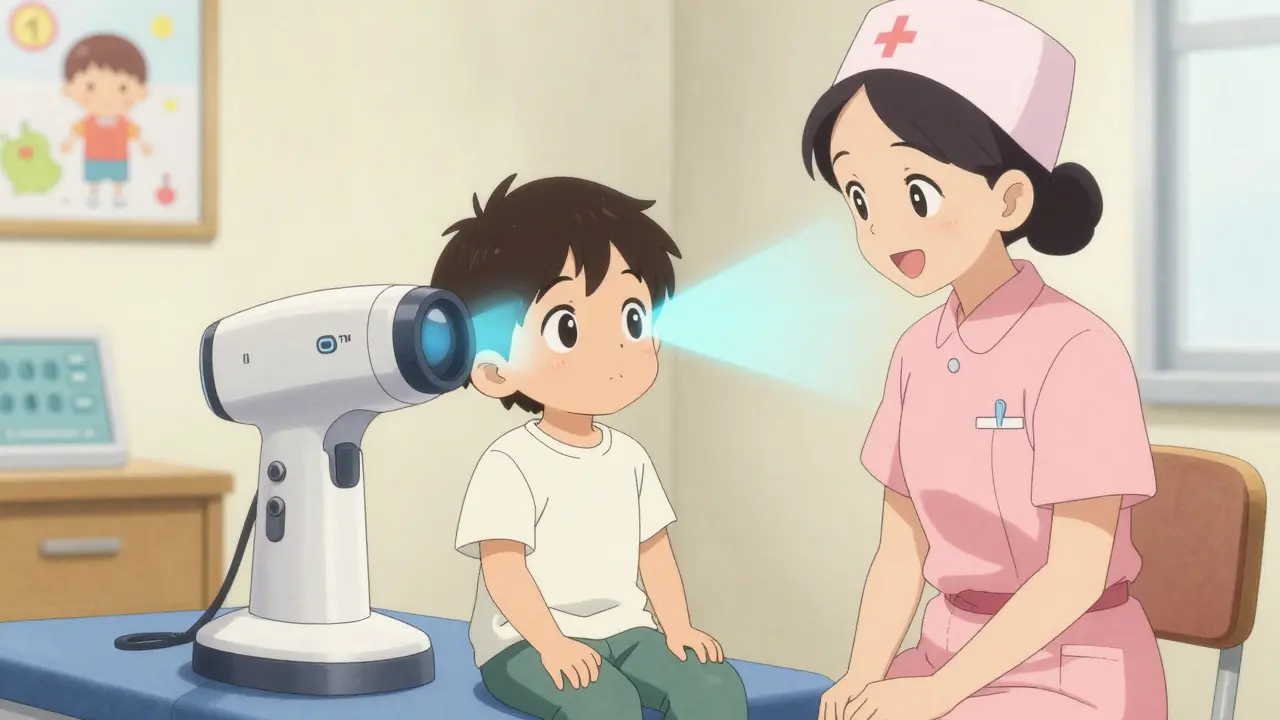
Every child deserves to see the world clearly - but too many don’t get checked until it’s too late. Vision problems in kids don’t always come with obvious signs. A child might not say their vision is blurry. They might not rub their eyes or squint. Instead, they’ll just tilt their head, sit too close to the TV, or avoid drawing and reading. By the time parents notice, the window for easy correction may already be closing.
Why Screening Before Age 5 Matters
The visual system in children is still growing until about age 7. During this time, the brain learns how to interpret what the eyes see. If one eye is blurry or misaligned - like in amblyopia (lazy eye) or strabismus (crossed eyes) - the brain starts ignoring signals from that eye. Once that happens, the eye can become permanently weak. No glasses, no surgery, no patching later on can fully fix it. Studies show that if amblyopia is caught before age 5, treatment works in 80-95% of cases. After age 8, success drops to just 10-50%. That’s not a small difference. That’s the difference between seeing clearly for life or living with reduced vision forever. The U.S. Preventive Services Task Force gives pediatric vision screening a Grade B recommendation - meaning it’s proven to work and should be done for every child between 3 and 5 years old. This isn’t optional. It’s essential preventive care.What Gets Screened and When
Screening isn’t one-size-fits-all. It changes based on age and how well the child can cooperate.- Newborn to 6 months: The red reflex test is used. A doctor shines a light into each eye to check for reflections. Normal eyes glow red. White, gray, or uneven reflections can signal cataracts, tumors, or retinal issues.
- 6 months to 3 years: Doctors watch for eye alignment, pupil response, and how well the eyes track movement. They also repeat the red reflex test. No eye chart needed yet.
- Age 3 and up: This is when visual acuity testing begins. Kids are asked to identify shapes or letters from 10 feet away. For young kids who can’t read, symbols like LEA symbols (circles, squares, apples, houses) or HOTV letters are used instead of traditional Snellen charts.
- Age 3: Must identify most symbols on the 20/50 line
- Age 4: Must pass the 20/40 line
- Age 5+: Must pass the 20/32 line (or 20/30 on Snellen charts)
Two Main Ways to Screen: Charts vs. Machines
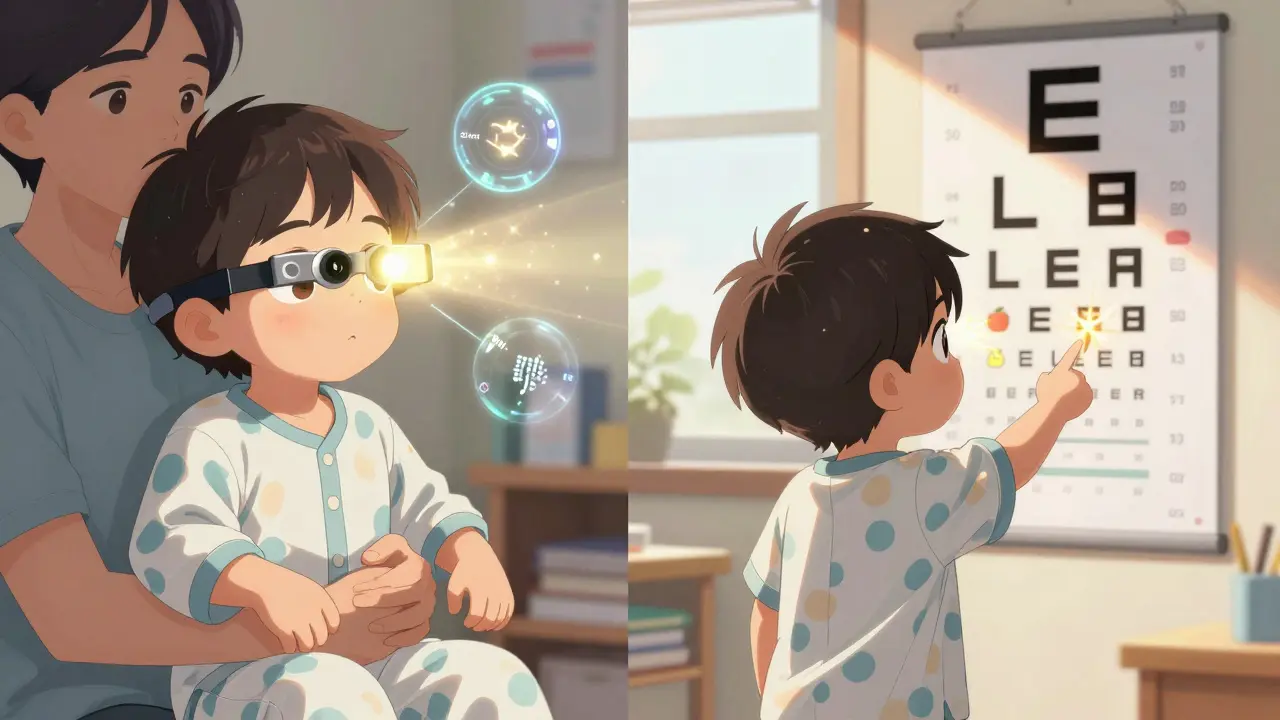
There are two main approaches: traditional eye charts and modern instrument-based devices. Optotype-based screening (charts and symbols) is the gold standard for kids who can cooperate. But it has a big flaw: about 1 in 4 three-year-olds just won’t play along. They get distracted, scared, or don’t understand the task. That’s why many clinics now use instrument-based screening. Devices like the SureSight, Power Refractor, and the newer blinq™ scanner can screen a child in under a minute - no response needed. The child just looks at a light while the device measures how light focuses on the retina. It catches refractive errors, misalignment, and asymmetry between eyes. Here’s how they compare:| Method | Time per Child | Sensitivity (Detects True Cases) | Specificity (Avoids False Alarms) | Best For |
|---|---|---|---|---|
| LEA Symbols / HOTV Charts | 3-5 minutes | 71-89% | 85-92% | Cooperative children, age 5+ |
| SureSight / Power Refractor | 1-2 minutes | 80-88% | 82-89% | Uncooperative or very young children |
| blinq™ Scanner | Under 1 minute | 100% | 91% | Children 2-8 years, ideal for busy clinics |
| Random Dot Stereoacuity Tests | 3-4 minutes | 46-55% | 75-80% | Supplemental only |
What Happens After a Positive Screen?
A failed screen doesn’t mean your child needs glasses or surgery. It means they need a full eye exam by a pediatric ophthalmologist or optometrist. Many parents worry about cost or delay. But untreated vision problems don’t fix themselves. In fact, they get worse. A child with undiagnosed amblyopia might struggle in school, avoid sports, or develop poor depth perception that affects coordination. Referral is simple. If screening shows:- Worse than 20/40 vision in either eye
- Significant difference between eyes
- Constant eye turn
- Abnormal red reflex
Barriers to Screening - And How to Beat Them
Even though screening works, it’s not happening everywhere. Why?- Uncooperative children: 15-30% of 3-year-olds won’t cooperate with chart tests. Solution: Use instrument-based tools first.
- Improper lighting: A dimly lit room can make a child’s vision look worse than it is. Solution: Use a light meter to ensure 100-150 lux on the chart.
- Wrong distance: Testing at 8 feet instead of 10 feet inflates false positives. Solution: Use a 10-foot measuring cord - always.
- Provider training gaps: A 2018 study found 25% of screenings were done incorrectly. Solution: Free online training from the National Center for Children’s Vision and Eye Health (NCCVEH) is available to all providers.
Who Gets Left Behind - And Why
Not all children get screened equally. Data from the National Survey of Children’s Health shows Hispanic and Black children are 20-30% less likely to receive recommended vision screening. Why? Access issues. Language barriers. Lack of awareness. Transportation. The National Eye Institute is now funding $2.5 million in research (2021-2024) to fix this gap. Community health centers are starting mobile screening vans. Schools are partnering with local eye clinics. These efforts are starting to close the divide.What’s Next? The Future of Pediatric Vision Screening
The next big shift? Screening earlier. A 2022 study in JAMA Pediatrics showed instrument-based screening works reliably as early as 9 months. That’s before a child can even say “apple” or “circle.” If guidelines update by 2025 - as expected - we could start catching vision problems before age 1. That’s huge. Because the earlier you treat amblyopia, the faster and more completely vision recovers. Some kids need only a few weeks of patching. Others need months. But if caught at 18 months? Recovery rates jump to over 90%. The economic case is clear too. The USPSTF found every dollar spent on pediatric vision screening saves $3.70 in future costs - from special education to lost productivity to lifelong vision care. That’s $1.2 billion saved every year in the U.S. alone.What Parents Should Do
You don’t need to wait for a school screening. Don’t assume your child’s pediatrician will catch it - many still rely on outdated methods.- Ask at every well-child visit after age 1: “Are you doing vision screening today?”
- If they say no, ask why - and insist on it.
- If your child fails, don’t delay the referral. Get the full eye exam within 60 days.
- Even if your child passes, watch for signs: squinting, head tilting, closing one eye to read, bumping into things.
Can a child pass a school vision screening but still have a problem?
Yes. School screenings are often basic and only check distance vision. Many children have undetected near vision problems, astigmatism, or eye coordination issues that won’t show up on a simple chart. A full eye exam by an eye specialist is the only way to be sure.
Is vision screening covered by insurance?
Yes. Under the Affordable Care Act, pediatric vision screening is a required benefit. Most private plans and Medicaid programs cover screening at well-child visits. Comprehensive eye exams after a failed screen are also typically covered.
My child passed the screening. Do they still need an eye exam?
If they have no symptoms and passed screening, a full eye exam isn’t needed until age 5-6 - unless your provider recommends otherwise. But if you notice signs like eye rubbing, head tilting, or trouble reading, don’t wait. Get an exam.
What if my child won’t sit still for the test?
That’s normal for toddlers. Many clinics now use instrument-based devices like the blinq™ scanner or SureSight that don’t require the child to respond. These devices work while the child is held by a parent or just looking at a light. No cooperation needed.
Can vision problems be fixed without glasses?
Yes. For amblyopia, the most common treatment is patching the stronger eye to force the weaker one to work. Atropine eye drops (which blur the good eye) are also used. In some cases, vision therapy or surgery for strabismus helps. Glasses are often part of treatment, but not always the only solution.
Hilary Miller
January 21, 2026 AT 17:47My kid passed the school screening but we still got the full eye exam - turned out he had mild astigmatism. School tests are a start, not a finish.
Thank you for this. Needed to see it laid out like this.
Rob Sims
January 21, 2026 AT 22:11Oh great. Another post telling me I’m a bad parent because I didn’t force my 2-year-old to stare at a chart for five minutes while screaming like a banshee.
Let me guess - you also think I should’ve done prenatal yoga and fed my baby organic kale puree? Grow up.
Sarvesh CK
January 23, 2026 AT 15:55It is truly remarkable how the human visual system, in its developmental infancy, exhibits such plasticity - a phenomenon that, when harnessed early, can avert lifelong neurological adaptation to suboptimal sensory input.
One cannot help but reflect upon the profound implications of this for public health policy: if we can correct amblyopia with 90% efficacy before age five, yet allow systemic neglect to persist due to logistical inertia, are we not complicit in the erosion of human potential?
Instrument-based screening, particularly devices like the blinq™ scanner, represent not merely technological progress, but a moral imperative - a tool that removes the burden of compliance from the child and places accountability squarely on the shoulders of the system.
The disparities in access across racial and socioeconomic lines are not accidental; they are structural failures masked as procedural gaps.
And yet, we continue to treat vision screening as an optional wellness check rather than the foundational neurodevelopmental intervention it truly is.
Consider this: a child who cannot see the board may be labeled ‘inattentive’ or ‘lazy’ - when in truth, their brain is fighting to interpret a world rendered blurry by an easily correctable optical defect.
The economic return on investment - $3.70 saved for every dollar spent - is not merely a statistic; it is a testament to the wisdom of prevention over remediation.
Let us not forget that in many parts of the world, even basic optometric care remains a luxury - and yet here, in a nation with such advanced technology, we still debate whether to implement universal screening.
Perhaps the real question is not whether we can afford to screen - but whether we can afford not to.
My gratitude to the authors of the VIP study and to all frontline providers who persist despite underfunding and bureaucratic indifference.
Children do not ask for perfection - only the chance to see clearly.
And that, in the end, is not a privilege - it is a right.
Tatiana Bandurina
January 25, 2026 AT 07:46I work in pediatrics. I’ve seen parents refuse screening because ‘they don’t believe in glasses’ or ‘it’s just a phase.’ Then, two years later, they’re crying in my office because their kid can’t read and the school says they’re ‘slow.’
It’s not just about vision. It’s about denial. And it’s killing potential.
Philip House
January 25, 2026 AT 11:13Yeah, but let’s be real - this whole ‘screening before 5’ thing is just Big Optometry pushing their agenda.
My kid saw fine. He didn’t need a machine. He just needed to stop staring at the iPad.
And why are we trusting some FDA-cleared gadget over a trained eye doctor? Sounds like a corporate scam to me.
Also, why are we spending millions on mobile vans when we can’t fix the public school system? Priorities, people.
arun mehta
January 26, 2026 AT 02:20👏👏👏 This is the kind of post that makes me proud to be part of a global community that values science over superstition.
Every parent, every pediatrician, every school nurse - read this. Save a child’s future.
🌍✨ #VisionForAll #EarlyDetectionSavesLives 🌟
shivani acharya
January 27, 2026 AT 12:57Oh so now we’re scanning babies at 9 months? Next they’ll be implanting microchips at birth to track ‘developmental milestones.’
Let me guess - the blinq™ scanner also sends your kid’s data to some government database? ‘For research.’
My cousin’s neighbor’s daughter got flagged for ‘asymmetry’ and now she’s got a $2000 bill and a 6-month patching schedule.
They’re not saving vision - they’re creating a whole new industry out of fear.
My kid’s eyes are fine. He just likes to squint when he’s thinking.
Don’t you dare tell me what’s ‘normal’ for my child.
Oren Prettyman
January 28, 2026 AT 23:57Let’s analyze the statistical validity of the 80–95% success rate cited. The VIP study sample was heavily skewed toward urban, insured populations. The 10–50% efficacy drop-off after age 8 assumes consistent treatment adherence - a condition rarely met in low-income households where transportation, language barriers, and parental work schedules render follow-up nearly impossible.
Furthermore, the specificity of instrument-based devices, while high, still generates false positives that trigger cascading referrals - each one costing hundreds, if not thousands, in unnecessary diagnostic workups.
The claim that ‘every dollar spent saves $3.70’ assumes perfect compliance, zero administrative overhead, and universal insurance coverage - none of which reflect the lived reality of 40% of American families.
And yet, we continue to treat this as a binary issue: screen or neglect.
What about the middle ground? What about community-based, culturally competent outreach - not just machines in a clinic, but trained liaisons who speak Spanish, Hmong, or Somali, who understand that ‘no’ doesn’t mean ‘no,’ it means ‘I don’t trust this system.’
Until we address the root causes of inequity - not just the symptoms - we are not preventing lifelong vision problems.
We are simply automating them.