
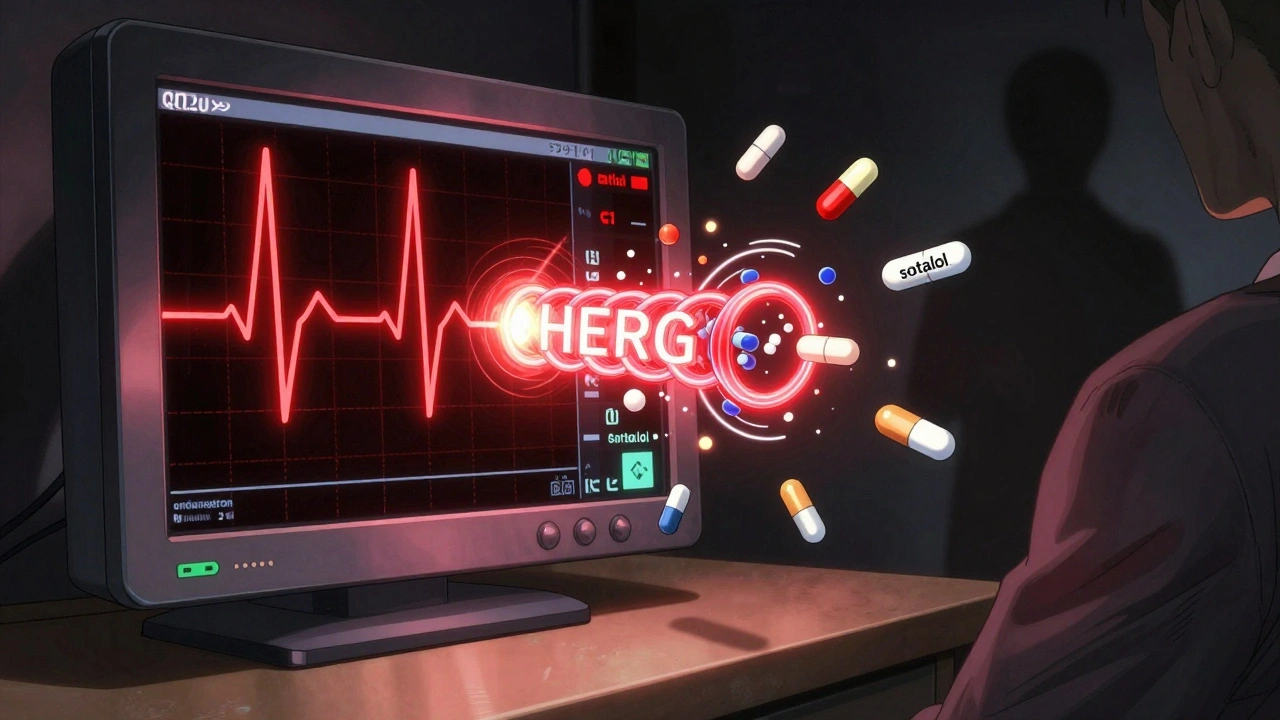
When your heart beats, it follows a precise electrical pattern. That pattern shows up on an ECG as waves and intervals - one of the most important being the QT interval. This number tells doctors how long it takes your heart’s lower chambers to recharge between beats. If that interval gets too long - a condition called QT prolongation - your heart can slip into a dangerous rhythm called torsades de pointes. And in some cases, that rhythm turns fatal.
QT prolongation isn’t always caused by heart disease. More often, it’s triggered by medications. Hundreds of commonly prescribed drugs - from antibiotics to antidepressants - can stretch that interval, sometimes silently. The risk is real, even if the event is rare. And knowing which drugs to watch for could save your life.
What Exactly Is QT Prolongation?
The QT interval measures the time from when the heart’s ventricles start contracting to when they fully recover. It’s not a fixed number. It changes with your heart rate. That’s why doctors use a corrected version - QTc - which adjusts for how fast or slow your heart is beating. Bazett’s formula is the most common way to calculate it, though it’s not perfect, especially at very slow or fast heart rates.
A normal QTc is under 450 ms for men and under 460 ms for women. Once it hits 500 ms or more, the risk of torsades de pointes jumps significantly. A rise of more than 60 ms from your baseline is also a red flag. That’s why doctors check your ECG before and after starting certain medications - not to scare you, but to catch trouble early.
Most QT-prolonging drugs work by blocking the hERG potassium channel. This channel helps reset the heart’s electrical charge after each beat. When it’s blocked, the heart takes longer to recharge. That delay creates a perfect storm for chaotic rhythms. It’s not the drug’s fault alone - it’s the combination of the drug, your body, and other factors.
High-Risk Medications You Should Know
Some drugs are known to cause QT prolongation more than others. The list is long, but these categories stand out:
- Antiarrhythmics: Drugs like sotalol, dofetilide, and quinidine are designed to treat arrhythmias - but they can cause them too. Sotalol carries a 2-5% risk of torsades in clinical trials. Quinidine? Around 6% of patients develop it.
- Antibiotics: Erythromycin and clarithromycin (macrolides) are common culprits. Moxifloxacin (a fluoroquinolone) can add 6-10 ms to your QTc. Azithromycin is less risky, but still flagged in combination with other drugs.
- Antipsychotics: Haloperidol, ziprasidone, and thioridazine all carry warnings. Ziprasidone even has a black box warning from the FDA. These drugs are often used in emergency settings, making accidental combinations dangerous.
- Antiemetics: Ondansetron (Zofran) is one of the most common causes of drug-induced torsades. It’s given for nausea, especially after surgery or chemo - but it’s also one of the top drugs linked to TdP in FDA reports.
- Antidepressants: Citalopram and escitalopram (Celexa, Lexapro) are dose-dependent. The FDA limits citalopram to 40 mg daily, and 20 mg if you’re over 60. Higher doses? Higher risk.
- Opioid replacement: Methadone is a major concern. Doses over 100 mg daily significantly increase QTc. Many patients on methadone maintenance have no symptoms - until they do.
- Cancer drugs: Tyrosine kinase inhibitors like vandetanib and nilotinib are increasingly common. About 44% of newer oncology drugs carry QT prolongation warnings.
Even drugs you think are safe - like fluconazole (an antifungal) or certain antihistamines - can add to the risk when stacked with others.
Why Some People Are at Higher Risk
Not everyone who takes a QT-prolonging drug develops torsades. But certain factors make it much more likely:
- Female sex: Women make up about 70% of documented torsades cases. Hormonal differences and slower drug clearance play a role.
- Age over 65: Slower metabolism and more medications increase risk.
- Low potassium or magnesium: Electrolyte imbalances make the heart more electrically unstable. This is common in people on diuretics or with eating disorders.
- Heart disease: Prior heart attack, heart failure, or bradycardia (slow heart rate) make the heart more vulnerable.
- Genetics: About 30% of drug-induced torsades cases involve hidden mutations in the hERG gene or related channels. You might not know you’re at risk until it’s too late.
- Drug combinations: Taking two or more QT-prolonging drugs multiplies the risk. A 2020 FDA analysis found 68% of torsades cases involved multiple high-risk drugs. Haloperidol plus ondansetron? That combo has been linked to sudden QT spikes.
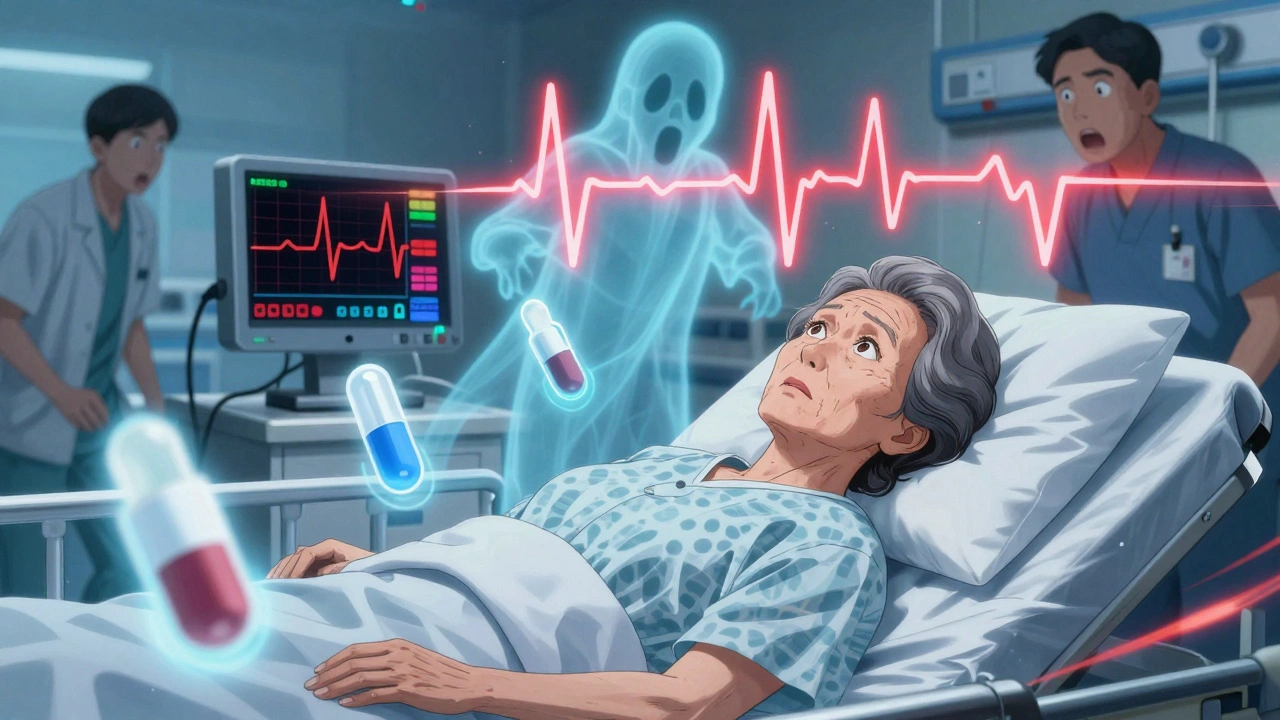
One real case from an emergency room: a 65-year-old woman got ondansetron for nausea and azithromycin for a respiratory infection. Her QTc jumped from 440 ms to 530 ms in 24 hours. She developed torsades. She survived - but barely.
How Doctors Manage the Risk
Most hospitals follow a simple three-step approach:
- Screen before prescribing: Check for electrolyte imbalances, existing heart conditions, and other medications. Ask about family history of sudden cardiac death.
- Baseline ECG: Recommended for anyone starting a high-risk drug - especially if they’re over 65, female, or on multiple QT-prolonging drugs.
- Follow-up ECG: Repeat within 3-7 days after starting or increasing the dose. That’s when the drug reaches steady state and the QT effect is strongest.
Some guidelines say: if your QTc goes above 500 ms or increases more than 60 ms from baseline, stop the drug - unless there’s no alternative. That’s what Medsafe (New Zealand’s drug safety agency) recommends. And it’s a standard many U.S. hospitals now follow.
Electronic health records are getting smarter. Systems with built-in QT risk alerts have cut inappropriate prescribing by over 50% in some hospital networks. They flag dangerous combos before the prescription even leaves the computer.

The Bigger Picture: Why This Matters
Drug-induced torsades is rare - less than 1 in 10,000 patient-years for most medications. But when it happens, it’s often sudden and deadly. And unlike heart attacks, there’s rarely warning. No chest pain. No dizziness. Just a flatline.
The pharmaceutical industry is responding. The CiPA initiative - launched by the FDA and global regulators - is replacing old QT testing with more advanced models that look at multiple ion channels, not just one. Since 2016, 22 drug candidates have been scrapped because of proarrhythmia risk. Each failure costs over $2 billion. That’s how seriously this is taken now.
But the real win? Better outcomes. Since 2014, systematic QT risk assessments have reduced drug-induced torsades by about 40%. It’s not perfect - but it’s working.
What You Can Do
If you’re taking any of these medications, here’s what to ask your doctor:
- “Is this drug known to affect the QT interval?”
- “Am I on any other meds that could add to the risk?”
- “Should I have an ECG before or after starting this?”
- “What symptoms should I watch for - like dizziness, palpitations, or fainting?”
Don’t panic if you’re on one of these drugs. Most people take them safely. But awareness matters. If you’ve had unexplained fainting, especially after starting a new medication, get your heart checked. And never stop a medication without talking to your doctor - sudden withdrawal can be just as dangerous.
The goal isn’t to avoid all risky drugs. It’s to use them wisely - with the right checks in place. That’s how medicine keeps getting safer.
Can a normal ECG rule out QT prolongation risk?
No. A normal ECG doesn’t mean you’re safe. Many people have normal QT intervals at rest but develop prolongation after taking a drug. That’s why baseline and follow-up ECGs are critical - especially after starting or increasing a high-risk medication. The effect often peaks 3-7 days after a dose change.
Are over-the-counter drugs safe for QT prolongation?
Some aren’t. Antihistamines like diphenhydramine (Benadryl) and certain cough syrups containing pseudoephedrine can prolong QT, especially in high doses or when combined with other drugs. Herbal supplements like licorice root can lower potassium and indirectly raise risk. Always check with your pharmacist before mixing OTC meds with prescriptions.
Is QT prolongation always reversible?
In most cases, yes. Stopping the offending drug and correcting electrolytes (potassium, magnesium) usually reverses the prolongation within days. But if torsades develops and isn’t treated quickly, it can lead to cardiac arrest. That’s why early detection matters - not waiting for symptoms.
Can genetic testing help predict QT risk?
It’s getting there. The QTGEN study in 2023 identified 23 genetic variants linked to drug-induced QT prolongation. But routine testing isn’t standard yet - it’s expensive and only explains part of the risk. Right now, the best predictor is still your medical history, current meds, and ECG results.
What should I do if I feel dizzy or have palpitations while on one of these drugs?
Don’t ignore it. Call your doctor or go to the ER. These symptoms could signal a dangerous rhythm. Bring a list of all your medications - including supplements and OTC drugs. An ECG can be done quickly and may catch a problem before it becomes life-threatening.
Are there safer alternatives to QT-prolonging drugs?
Often, yes. For nausea, metoclopramide is sometimes used instead of ondansetron - though it also carries QT risk, just lower. For depression, sertraline or citalopram at low doses may be safer than escitalopram at high doses. For infections, amoxicillin is preferred over azithromycin if you’re on other QT drugs. Always ask: “Is there a safer option for me?”
Doug Hawk
December 2, 2025 AT 04:01QT prolongation is one of those silent killers that flies under the radar because most docs don’t check baseline ECGs unless you’re on methadone or something overtly risky. But the real danger is polypharmacy - throw together ondansetron, azithromycin, and a beta blocker and boom, you’ve got a ticking time bomb in a 68-year-old woman with low magnesium. We’re not talking rare events anymore, we’re talking preventable deaths because no one connects the dots.
The FDA’s CiPA initiative is a step forward, but it’s still reactive. We need preemptive genetic screening for hERG variants in high-risk populations - especially women over 60 on multiple meds. It’s not expensive compared to an ICU stay.
Genesis Rubi
December 2, 2025 AT 21:11so like… if u take zofran and then get sick again and take benadryl and then your doc gives u citalopram for anxiety… u just gonna drop dead one day? like why does this even exist???
Michael Campbell
December 4, 2025 AT 08:39Big Pharma knows this. They don’t care. They make billions off these drugs. The FDA’s just a rubber stamp. Wake up.
Kristen Yates
December 5, 2025 AT 22:20I’ve been on escitalopram for 5 years. My doctor ordered a baseline ECG before I started. I never thought to ask, but I’m glad they did. Small things save lives.
Saurabh Tiwari
December 6, 2025 AT 13:19bro this is wild 😮 i live in india and my aunt got ondansetron after chemo and then azithro for cough… she fainted once but no one thought it was heart related. now i’m gonna check all her meds 🙏
Victoria Graci
December 6, 2025 AT 20:04There’s something deeply ironic about modern medicine: we’ve built algorithms to predict cancer recurrence and yet still rely on a 19th-century machine - the ECG - to prevent sudden death from a drug interaction. We’re using quantum-level diagnostics for some things and stone-age vigilance for others. The heart doesn’t care about your EHR alerts. It only cares about potassium, channels, and time.
Maybe the real question isn’t which drugs are dangerous - but why we treat the body like a machine that can be patched without understanding its symphony.
Saravanan Sathyanandha
December 7, 2025 AT 05:07As a clinician in rural India, I see this daily. Patients come with 8-10 prescriptions from different specialists. No one talks. No one coordinates. We don’t have EHR alerts. We don’t have baseline ECGs. We rely on patient memory - and trust me, they forget. This post is a wake-up call for systems like ours. We need simple, printed checklists. Not tech. Not apps. Paper. Because in villages, paper survives.
ruiqing Jane
December 7, 2025 AT 22:45If you're on any of these medications, please, please, please ask your doctor about your QT interval. Don’t assume it’s being checked. Don’t assume it’s not a concern. Your life might depend on one simple question: ‘Could this affect my heart rhythm?’
Fern Marder
December 9, 2025 AT 16:51Just had my mom on methadone for 3 years. QTc went from 420 to 510. She didn’t even feel anything. We got lucky. Now she’s on buprenorphine. 🙌
Allan maniero
December 11, 2025 AT 03:48I’ve been reading up on this since my dad had a near-miss last year after a combo of clarithromycin and fluoxetine. What struck me wasn’t the drug list - it was how little training primary care docs get on cardiac pharmacology. We send patients to cardiologists for everything, but no one teaches GPs how to spot these subtle, lethal interactions. The system is broken because we treat specialties like silos, not a single organism.
And yet - we’ve made progress. I remember when haloperidol was just ‘a sedative’. Now we know better. That’s the slow, painful, beautiful arc of medical progress.
Anthony Breakspear
December 13, 2025 AT 01:09Y’all are overcomplicating this. If you’re on 3+ meds and you’re over 60, get an ECG. If your doc says no, get a second opinion. That’s it. No PhD needed. No conspiracy. Just basic safety. My grandma’s alive today because I asked that one question.
Zoe Bray
December 15, 2025 AT 00:04It is imperative to underscore that the correction of the QT interval via Bazett’s formula is inherently flawed in the context of bradycardia and tachycardia, as it assumes a square-root relationship between heart rate and QT duration that does not hold universally. Fridericia’s correction demonstrates superior accuracy in clinical populations with arrhythmias or autonomic dysregulation. Furthermore, the use of machine learning-derived QT prediction models, such as those derived from the QT-ML Consortium, is beginning to supplant traditional formulaic approaches in tertiary care centers.
It is therefore not merely a matter of identifying high-risk medications, but of integrating dynamic, patient-specific electrophysiological modeling into clinical decision-making pathways - a paradigm shift that remains underutilized despite its demonstrable efficacy in reducing torsades de pointes incidence by up to 61% in prospective cohort studies.
John Morrow
December 15, 2025 AT 11:55The entire framework of QT risk assessment is built on statistical noise. We treat 500 ms as some magical threshold, but torsades can occur at 480 ms - and many patients with 520 ms never have an event. The real issue isn’t the interval - it’s the confluence of genetic susceptibility, electrolyte depletion, and polypharmacy. We’ve turned a complex biological phenomenon into a checkbox on an EHR form. We’re not preventing torsades - we’re just documenting it better.
The pharmaceutical industry’s shift to CiPA is a PR win, not a scientific revolution. The same molecules are still being approved. The same risk factors are still ignored. The same patients are still dying - just now, we have a compliance report to show we ‘tried’.
And let’s not pretend that ‘baseline ECG’ is standard practice. In community clinics, it’s a luxury. In ERs, it’s an afterthought. We’re treating a lethal arrhythmia like a billing code.
The only thing that saves lives isn’t the algorithm - it’s the clinician who asks, ‘What else is she on?’ - and actually listens.
Carolyn Woodard
December 17, 2025 AT 06:20My sister had torsades after a single dose of moxifloxacin. She was 28, healthy, no meds, no family history. Her QTc was 430 before, 540 after. They didn’t even test for genetic variants. Turns out she had a silent KCNH2 mutation. Now I’m pushing for genetic screening for all my family. This isn’t about old people on meds - it’s about hidden biology.
The fact that we don’t routinely test for hERG variants in young people with unexplained syncope is criminal. We wait for death to happen before we look for the cause. That’s not medicine. That’s luck.
And don’t get me started on how often ondansetron is given to kids for vomiting - with zero ECG monitoring. We’re gambling with children’s hearts because it’s ‘just for nausea’.
It’s not rare. It’s just silent until it’s too late.
Girish Padia
December 19, 2025 AT 02:11people just take pills like candy these days. no wonder the system is broken. if you dont know what your meds do, dont take them. simple.