
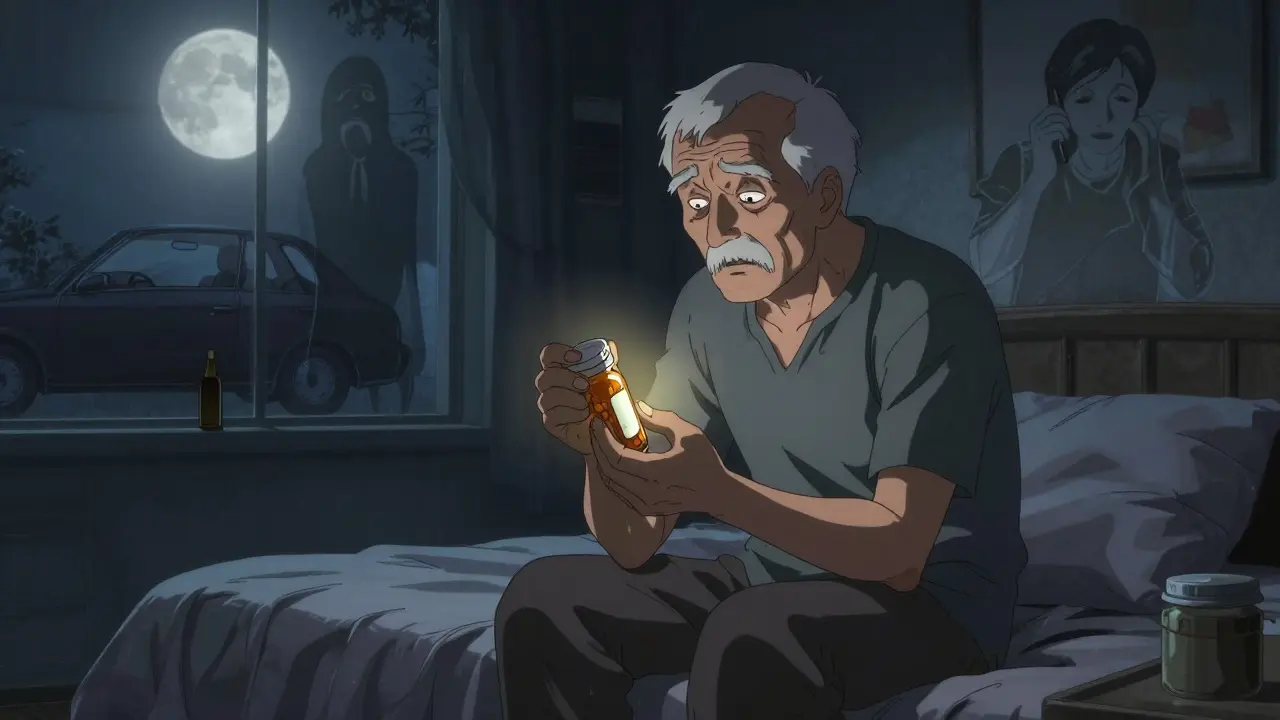
More than 1 in 10 adults over 80 in the U.S. are taking prescription sleep pills. That’s not a statistic from decades ago-it’s from 2023 data. And yet, most people don’t realize these medications aren’t meant to be taken for months or years. They’re designed for short-term use, maybe a few weeks, while you figure out what’s really keeping you awake. But too often, what starts as a quick fix turns into a long-term dependency-with side effects, withdrawal, and even dangerous behaviors like sleepwalking or sleep-driving.
How Sleep Medications Actually Work
Sleep medications don’t make you tired. They don’t work like a sleeping pill in a fairy tale. Instead, they change how your brain sends signals. Most of them boost a calming chemical called GABA, which slows down brain activity. That’s why you feel drowsy. But this isn’t natural sleep. It’s chemically induced drowsiness. Your brain doesn’t go through the normal cycles of deep sleep and REM. That’s why you might wake up feeling foggy, even after 8 hours.
There are several types. Benzodiazepines like lorazepam and clonazepam were the first big class, approved in the 1970s. They’re effective, but they’re also addictive. Then came the Z-drugs-zolpidem (Ambien), eszopiclone (Lunesta), and zaleplon (Sonata). These were marketed as safer, targeting only certain GABA receptors. But they’re not safer. They just have different risks. And they’re still controlled substances. In fact, the FDA tightened dosing rules for zolpidem in 2019 because women were waking up with impaired coordination, as if they’d had a few drinks.
Then there are the off-label options. Trazodone, an antidepressant, is one of the most commonly prescribed sleep aids-even though it’s not FDA-approved for insomnia. It costs as little as $4 a month. But it can cause priapism, a painful, prolonged erection. Doxepin (Silenor) is another off-label choice, but it carries heart risks at higher doses. Even OTC sleep aids like diphenhydramine (Benadryl) or doxylamine (Unisom) aren’t harmless. They’re anticholinergics, and long-term use is linked to a 54% higher risk of dementia, according to a major 2015 study in JAMA Internal Medicine.
The Hidden Dangers: Dependence and Withdrawal
Dependence doesn’t mean you’re addicted like someone using heroin. It means your body adapts. You need the same dose to get the same effect. Then you need more. Then you panic when you run out. That’s the cycle.
Studies show up to 33% of people using benzodiazepines for more than 4-6 weeks develop dependence. Z-drugs are lower-around 5-10%-but that’s still 1 in 10. And withdrawal? It’s not just trouble sleeping. It’s rebound insomnia worse than before you started. You might feel anxious, shaky, or even have seizures. One Reddit user, u/SleeplessInSeattle, described quitting Ambien after six months: “I couldn’t sleep for three nights straight. Ended up back on it.” That’s not weakness. That’s biology.
Then there are the bizarre side effects. The FDA has logged hundreds of reports of people sleep-driving, making phone calls, or cooking while asleep-none of which they remember. It’s rare, affecting about 0.5% of Z-drug users, but it’s real. And it’s why Ambien carries a boxed warning-the strongest kind-from the FDA. Women are especially at risk. That’s why the starting dose for women was cut from 10mg to 5mg in 2019.
Who’s Most at Risk?
You might think sleep meds are for everyone. But they’re not. The American Geriatrics Society Beers Criteria (2023) says they should be avoided entirely in older adults. Why? Because they double the risk of falls and increase fracture risk by 20-30%. A 70-year-old taking Lunesta isn’t just risking drowsiness-they’re risking a broken hip. And once that happens, recovery is harder. Mortality rates go up.
Women are 50% more likely than men to use sleep medications. Why? Partly because they report insomnia more often. Partly because doctors prescribe more readily. But also because women metabolize these drugs slower. A 5mg dose of zolpidem stays in a woman’s system longer than a man’s. That’s why the FDA lowered the dose for women.
And it’s not just age or gender. People with depression, chronic pain, or anxiety are more likely to be prescribed these drugs-and more likely to get stuck on them. The brain starts to rely on the chemical crutch instead of fixing the root problem.
What Works Better Than Pills?
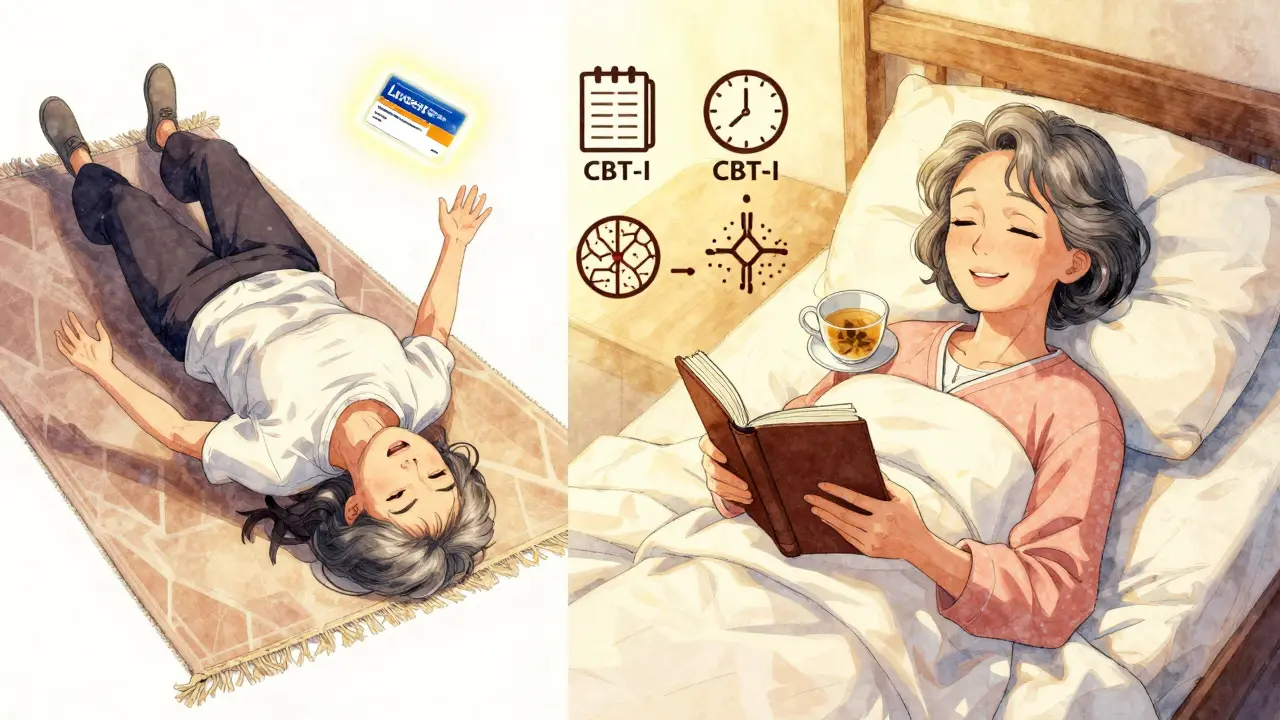
There’s a treatment that works better than any pill. It’s not new. It’s not flashy. It’s called Cognitive Behavioral Therapy for Insomnia, or CBT-I. And it’s the gold standard.
CBT-I doesn’t use drugs. It changes how you think about sleep. It teaches you to stop lying in bed awake for hours. It helps you break the cycle of worrying about not sleeping. It trains your body to associate the bed with sleep-not stress, not scrolling, not staring at the ceiling.
The data is clear. CBT-I helps 70-80% of people. That’s higher than any medication. And the effects last. A 2022 study in Sleep Medicine Reviews found that people who did CBT-I stayed asleep for years. People who took Ambien? Their sleep quality dropped back to baseline within months of stopping.
WebMD found that 78% of users who tried CBT-I reported better long-term results than medication. But 65% said the first few weeks were tough. That’s the catch. CBT-I takes effort. You have to keep a sleep diary. You have to limit time in bed. You have to stop napping. It’s not a quick fix. But it’s the only fix that lasts.
New Alternatives: Apps, Pills, and What’s Coming
The future of sleep treatment isn’t more pills. It’s better tools.
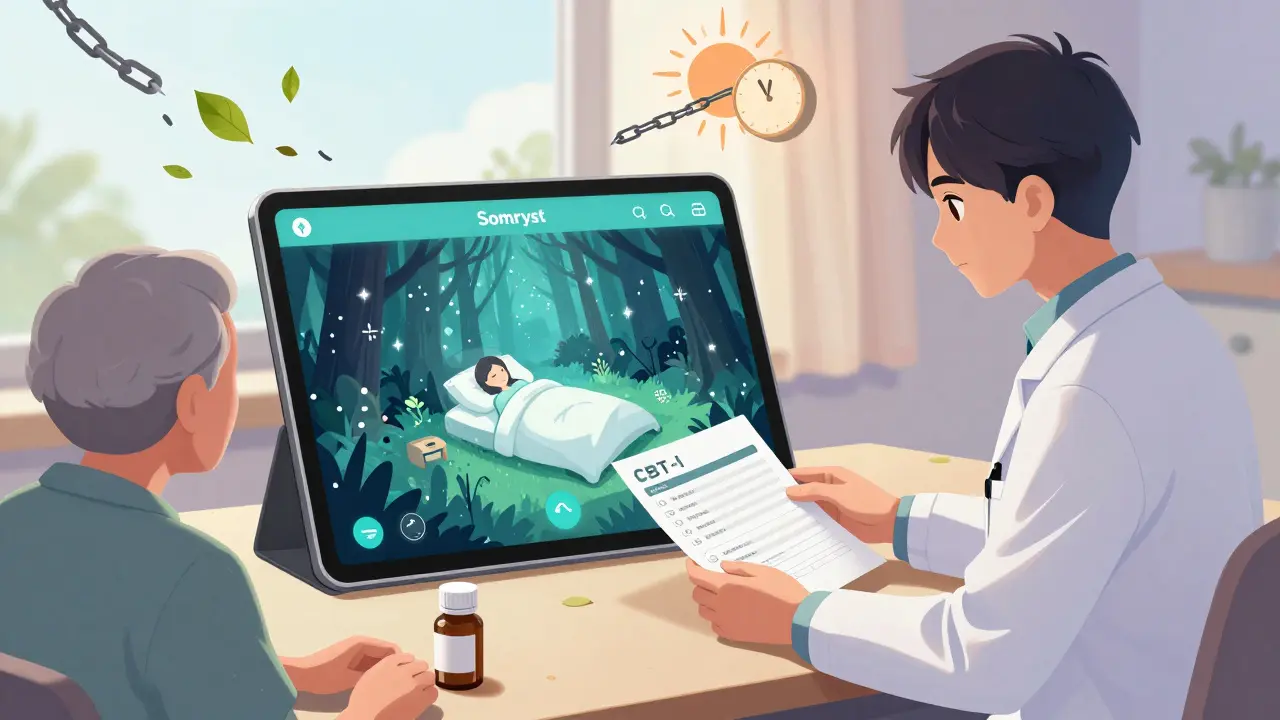
In 2020, the FDA approved the first digital therapeutic for insomnia: Somryst. It’s a prescription app that delivers CBT-I through your phone. Clinical trials showed 60% of users went into remission-meaning they slept normally without drugs. And it’s growing fast. Market analysts predict CBT-I digital tools will grow at 17.2% per year-five times faster than prescription sleep meds.
Then there’s Quviviq (daridorexant), a new orexin receptor antagonist approved in January 2022. It blocks the brain’s wake signal instead of pushing a sleep signal. Early trials show less next-day drowsiness than zolpidem. It’s not a cure, but it’s a step toward safer pharmacology.
Even melatonin-a popular OTC supplement-has its place. It doesn’t make you sleep. It tells your body it’s time to wind down. Amazon reviews show 4.2 out of 5 stars from over 50,000 users. No grogginess. No dependency. But it’s not magic. It works best for circadian rhythm issues-like jet lag or shift work-not chronic insomnia.
What to Do If You’re on Sleep Medication
If you’ve been taking a sleep pill for more than a few weeks, here’s what to do:
- Don’t quit cold turkey. Stopping suddenly can cause rebound insomnia or seizures. Talk to your doctor.
- Start a sleep diary. Write down when you go to bed, when you wake up, how you feel, and what you did before bed. This reveals patterns you didn’t notice.
- Ask about CBT-I. Request a referral. Many clinics now offer it. Some insurance plans cover it. Some apps are covered too.
- Reduce alcohol. Alcohol increases overdose risk by 300%. It also ruins sleep quality. Even one drink at night makes sleep meds more dangerous.
- Check your dose. Are you still taking the same dose you started with? If so, you might be due for a reduction. Older adults should be on the lowest possible dose.
The goal isn’t to never use sleep meds. It’s to use them wisely. For a few nights during a crisis. Not for months. Not for years.
When to Seek Help
Call your doctor if:
- You need more than the prescribed dose to fall asleep
- You wake up confused or don’t remember doing things at night
- You feel anxious about running out of pills
- You’ve been on them longer than 4 weeks
- You’re over 65
These aren’t signs of weakness. They’re signs your body is telling you something’s off. And there’s a better way.
Are sleep medications safe for long-term use?
No. Sleep medications are not designed for long-term use. Clinical guidelines from the American Academy of Sleep Medicine recommend them only for 2-5 weeks. Long-term use increases the risk of dependence, cognitive decline, falls (especially in older adults), and dangerous behaviors like sleep-driving. CBT-I is the recommended first-line treatment because it provides lasting results without these risks.
Can you become addicted to Ambien or Lunesta?
Yes. While Z-drugs like Ambien and Lunesta are less addictive than older benzodiazepines, they still carry a 5-10% risk of dependence after regular use for more than a few weeks. The body adapts, requiring higher doses for the same effect. Stopping suddenly can cause rebound insomnia, anxiety, and physical withdrawal symptoms. The FDA has issued boxed warnings for these drugs due to risks like sleep-driving and next-day impairment.
Is CBT-I really better than sleeping pills?
Yes, and the evidence is strong. CBT-I has a 70-80% success rate for improving sleep, compared to 50-60% for medications. More importantly, the benefits of CBT-I last for years after treatment ends, while sleep medication effects fade once you stop. Studies show people who use CBT-I don’t relapse into poor sleep the way they do after stopping pills. The American Academy of Sleep Medicine recommends CBT-I as the first treatment for chronic insomnia.
Why are sleep meds riskier for older adults?
Older adults metabolize these drugs slower, so the effects last longer. This increases next-day drowsiness, which raises the risk of falls and fractures by 50-60%. The Beers Criteria (2023) lists benzodiazepines and Z-drugs as potentially inappropriate for seniors due to these dangers. Even small doses can cause confusion, dizziness, and loss of balance. Many healthcare systems now require prior authorization for these drugs in patients over 65.
What are the safest OTC sleep aids?
There’s no truly safe OTC sleep aid for regular use. Diphenhydramine (Benadryl) and doxylamine (Unisom) are anticholinergics, linked to a 54% higher dementia risk with long-term use. Melatonin is the least risky option-it helps regulate your sleep-wake cycle but doesn’t force sleep. It’s best for jet lag or shift work, not chronic insomnia. Still, even melatonin should be used sparingly and not as a daily crutch.
Can digital apps replace sleep meds?
Yes, for many people. The FDA-approved app Somryst delivers CBT-I digitally and has been shown to help 60% of users achieve remission from insomnia without medication. Other apps and online programs are now covered by some insurers. They’re not a magic solution, but they’re safer, more sustainable, and more effective long-term than pills. They’re especially helpful for people who can’t access in-person therapy.
There’s a quiet revolution happening in sleep medicine. It’s not about new pills. It’s about returning to what works: understanding your body, changing habits, and treating the mind-not just the symptoms. You don’t need to live with sleepless nights. But you might need to stop reaching for the pill bottle and start building a better sleep routine instead.
Mike Dubes
March 1, 2026 AT 01:54John Cyrus
March 1, 2026 AT 06:24John Smith
March 1, 2026 AT 09:32Matt Alexander
March 1, 2026 AT 22:52Gretchen Rivas
March 3, 2026 AT 09:51Siri Elena
March 4, 2026 AT 13:30Divya Mallick
March 4, 2026 AT 19:38Pankaj Gupta
March 5, 2026 AT 03:07Alex Brad
March 6, 2026 AT 00:04Renee Jackson
March 6, 2026 AT 18:53RacRac Rachel
March 6, 2026 AT 20:37Stephen Vassilev
March 8, 2026 AT 12:21