
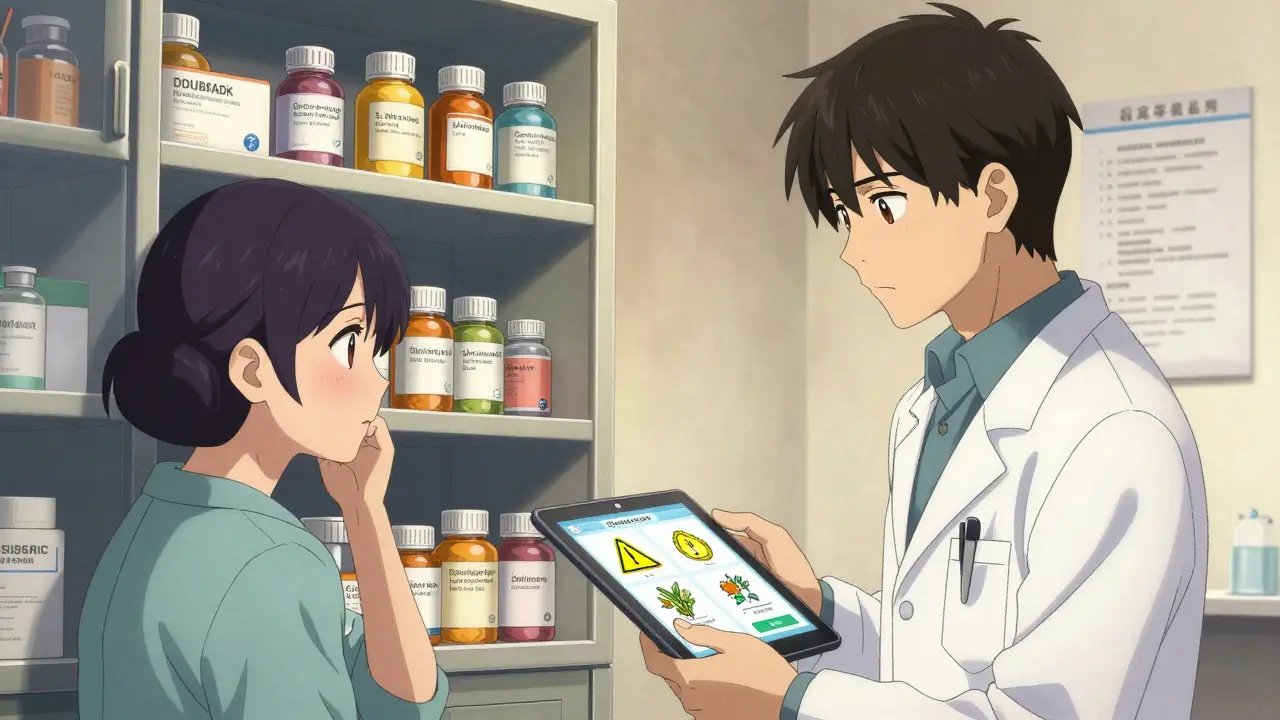
Most people think if it’s natural, it’s safe. That’s why so many take turmeric for joint pain, St. John’s wort for low mood, or garlic pills for heart health - and never mention it to their doctor. But here’s the truth: supplements aren’t harmless snacks. They’re powerful substances that can interfere with your medications, worsen conditions, or even cause hospitalization - and your doctor won’t know unless you tell them.
Why Doctors Don’t Always Ask
You might assume your doctor should know what you’re taking. But in reality, most don’t ask. A 2021 survey found that only 27% of physicians feel properly trained to talk about supplements. Many assume patients will bring it up. Others think, ‘It’s just a vitamin,’ and don’t see it as part of the medical picture. In a 15-minute appointment, they’re focused on blood pressure, diabetes, or chest pain. Supplements? They’re an afterthought - unless you mention them first.And patients? They’re afraid. Some worry their doctor will judge them. Others believe supplements are ‘not real medicine’ and don’t count. One Reddit user shared how they took garlic pills for years - until they bled excessively during minor surgery. Their doctor had no idea. That’s not rare. Studies show only about 33% of people who use herbal remedies or supplements tell their conventional doctor.
What Happens When You Don’t Tell
Let’s say you’re on warfarin, a blood thinner. You start taking ginkgo biloba because you read it helps memory. Sounds harmless, right? Wrong. Ginkgo can thin your blood even more. The result? Internal bleeding, emergency visits, maybe even a stroke. This isn’t hypothetical. It’s documented in medical journals.St. John’s wort is another big one. It’s marketed as a natural antidepressant. But it can make birth control fail. It can stop your antidepressants from working. It can wreck the effectiveness of heart meds, cancer drugs, and even HIV treatments. And you won’t know until something goes wrong.
Even ‘safe’ things like vitamin E, fish oil, or green tea extract can interfere. High doses of vitamin E increase bleeding risk. Fish oil can lower blood pressure too much if you’re already on meds for it. Green tea extract can stress your liver if you’re taking acetaminophen regularly.
The FDA doesn’t test supplements before they hit shelves. Labels say ‘Not evaluated by the FDA’ for a reason. That means what’s on the bottle? Might not be what’s inside. One 2023 study found 20% of herbal products didn’t contain the herb listed - or had hidden ingredients like steroids or prescription drugs. Your doctor can’t protect you if they don’t know what you’re taking.
What You Should Tell Your Doctor
Don’t just say ‘I take vitamins.’ Be specific. List everything:- Herbs: turmeric, ginger, echinacea, milk thistle, ashwagandha
- Supplements: fish oil, magnesium, vitamin D, CoQ10, melatonin
- Protein powders, amino acids, energy boosters, detox teas
- Any product bought online, at a health store, or recommended by a friend
Bring the bottles. Seriously. Labels have the exact names and doses. Your doctor might not know what ‘Ashwagandha Root Extract 500mg’ means - but they can look up the active compounds if they see the label. Many patients don’t realize that even ‘natural’ products can have the same chemical pathways as prescription drugs. That’s how interactions happen.

How to Start the Conversation
If you’re nervous, here’s how to say it without sounding defensive:- ‘I’ve been taking [name] for [reason]. I wanted to make sure it’s okay with my other meds.’
- ‘I know you didn’t ask, but I’m taking [name] and I didn’t know if I should mention it.’
- ‘I read this might help with [symptom]. Can you tell me if it’s safe with my current treatment?’
Most doctors will appreciate you bringing it up. A 2022 survey found that 78% of patients who disclosed got helpful advice - and 63% said it made them trust their provider more. You’re not being annoying. You’re being smart.
What Your Doctor Should Do
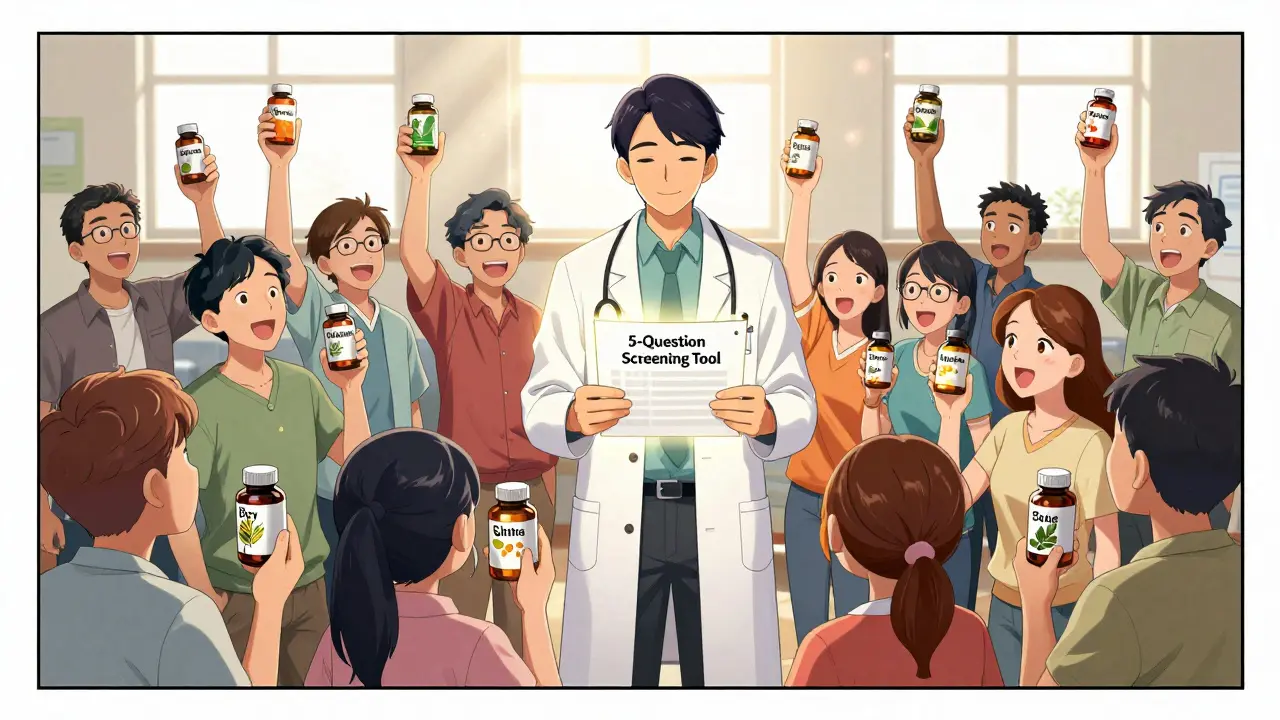
Your doctor isn’t expected to know every herb on the planet. But they should ask. The American Medical Association now recommends medical schools teach herb-drug interactions. Some clinics use a simple 5-question screening tool during intake:- Do you take any vitamins, minerals, or supplements?
- Do you use any herbal products or teas for health?
- Have you started or stopped any of these in the last 3 months?
- Have you had any side effects you think might be from them?
- Would you like me to check if any of these interact with your prescriptions?
When providers use this tool, disclosure rates jump from 33% to 78%. That’s not magic - it’s just asking. If your doctor never asks, bring it up yourself. You’re the only one who knows what’s in your medicine cabinet.
What’s Changing - and What’s Coming
The FDA is tightening up. Their 2023 list of unsafe supplement ingredients grew from 102 to 172. The industry is under more pressure. Digital tools like MyMedList - an app developed by the University of Arizona - help patients track everything they take and share it with providers. In a 2023 trial, users improved their disclosure accuracy by 44%.By 2026, federal guidelines expect all electronic health records to have a mandatory field for supplement use. That means your doctor’s system will prompt them to ask. But until then? You can’t wait for the system to fix itself.
Real Stories, Real Risks
One woman in Adelaide took turmeric daily for arthritis. She didn’t tell her cardiologist. When her blood pressure spiked, they thought it was her meds. Turns out, turmeric can interfere with blood pressure drugs - and she was taking three of them. Her doctor adjusted her treatment only after she mentioned the supplement.A man in Perth took melatonin for sleep. He was on an antidepressant. He felt worse, not better. His doctor finally asked about supplements - and discovered melatonin was worsening his serotonin levels. He switched to a different sleep aid, and his mood improved within weeks.
These aren’t outliers. They’re common. And they’re preventable.
Your Next Steps
1. Check your cabinet. Write down every supplement, herb, and potion you take - even if you think it’s ‘just a tea.’2. Bring the bottles. Don’t rely on memory. Labels have exact names and doses.
3. Ask the question. At your next appointment, say: ‘I want to make sure everything I’m taking is safe with my prescriptions.’
4. Follow up. If your doctor says ‘it’s fine,’ ask: ‘Is there any risk I should watch for?’
5. Update regularly. If you start or stop something, tell your doctor. Don’t wait for your annual checkup.
This isn’t about being perfect. It’s about being safe. Your body is a complex system. Supplements aren’t harmless. And your doctor can’t help you if they’re working in the dark.
CHETAN MANDLECHA
December 24, 2025 AT 10:39Been taking turmeric for my knees since 2020. Never told my doc. Thought it was just ‘natural spice.’ Then I got dizzy during a routine blood draw. Turned out my INR was sky-high. Turns out turmeric’s a blood thinner. Doc didn’t even blink when I said I’d been taking it daily. Just said, ‘Next time, bring the bottle.’
Ajay Sangani
December 24, 2025 AT 14:55so... if its natural why is it so dang dangerous? like... if the plant has been used for 5000 years in ayurveda why does the modern medical system treat it like a poison? is it because they cant patent it? or because they dont understand the whole system? i mean... we dont question antibiotics being synthetic... but we freak out when someone takes ashwagandha? something feels off here.
Gray Dedoiko
December 26, 2025 AT 00:06My grandma took fish oil and warfarin for years. Never said a word. One day she came in with a massive bruise on her thigh from just sitting wrong. ER doc asked if she took anything weird. She said ‘just vitamins.’ He pulled up her chart and saw the fish oil. Said it was a miracle she didn’t bleed out. Now she brings every bottle to every appointment. Even the gummy vitamins. Honestly? It’s saved her life.
Aurora Daisy
December 26, 2025 AT 20:22Oh wow, so now we’re supposed to treat every herbal remedy like a nuclear weapon? In Britain, we’ve been using elderberry for colds since Queen Victoria’s time. You think we’re all just idiots for not running to our GPs every time we brew a cup of chamomile? This is medical arrogance dressed up as ‘safety.’
Paula Villete
December 27, 2025 AT 20:59Just wanted to say… I took St. John’s wort for mild anxiety for 8 months. Didn’t think it mattered. Then I started having weird heart palpitations. My psychiatrist asked me about supplements during a follow-up (thank god she did). Turns out it was canceling out my SSRI. I felt like an idiot. But now I keep a little notebook. Every pill, every tea, every ‘natural’ thing. I even wrote down the brand. My doctor said it’s the most thorough intake she’s seen in years. Don’t be like me. Just… tell them.
Georgia Brach
December 28, 2025 AT 06:15Let’s be clear: this article is fearmongering disguised as public health. The FDA doesn’t regulate supplements because they’re not drugs. That’s not a loophole-it’s a philosophical distinction. If you want to take garlic pills and die, that’s your right. Your doctor’s job isn’t to police your lifestyle choices. This is just another step toward medical paternalism. Next they’ll want you to report your yoga routine.
Katie Taylor
December 29, 2025 AT 14:42STOP WAITING. Just tell your doctor. Now. Today. I had a friend who took melatonin and fluoxetine together for months. She went from anxious to suicidal in 3 weeks. No one asked. No one knew. She almost didn’t make it. You think your doc is gonna guess? They’re not mind readers. You are the only one who knows what’s in your body. Speak up. It’s not embarrassing. It’s survival.
Payson Mattes
December 30, 2025 AT 00:43Did you know the FDA is in bed with Big Pharma? They don’t test supplements because they’re paid to keep them off the market. The real danger? Prescription drugs kill 250,000 people a year. But you’ll never hear that. Meanwhile, turmeric? ‘Dangerous.’ I’ve got a cousin who’s a pharmacist at CVS-she says 80% of ‘herbal’ products have hidden synthetic drugs in them. That’s not natural. That’s corporate fraud. But your doc won’t tell you that. They’re trained to trust the label. And the label is a lie.
Isaac Bonillo Alcaina
December 30, 2025 AT 23:53Let’s address the elephant in the room: 92% of people who take supplements are either delusional, gullible, or both. You think a $12 bottle from GNC has the same potency as a clinical-grade extract? No. You’re wasting money. And worse-you’re risking your health by assuming ‘natural’ means ‘safe.’ If you’re taking supplements, you’re not being proactive-you’re being reckless. And now you want your doctor to clean up your mess? Don’t be surprised when they roll their eyes.
Bhargav Patel
January 1, 2026 AT 03:18It is not merely a matter of pharmacological interaction; it is a matter of epistemological dissonance. The Western biomedical paradigm operates within a reductionist framework, wherein substances are isolated, quantified, and pathologized. Traditional systems, such as Ayurveda or Traditional Chinese Medicine, operate holistically-considering the individual’s constitution, season, and energetic balance. To reduce turmeric to ‘anti-coagulant’ is to miss its purpose entirely. Yet, in the absence of dialogue, the practitioner defaults to the only language they know: pharmacology. Thus, the patient is caught between two epistemic worlds. The solution? Not silence. Not fear. But translation. Bring the bottle. Speak the name. Let the doctor translate. Let the patient explain. Only then does healing become mutual.
Steven Mayer
January 1, 2026 AT 05:13The pharmacokinetic implications of polypharmacy with phytochemicals are grossly underdocumented in clinical trials. The CYP450 enzyme system is particularly vulnerable to inhibition by flavonoids, alkaloids, and terpenoids present in botanicals. For instance, ginkgo biloba’s flavonoid glycosides induce CYP2C9 and CYP3A4 modulation, which can significantly alter the AUC and Cmax of warfarin and statins. Without metabolomic profiling, clinicians are operating under incomplete pharmacodynamic models. This is not anecdotal-it’s systems biology.
Usha Sundar
January 2, 2026 AT 10:28I took ashwagandha for stress. My period stopped. Didn’t tell anyone. Then I panicked. Turned out it was the supplement. Now I tell my doctor everything. Even the ‘just tea’ stuff. No drama. Just facts. Save yourself the meltdown.
claire davies
January 3, 2026 AT 07:35My mum’s from Kerala, and she’s been drinking turmeric milk since she was five. She’s 82, walks 5k steps a day, and still makes her own curry paste. She never told her GP about it. But she also doesn’t take blood pressure meds or statins. The real issue isn’t the herb-it’s the fact that we’ve outsourced our health to pills and appointments. Maybe the problem isn’t that people don’t tell their doctors… maybe it’s that doctors don’t ask about how people actually live. My mum’s ‘supplement’ is community, sunlight, and no processed sugar. Should we report that too?
Blow Job
January 4, 2026 AT 22:46Bro, I was skeptical too. Then I started taking CoQ10 for my heart and forgot to tell my doc. He adjusted my beta-blocker dose and I almost passed out. Now I have a sticky note on my fridge: ‘Tell the doc about EVERYTHING.’ Even the protein powder. Even the sleep gummies. Seriously. Just say it. They won’t judge. They’ll thank you.
Christine Détraz
January 5, 2026 AT 14:38I used to think supplements were just ‘bonus health.’ Then I got hospitalized for liver inflammation after taking green tea extract with Tylenol. Turns out, I wasn’t the first. My doctor said, ‘You’re lucky you came in when you did.’ I didn’t feel lucky. I felt stupid. But now I keep a list. I even screenshot the labels. And I say, ‘Hey, I’m taking this-what do you think?’ Turns out, most docs are relieved someone finally asked. It’s not weird. It’s wise.