
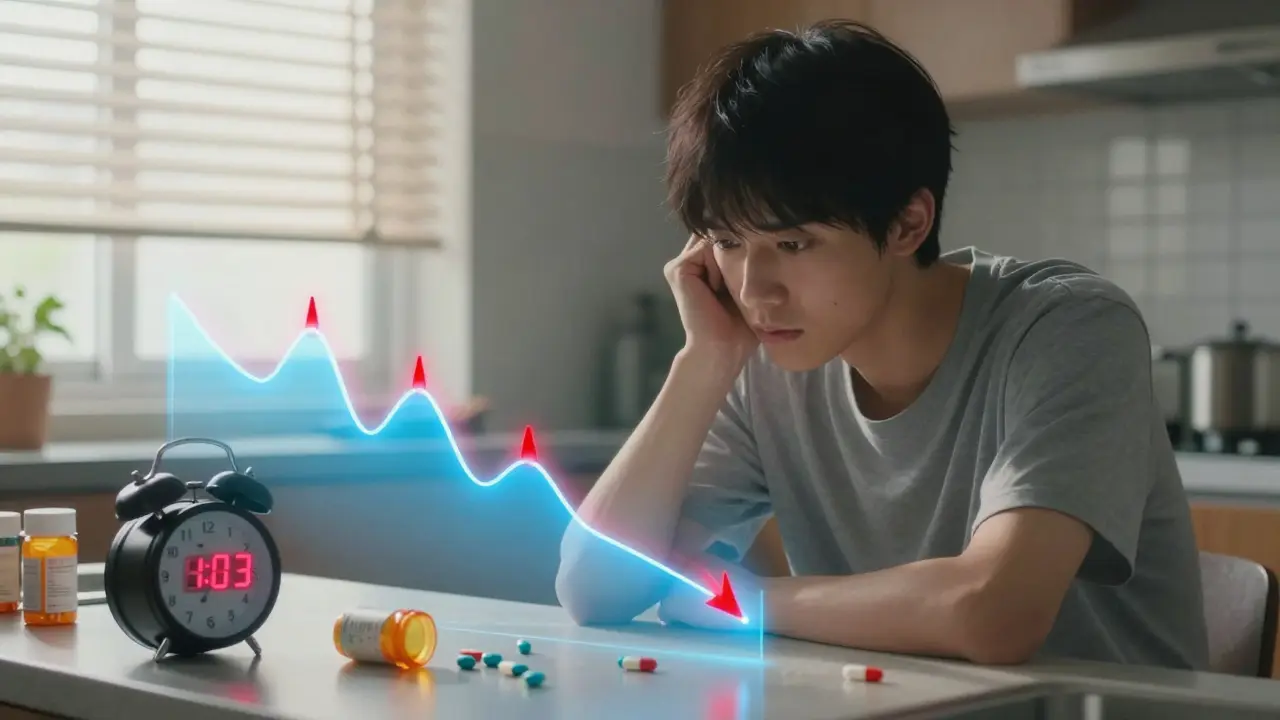
Missing a dose of your prescription medication might seem harmless-especially if you’re feeling fine. But skipping even one pill can set off a chain reaction that puts your health at risk. It’s not about being perfect. It’s about keeping the drug levels in your body steady so your treatment actually works. When you take your medicine at the wrong time, or skip it entirely, you’re not just breaking a rule. You’re messing with your body’s chemistry in ways you can’t always see.
Why Timing Matters More Than You Think
Your body doesn’t work on a schedule that matches your morning coffee or your evening TV show. It works on chemistry. Every prescription drug has a specific window where it needs to be in your bloodstream to do its job. Too little, and the treatment fails. Too much, and you risk side effects or toxicity. This is especially true for medications that need to stay in your system around the clock.
Take antibiotics, for example. If you stop taking them after three days because your sore throat feels better, you’re not cured-you’re just weakening the bacteria. The strongest ones survive, multiply, and come back stronger. That’s how antibiotic resistance starts. The CDC Centers for Disease Control and Prevention says you must finish every antibiotic course, no matter how you feel. Same goes for blood pressure pills. High blood pressure doesn’t give you symptoms, but it’s still silently damaging your arteries and heart. Skipping doses causes dangerous spikes and drops in pressure, increasing your risk of stroke or heart attack.
Medicines That Can’t Wait
Not all meds are created equal. Some have zero room for error. Here are a few where timing isn’t optional:
- Anticoagulants (like warfarin): These thin your blood to prevent clots. If you take them inconsistently, your INR (a blood test that measures clotting time) swings wildly. Too low? You could get a clot. Too high? You could bleed internally. Dosing must be exact, and INR checks every 2-4 weeks are standard.
- Immunosuppressants (after organ transplant): Your body sees a new organ as an invader. These drugs suppress that response. Miss a dose, and your immune system might start attacking the transplant. Rejection can happen fast-and it’s often irreversible.
- Diabetes meds (especially insulin or sulfonylureas): These regulate blood sugar. Take them without eating? You risk hypoglycemia-low blood sugar-that can lead to confusion, seizures, or even coma. Take them after eating? Your sugar spikes dangerously high.
- Seizure medications: Even a single missed dose can trigger a seizure in someone with epilepsy. The brain’s electrical activity depends on stable drug levels.
These aren’t "take when you remember" meds. They’re "take at this exact time, every time" meds. The Food and Drug Administration FDA requires clear labeling for these: "Take on empty stomach," "With food," "At bedtime." Ignore those instructions, and you’re guessing with your health.
Why People Skip Doses (And Why It’s Dangerous)
People don’t skip doses because they’re careless. They do it because it’s hard.
- Forgetfulness: Especially for older adults managing five or more medications. One study found that each additional daily pill reduces adherence by 16%. That’s not a small drop-it’s a cliff.
- Feeling fine: If you’re not sick, why take a pill? That’s the logic behind stopping blood pressure or cholesterol meds. But those conditions don’t scream-they whisper. And by the time you feel it, it’s too late.
- Side effects: Nausea, dizziness, fatigue-these are scary. Instead of talking to your doctor, many people just quit. That’s risky. Often, side effects fade after a few weeks. Or there’s a different pill that won’t cause them.
- Cost: A $500 monthly co-pay for a life-saving drug? Many choose to skip doses or split pills. But that’s not safer-it’s more dangerous. Talk to your pharmacist about patient assistance programs. They exist.
- Confusion: "Take one blue pill in the morning and one white pill at night." What if they look alike? What if the bottle says "daily" but the label says "twice daily"? That’s not your fault. It’s a system failure.
The American Heart Association American Heart Association reports that nearly half of U.S. adults have high blood pressure, and about 50% aren’t taking their meds as prescribed. That’s 54 million people at risk of preventable strokes and heart attacks. This isn’t about discipline. It’s about design.
How to Get It Right-Without Stress
You don’t need to be a robot. You just need a system.
- Use a pill organizer: A simple weekly box with morning, afternoon, evening, and night slots cuts confusion. Many pharmacies give them out free.
- Set phone alarms: Label them: "Morning BP Pill," "Evening Insulin." Don’t just say "Take meds." Be specific.
- Pair meds with habits: Brush your teeth? Take your pill right after. Have coffee? Take your pill with it. Your brain links routines.
- Ask for a medication review: Every six months, ask your pharmacist to look at all your pills. Are there duplicates? Interactions? Can some be combined? Simplifying reduces errors.
- Use the teach-back method: When your doctor prescribes something, say: "Just to make sure I got it-can you have me repeat it?" Then say it out loud. If you can’t explain it, you won’t take it right.
One patient in Adelaide told me she used to miss her diabetes meds because her work schedule changed. She started keeping her insulin pen in her purse, next to her coffee cup. Now she takes it every morning before her commute. No alarms. No lists. Just habit.
What Happens When You Skip
It’s not abstract. It’s real.
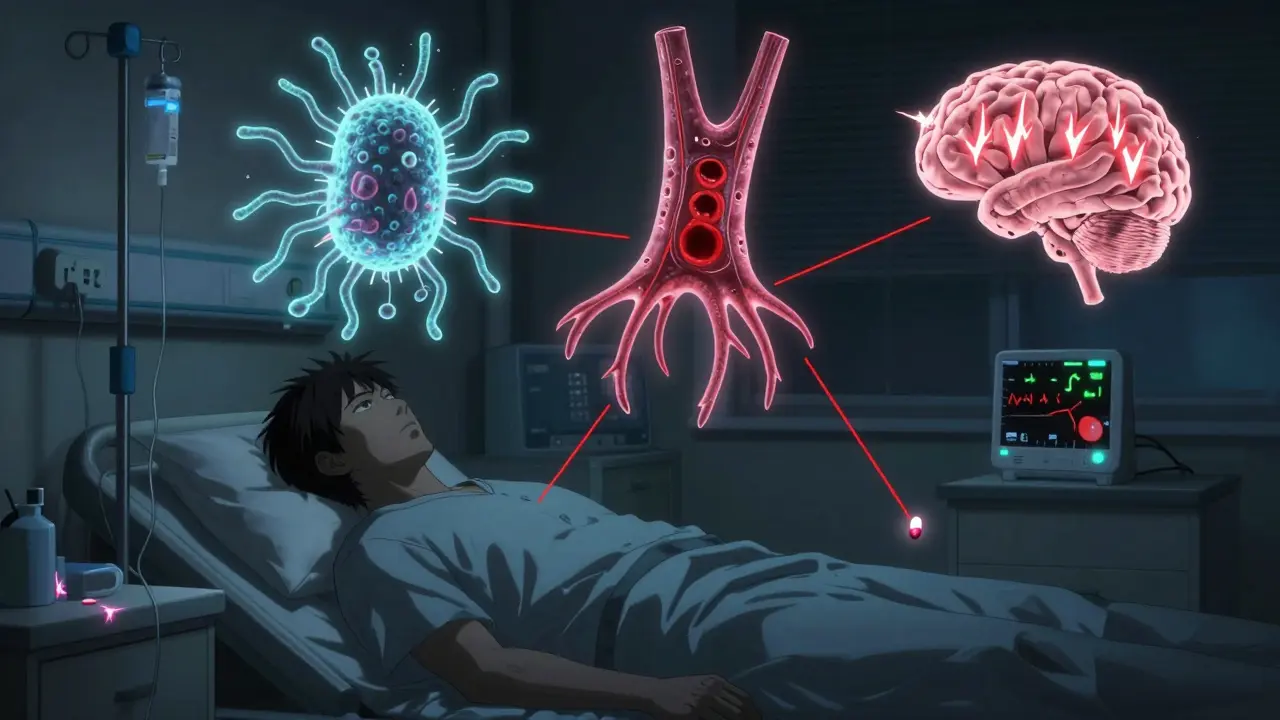
One man skipped his warfarin for three days because he thought he was "fine." He woke up with a swollen leg and a blood clot. He spent two weeks in the hospital. His wife said: "He didn’t think one missed pill mattered. He was wrong." Another woman stopped her antibiotics after five days because her cough was gone. Two weeks later, she had pneumonia. She needed IV antibiotics. Her doctor said: "You didn’t just get sick. You made the infection harder to treat." These aren’t rare cases. They’re common. The Annals of Pharmacotherapy Annals of Pharmacotherapy estimated that in the U.S., non-adherence causes over 125,000 deaths each year. That’s more than car accidents. More than breast cancer. It’s a silent epidemic.

When to Call for Help
If you’re struggling, you’re not alone. And you don’t have to figure it out yourself.
- Call your pharmacist. They’re trained in medication timing. They can spot conflicts, simplify regimens, and even set up automatic refill reminders.
- Ask for a medication therapy management (MTM) session. Medicare Part D and many private insurers offer this free service. A pharmacist sits down with you, reviews every pill, and builds a plan.
- Use digital tools. Apps like Medisafe, MyTherapy, or even your phone’s health app can track doses and send alerts. Some smart pill bottles even beep when opened.
- Talk to your doctor about cost. There are generic versions, patient assistance programs, and mail-order options. Don’t let price decide your health.
Medication timing isn’t about punishment. It’s about protection. You’re not just taking a pill. You’re preventing a stroke, a hospital stay, or worse. Every dose matters-not because your doctor said so, but because your body needs it.
What happens if I miss a dose of my blood pressure medicine?
If you miss a single dose, take it as soon as you remember-if it’s within a few hours of your usual time. If it’s close to your next dose, skip the missed one. Don’t double up. But missing doses regularly causes dangerous spikes in blood pressure, increasing your risk of stroke, heart attack, or kidney damage. Consistency matters more than perfection.
Can I skip my antibiotic if I feel better?
No. Stopping antibiotics early-even if you feel fine-allows the toughest bacteria to survive. These survivors multiply and can cause a worse infection later. They may also become resistant to future treatments. Always finish the full course unless your doctor tells you otherwise.
Why do some pills need to be taken with food and others on an empty stomach?
Food can change how your body absorbs the drug. Some pills work better with food because it slows digestion, letting the medicine absorb slowly. Others can irritate your stomach if taken on an empty stomach. Some, like certain antibiotics or thyroid meds, are blocked by food entirely. Always follow the label. If it says "take on empty stomach," wait at least one hour before or two hours after eating.
I’m on five different pills. How do I keep track?
Use a weekly pill organizer with morning, afternoon, evening, and night compartments. Set phone alarms for each dose. Ask your pharmacist to review your regimen-they might find duplicates or suggest combined pills. Many pharmacies offer pre-filled blister packs with your name and times clearly printed. You don’t have to remember everything. Tools exist to help.
Is it okay to split pills to save money?
Only if your doctor or pharmacist says it’s safe. Some pills are designed to release slowly, and splitting them can change how they work. Others have coatings that prevent stomach irritation-splitting ruins that. Ask before you cut. There are often cheaper generic versions or patient assistance programs that cost less than splitting pills.
Next Steps: Make It Stick
Start today. Grab your pill bottle. Read the label again. Do you know why you take it? When? With or without food? If you’re not sure, call your pharmacist. Don’t wait until you feel sick. Your health doesn’t wait.
Set one alarm. Buy one pillbox. Ask one question. Small steps build lasting habits. Because skipping doses isn’t a minor mistake. It’s a risk you can’t afford to take.
Sumit Mohan Saxena
February 28, 2026 AT 12:12Adherence to prescribed medication regimens is not merely a matter of personal discipline; it is a critical component of clinical efficacy and public health infrastructure. The pharmacokinetic parameters of most therapeutics are engineered with precise half-lives and therapeutic windows in mind. Deviations from scheduled dosing introduce nonlinear fluctuations in plasma concentrations, which may precipitate subtherapeutic exposure or toxic accumulation. This is particularly salient for drugs with narrow therapeutic indices such as warfarin, digoxin, and cyclosporine. Empirical evidence from longitudinal cohort studies consistently demonstrates that non-adherence correlates strongly with increased hospitalization rates and mortality, irrespective of disease state. Systemic interventions-including pill organizers, automated dispensers, and pharmacist-led medication therapy management-are not luxuries but necessary components of modern chronic disease care.
Sophia Rafiq
March 1, 2026 AT 08:51Martin Halpin
March 2, 2026 AT 05:06You know what’s really interesting about this whole narrative? It’s built on the assumption that pharmaceutical companies and regulatory bodies are acting in good faith. But let’s look at the data: the FDA approves drugs based on clinical trials that often exclude elderly patients, those with comorbidities, or people who can’t afford the meds they’re prescribing. Meanwhile, the cost of a single insulin vial in the U.S. is over $250 while it costs $3 in Canada. And yet we’re lecturing people for skipping doses? This isn’t about responsibility-it’s about systemic failure. The real issue isn’t that people are lazy, it’s that the system is designed to punish the poor, the elderly, and the chronically ill for not being able to afford the very tools meant to keep them alive. I’ve seen people split pills because they’re choosing between insulin and rent. And now you want to blame them? That’s not a medical problem-that’s a moral collapse.
Eimear Gilroy
March 2, 2026 AT 21:29Charity Hanson
March 4, 2026 AT 20:42Y’ALL. I was one of those people who skipped meds because I felt fine. Then I had a mini-stroke at 42. Not dramatic. No sirens. Just numbness in my hand. Turns out my BP had been spiking for months. I didn’t feel it. That’s the silent killer. I got a pill box. I set alarms. I started writing sticky notes: ‘This isn’t optional. This is survival.’ And now? I’m still here. You think you’re just skipping a pill? You’re skipping your future. Don’t wait for the hospital to wake you up. Start today. One pill. One alarm. One choice. You got this.
Byron Duvall
March 6, 2026 AT 09:10Full Scale Webmaster
March 7, 2026 AT 15:52Let’s be real. This post is a corporate propaganda piece disguised as public health advice. Who benefits from you taking five pills a day? The pharmaceutical industry. Who profits when you get hospitalized for a missed dose? The hospital system. Who gets paid to write these articles? The same people who get funding from drug manufacturers. The CDC? The FDA? The AHA? All of them have ties to pharmaceutical lobbyists. You think they care about your life? They care about your co-pay. I’ve seen patients on insulin forced to ration because their insurance won’t cover the full dose. And now you want to shame them for skipping? This isn’t about health. It’s about control. It’s about profit. It’s about making people feel guilty so they keep buying pills they can’t afford. Wake up. The real epidemic isn’t non-adherence-it’s greed.
Angel Wolfe
March 9, 2026 AT 02:42Lisa Fremder
March 9, 2026 AT 02:42Justin Ransburg
March 10, 2026 AT 17:17Thank you for this thoughtful and evidence-based piece. Medication adherence remains one of the most under-addressed challenges in preventive medicine. The psychological, economic, and systemic barriers are real-but they are not insurmountable. Community health workers, pharmacist-led interventions, and telehealth follow-ups have shown remarkable success in improving adherence rates across diverse populations. The key is not moralizing, but mobilizing. We must treat medication management as a public health priority, not an individual failing. Every patient deserves access to clear, simple, and supported care. Let’s build systems that work for humans-not just for algorithms.
Vikas Meshram
March 11, 2026 AT 12:31